In an age where nearly every device we own emits or receives wireless signals, protecting our digital privacy has become a growing priority, and some people also want to limit their RF exposure [3][4].
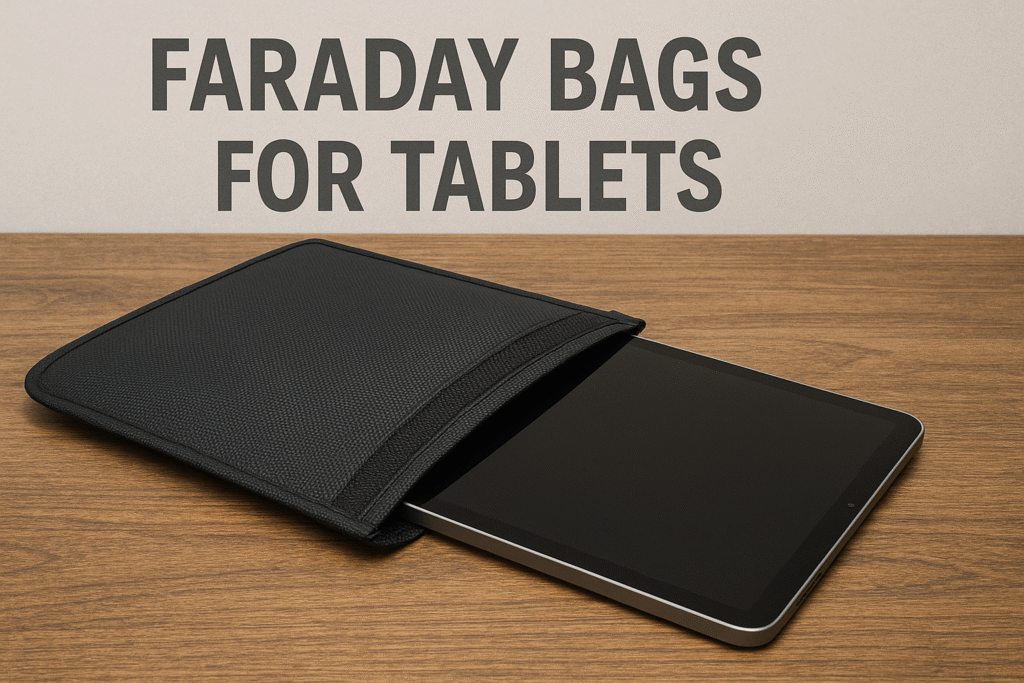
Enter the Faraday pouch, a compact, portable enclosure that can block signals such as Wi-Fi, Bluetooth, GPS, RFID, and even 5G.
This guide explores how Faraday pouches work, how signal blocking works, how to choose and test one, and real-world uses from privacy to protection.
What Is a Faraday Pouch?
A Faraday pouch is a small, portable version of a Faraday cage, an enclosure made from conductive material that blocks electromagnetic fields (EMF) and radiofrequency (RF) signals.
When you place your phone, key fob, or other wireless device inside the pouch, the conductive layers reflect and absorb incoming and outgoing electromagnetic waves, effectively isolating the device from external communication.
In other words: no calls, no texts, no GPS tracking, and no data transmission.
Common aliases:
- Signal-blocking bag
- EMF protection pouch
- Privacy or security pouch
- RFID-blocking wallet
How Does a Faraday Pouch Work?
The technology is based on the Faraday cage, which Michael Faraday demonstrated in 1836.
He showed that a conductive enclosure redistributes electrical charge around its exterior, preventing electromagnetic fields from penetrating inside.
Research note: UK police published video of thieves using two relay devices to steal a keyless car in 1 minute [7].
1. Conductive Shielding Layers
Faraday pouches typically use metallic fibers or mesh (e.g., copper, nickel, or silver) sewn or laminated into fabric. These create a continuous conductive barrier that reflects RF waves.
2. Reflection & Absorption
When radio waves hit the surface, most energy is reflected; some is absorbed and dissipated as heat. The level of protection depends on:
- Conductivity of materials
- Density of the weave
- Layering and closure quality
3. Complete Enclosure
For a Faraday pouch to work, the device must be fully enclosed, meaning no gaps where signals can leak in or out. Even a small opening near the zipper or flap can compromise effectiveness.
What Types of Signals Can a Faraday Pouch Block?
Most modern Faraday pouches are designed to block a wide spectrum of signals, including:
| Signal Type | Approx. Frequency Range | Examples |
|---|---|---|
| Cellular (2G-5G) | 700 MHz: 6 GHz | Phones, tablets |
| Wi-Fi | 2.4 GHz / 5 GHz / 6 GHz | Routers, hotspots |
| Bluetooth | 2.4 GHz | Wearables, headsets |
| GPS | 1.5 GHz | Navigation, tracking |
| RFID/NFC | 13.56 MHz | Credit cards, passports |
| Key fob signals | 300 to 400 MHz | Car remotes |
| Satellite & high-band 5G | 24 to 40 GHz + | Emerging networks |
High-quality pouches can provide attenuation up to 60 dB: 100 dB, meaning the signal power that gets through is cut to one millionth (60 dB) or less, down to one ten-billionth (100 dB).
(ASTM D4935-18 Standard Test Method)
Common Uses for Faraday Pouches
1. Privacy & Anti-Tracking
Journalists, travelers, and security-conscious users rely on Faraday pouches to block GPS and data tracking when carrying their phones.
When your device is inside a properly sealed pouch, it cannot send or receive data: effectively making it invisible to networks.
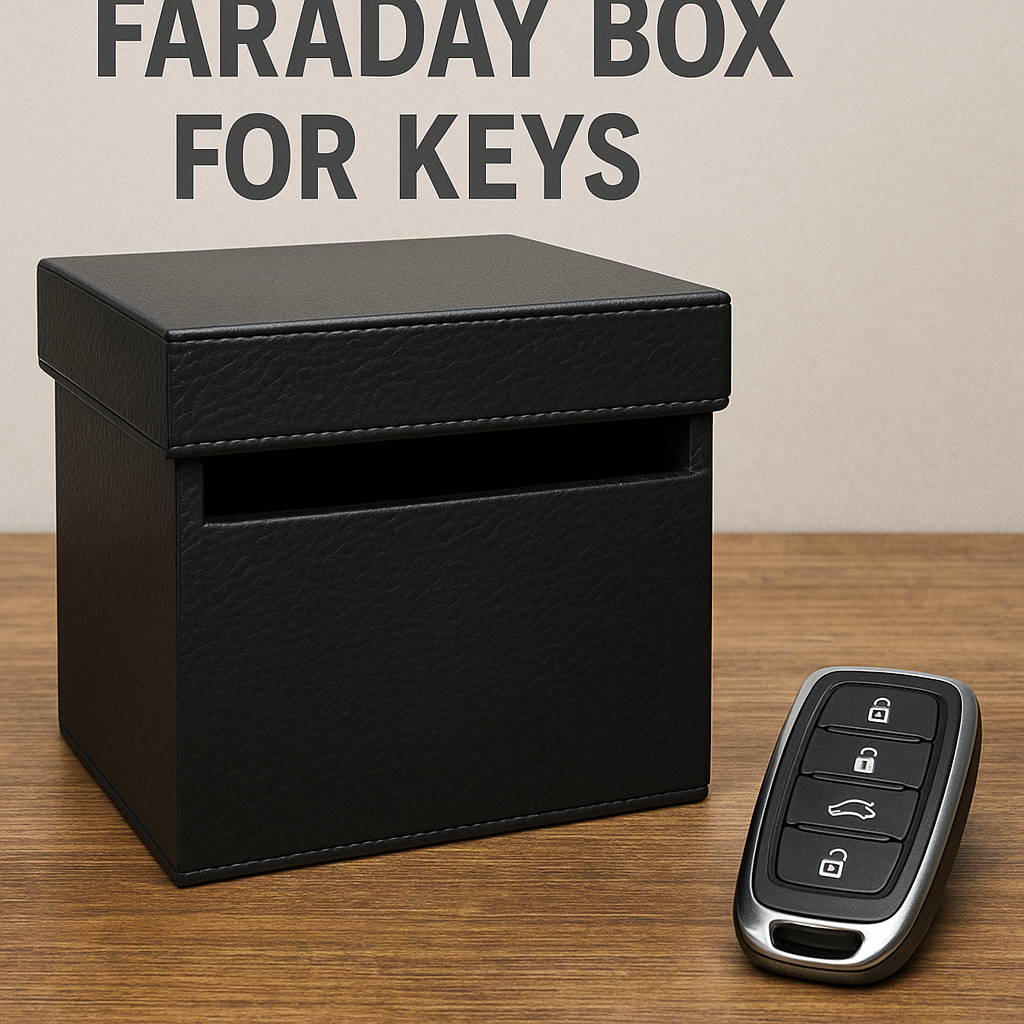
2. Car Key Protection (Relay Attack Prevention)
Thieves can clone signals from wireless car key fobs using relay amplifiers.
A Faraday pouch for key fobs prevents this by blocking the fob’s RF output while stored.
3. Digital Security & Cyber Forensics
Law enforcement and cybersecurity experts use Faraday bags to prevent evidence tampering: blocking remote access to confiscated devices.
4. EMF Exposure Reduction
Some consumers use Faraday pouches to reduce direct exposure from phones when carrying them in pockets or purses.
Note: This is effective only when the phone is not actively searching for a signal, otherwise, it increases power output and battery drain.
Whether that lowers any health risk is unproven. A WHO-commissioned review graded the evidence as moderate certainty that head-held phone use likely does not increase the risk of glioma, meningioma, acoustic neuroma, pituitary or salivary gland tumours in adults [3].
5. Travel Security
RFID-blocking pockets protect passports and cards from skimming at airports and hotels.
Materials Used in Faraday Pouches
| Material Type | Properties | Typical Use |
|---|---|---|
| Silver-thread fabric | Excellent conductivity, soft, flexible | Premium privacy pouches |
| Copper-nickel mesh | Durable, high attenuation | Professional or military-grade bags |
| Carbon-fiber lining | Lightweight, moderate attenuation | Consumer phone pouches |
| Aluminum film layer | Cost-effective but less durable | Wallets or one-use envelopes |
Multiple layers are often used: an outer nylon or canvas shell for durability, with internal conductive layers for shielding.
Choosing the Right Faraday Pouch
Before buying, look for verified performance data and consider your intended use.
| Feature | What to Look For |
|---|---|
| Tested frequency range | Look for lab results (ASTM D4935 / IEEE 299) showing coverage up to 40 GHz or higher. |
| Attenuation rating | Ask which frequencies the figure covers; ratings vary by frequency and test setup. One study cited more than 20 dB as acceptable for industrial textile use. | [5][6]
| Closure | Velcro or magnetic seal that fully covers the opening. |
| Size | Enough room for your device: a tight fit ensures full shielding. |
| Durability | Reinforced seams, tear-resistant shell. |
| Grounding | Not necessary for portable pouches, but beneficial for static discharge. |
Examples of Popular Consumer Options
- Silent Pocket® Faraday Sleeves (privacy-focused, simple design)
- Mission Darkness™ TitanRF Pouches (military & forensic use)
- DefenderShield® ConcealShield (consumer travel & EMF market)
(Referenced only for illustration; always verify independent testing data.)


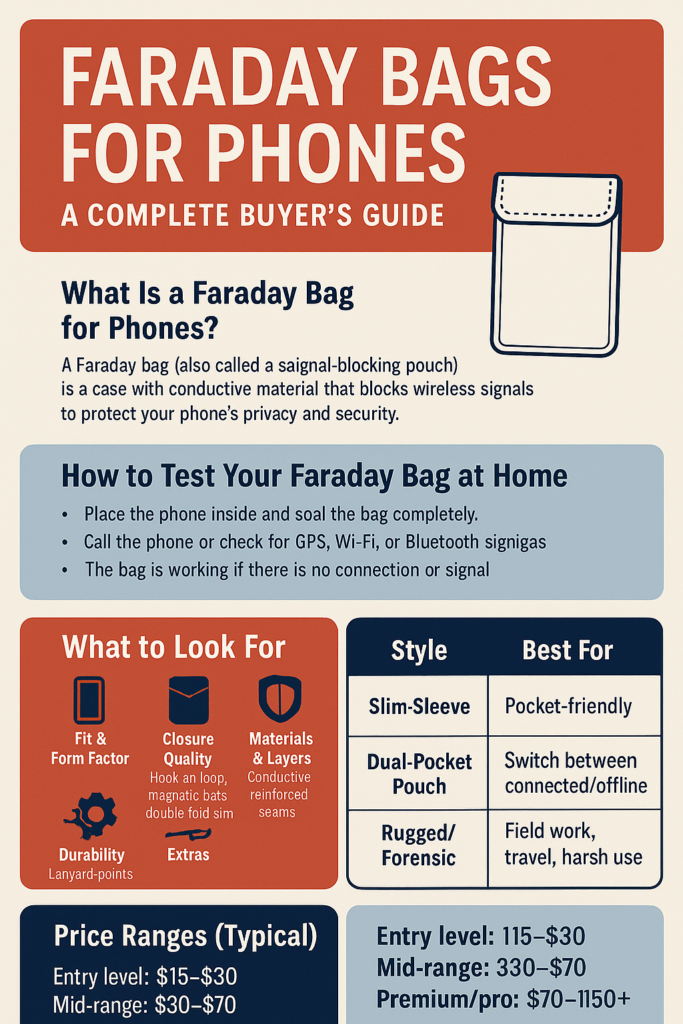
How to Test a Faraday Pouch at Home
Testing is straightforward and ensures your pouch is working as intended.
- Call Test:
- Place your phone inside and close the pouch completely.
- Attempt to call or text your number: it should fail.
- Wi-Fi / Bluetooth Test:
- Turn on Wi-Fi and place the phone near a router.
- If the pouch works, signal strength should drop to zero.
- Key Fob Test:
- Place the fob inside and try unlocking your car: it should not respond.
- RF Meter Test (Optional):
- Use a handheld RF meter near the pouch to measure attenuation in µW/m².
A Faraday pouch only works when sealed, so test it before you rely on it
Call the sealed phone and see whether it rings
A simple functional check, not a laboratory measurement of attenuation.
Data table
| Step | Stage | What happens |
|---|---|---|
| 1 | Baseline | Note signal bars, Wi-Fi and location with the phone outside the bag |
| 2 | Seal | Close the bag fully: roll-top folded, flap pressed flat |
| 3 | Call it | Call the sealed phone from another phone and wait |
| 4 | Read it | No ring: sealed. A ring, buzz or delayed text: a leak |
| 5 | Repeat | Test Wi-Fi and Bluetooth too, after any wear or a wash |
Chart: frequencyblockers.com: A Faraday pouch only works when sealed, so test it before you rely on it
Embed this chart
Free to reuse on your site. Copy the code below; please keep the credit link.
Typical readings:
| Before (open) | After (sealed) | Reduction |
|---|---|---|
| 5,000 µW/m² | 50 µW/m² | ~99% |
Limitations & Misconceptions
While Faraday pouches are effective, it’s important to understand their limits:
- Not all frequencies are blocked equally: Low-frequency magnetic fields may penetrate thinner fabrics.
- Not for active use: Phones inside can’t receive calls or messages.
- Battery drain: If powered on, devices will search for signal and drain faster.
- Quality varies: Many cheap pouches use decorative “metallic” fabric that provides minimal attenuation.
Related to faraday bag limitations: Why do faraday bags stop working?
Always seek verified dB attenuation data rather than vague claims like “blocks 99% of EMF.”
Faraday Pouch vs. Other Frequency Blocking Options
| Product Type | Primary Function | Best Use Case |
|---|---|---|
| Faraday Pouch | Portable, total signal isolation | Phones, fobs, travel |
| Shielding Fabric | Flexible DIY material | Curtains, clothing, bedding |
| Shielding Paint | Permanent wall barrier | Bedrooms, offices |
| Window Film / Mesh | Blocks through glass | Apartments, towers nearby |
| Grounded Mats / Liners | Redirect electric fields | Desks, floors |
Each tool serves a different purpose: a Faraday pouch is about temporary isolation, not everyday use while the device is active.
Practical Applications
- Travel: Keep passports and credit cards in RFID-safe sleeves.
- Commute: Store phone or fob securely in bag compartment.
- Home: Use small pouch for key fobs to prevent relay theft.
- Work: Professionals in cybersecurity or journalism can ensure total signal privacy.
Care and Maintenance Tips
- Avoid folding or crushing: it can break conductive fibers.
- Keep interior dry; moisture reduces conductivity.
- Clean gently with a damp cloth; never machine wash.
- Replace if the inner metallic layer becomes frayed or darkened.
With normal use, a good pouch lasts 2 to 5 years before performance may degrade.
Are Faraday Pouches Worth It?
If you value digital privacy, vehicle security, or simply want to limit EMF exposure, a Faraday pouch is a compact, affordable tool that provides measurable protection.
A well-made pouch can cut signal sharply, but results depend on the seal, fit and frequency. In a field test of forensic phone-shielding devices, most test cases still reached the phone, so test your own pouch with your own device [1][2].
For the price of a few cups of coffee, you can add a layer of real-world signal control to your personal data security.
Key Takeaways
- A Faraday pouch blocks wireless signals by surrounding devices with conductive materials that reflect and absorb EMF energy.
- Ideal for privacy, travel, key fob security, and temporary EMF shielding.
- Effectiveness depends on material, layering, and closure quality.
- Always verify attenuation ratings (in dB), not just marketing claims.
- Proper use = complete closure + periodic testing.
References
- Electronics Notes: Shielding Effectiveness Explained
- ASTM D4935-18 Standard Test Method
- National Insurance Crime Bureau: Keyless Entry Theft Prevention
- Police1: Why Every Officer Needs a Faraday Bag
- Safe Living Technologies: EMF Testing Tools
- Wikipedia: Faraday Cage
Featured Products
Looking for quality EMF protection? Check out these recommended products:
Frequently Asked Questions
What exactly can a Faraday pouch block, and will it stop all wireless signals?
A Faraday pouch blocks Wi-Fi, Bluetooth, GPS, RFID, cellular signals, and 5G by reflecting and absorbing electromagnetic waves. However, it’s not 100% effective against all frequencies; effectiveness depends on the pouch’s material quality, thickness, and how well it’s sealed around your device.
Can I really test a Faraday pouch myself at home to see if it works?
Yes, you can perform a simple test by placing your phone inside the pouch and trying to call it from another phone or checking if it shows signal bars. A working Faraday pouch should prevent incoming calls and show no cellular or Wi-Fi connectivity while the device is fully enclosed.
Are signal-blocking bags actually worth buying, or are they just a gimmick?
Faraday pouches have legitimate uses including protecting car key fobs from relay attacks, securing devices during travel, and reducing EMF exposure for sensitive individuals. Whether they’re worth it depends on your specific needs such as privacy concerns, digital security requirements, or health sensitivity to electromagnetic fields.

What’s the difference between a Faraday pouch and other frequency blocking options?
A Faraday pouch is portable and designed for individual devices, while other options like full Faraday cages, shielded rooms, or protective clothing offer different coverage levels and purposes. Pouches are ideal for travel and everyday privacy, whereas larger enclosures provide comprehensive protection for multiple devices or extended use.
References
- Eric Katz et al. A field test of mobile phone shielding devices. Purdue e-Pubs (Purdue University System) (2011). source
- Andrew C. Marvin et al. A Method for the Measurement of Shielding Effectiveness of Planar Samples Requiring No Sample Edge Preparation or Contact. IEEE Transactions on Electromagnetic Compatibility (2009). doi:10.1109/temc.2009.2015147
- Karipidis K et al. The effect of exposure to radiofrequency fields on cancer risk in the general and working population: A systematic review of human observational studies – Part I: Most researched outcomes. Environment international (2024). PMID 39241333
- Peter A. Valberg et al. Workgroup Report: Base Stations and Wireless Networks, Radiofrequency (RF) Exposures and Health Consequences. Environmental Health Perspectives (2006). PMID 17431492
- Pušić T et al. Electromagnetic Shielding Properties of Knitted Fabric Made from Polyamide Threads Coated with Silver. Materials (Basel, Switzerland) (2021). PMID 33800263
- Ming Li Jiao et al. Electromagnetic Interference Shielding Properties of Silver-Plated Polyester Fabric. Applied Mechanics and Materials (2012). doi:10.4028/www.scientific.net/amm.239-240.310
- Li J et al. User Context Detection for Relay Attack Resistance in Passive Keyless Entry and Start System. Sensors (Basel, Switzerland) (2020). PMID 32784905
These statements have not been evaluated by the Food and Drug Administration. This information is not intended to diagnose, treat, cure, or prevent any disease. Content is for informational purposes only and is not medical advice; consult a qualified healthcare provider before starting any supplement. As an Amazon Associate we earn from qualifying purchases.