If you have noticed a new metal box or cylindrical antenna mounted on a utility pole or streetlight near your home, you are likely looking at a 5G small cell tower. These compact wireless base stations are appearing in residential neighborhoods across the country as carriers race to densify their networks. Unlike the large macro towers that have dominated the cellular landscape for decades, small cells sit right in the middle of neighborhoods, sometimes just a few dozen feet from bedroom windows.
For many homeowners, the first reaction is surprise. There was no public hearing, no notice in the mailbox, and no opportunity to weigh in. One week the pole was bare; the next, it had equipment bolted to it. That experience is not unusual, and it raises legitimate questions about what these installations are, how much RF energy they emit, what legal rights homeowners actually have, and what practical steps you can take if one shows up near your property.
What Are 5G Small Cell Towers?
A small cell is a low-powered radio access node designed to cover a limited area, typically ranging from about 300 feet up to roughly 1,600 feet. They are part of the broader 5G densification strategy. Because higher-frequency 5G signals (especially millimeter-wave bands) travel shorter distances and are easily blocked by buildings, trees, and even rain, carriers need many more access points to deliver reliable coverage.
Small cells are typically mounted on existing infrastructure: streetlights, utility poles, traffic signals, and building rooftops. They stand around 30 feet tall or less, far shorter than the 150-to-300-foot macro towers most people picture when they think of cell towers. The equipment usually consists of a small antenna unit (sometimes cylindrical, sometimes a flat panel) along with a radio unit, power supply, and fiber or microwave backhaul connection.
Industry estimates suggest that to deliver full 5G coverage, a small cell may eventually be needed roughly every one to two blocks in areas where providers plan to offer service. That is a dramatic increase in the density of wireless infrastructure compared to the macro-tower era, and it explains why so many homeowners are encountering these installations for the first time.
How Small Cells Differ from Traditional Cell Towers
The most important differences between a 5G small cell tower and a traditional macro cell tower come down to power output, coverage range, and density.
Power output. A macro tower antenna may transmit at 10 to 500 watts per channel, and a single tower often has dozens of channels across multiple carriers and frequency bands. A small cell typically transmits at 2 to 10 watts. That is a significant difference in raw power.
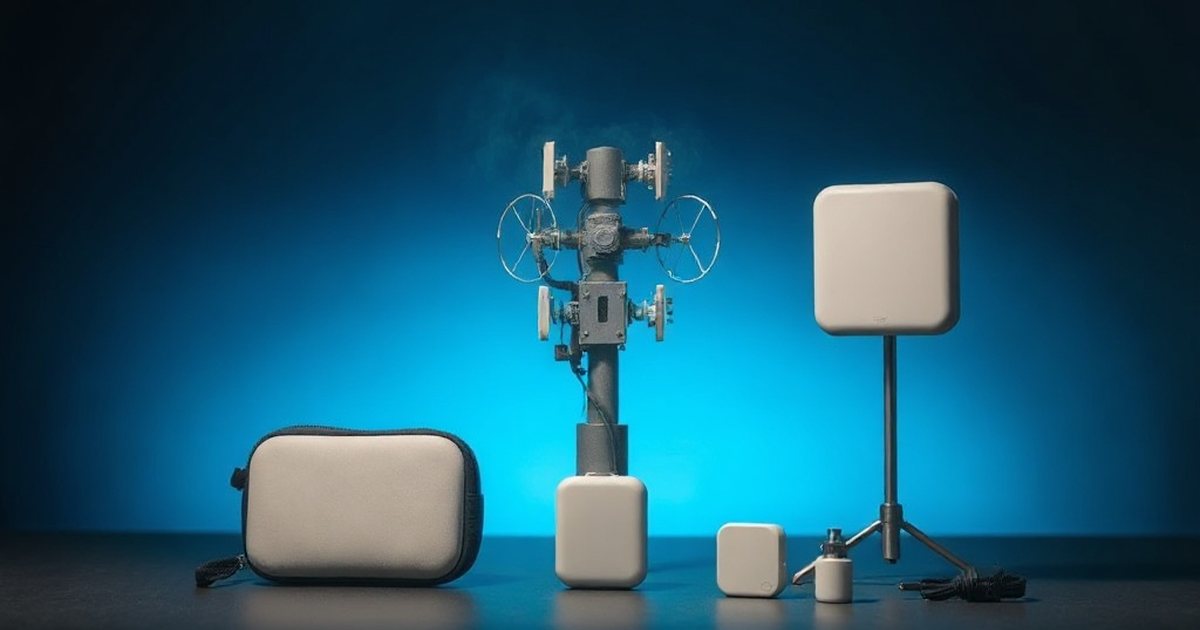
Coverage range. Because of that lower power, each small cell covers a much smaller area. Where a macro tower might serve users several miles away, a small cell covers a few hundred to roughly 1,600 feet.
Density. The tradeoff is that far more small cells are needed to cover the same area. Instead of one tall tower serving a wide radius, neighborhoods may get dozens of small cells on poles throughout their streets. This is the core of the densification strategy that makes 5G speeds possible.
Height and proximity. Macro towers are typically 150 feet or higher, and their antennas direct the main beam outward and slightly downward to cover ground-level users at a distance. If you stand directly beneath a macro tower, you are actually in a relatively low-exposure zone because the main beam passes over you. Small cells, by contrast, are mounted at 25 to 35 feet, much closer to where people live and walk. That proximity is the key factor that concerns many homeowners.
Visibility. Macro towers are hard to miss. Small cells are designed to blend in. Some municipalities have adopted design standards requiring small cell equipment to be housed within the pole itself, matching the height, diameter, and finish of adjacent poles. In practice, many installations are still visibly identifiable as added equipment, but the industry trend is toward greater concealment.
The Regulatory Reality: Why Homeowners Have Limited Say
One of the most frustrating aspects of small cell deployment for homeowners is how little input they have in the process. This is not a perception problem; it is a structural feature of federal and state telecommunications law.
The foundation is the Telecommunications Act of 1996, which strengthened the FCC’s ability to preempt local zoning decisions and gave the federal government complete authority over RF radiation exposure standards. Under this law, local jurisdictions cannot deny a wireless facility application on the basis of health or environmental concerns related to RF emissions, as long as the facility complies with FCC exposure limits.
In 2018, the FCC adopted its Small Cell Order, which went further. It capped the fees municipalities can charge for small cell permits and pole attachments, imposed “shot clock” deadlines requiring cities to approve or deny applications within 60 to 90 days, and established that if a city fails to act within that window, the application may be “deemed granted.” Many state legislatures passed companion laws giving wireless providers broad rights to install small cells in public rights-of-way with minimal zoning review.
The practical effect: your city’s planning department typically has limited authority to deny a small cell installation. Where municipalities retain the most control is on aesthetic grounds, requiring equipment to match surrounding infrastructure in color, height, and style. But they generally cannot reject an application outright or impose setback requirements that would effectively block deployment.
In September 2025, the FCC adopted a Notice of Proposed Rulemaking (the “Build America” proposal) that would expand federal preemption even further. Among its provisions, the proposal would bar local governments from adding new conditions when renewing permits for existing towers, refers to setback requirements (which distance towers from homes or schools) as potential “regulatory impediments,” and would allow carriers to override local zoning in more situations without proving a coverage gap. Major local government associations, including the National League of Cities and the National Association of Counties, have urged the FCC to withdraw or substantially revise the proposal.
The comment period on this rulemaking closed in early 2026, and as of this writing the FCC has not taken final action. This remains an evolving area of law, and the outcome will shape how much voice communities have in future small cell deployments.
What Research Says About Small Cell RF Levels
Understanding the actual RF exposure from a nearby small cell requires looking at real measurement data rather than relying on assumptions.
A peer-reviewed study published in the journal Sensors (available through the National Institutes of Health) measured RF electromagnetic fields near two 5G NR base stations at distances ranging from 0.5 meters to 100 meters. The researchers found that even at very close distances, exposure levels remained below international safety guidelines. The maximum exposure ratio compared to ICNIRP limits was 0.15 for occupational exposure (at 0.5 meters) and 0.68 for general public exposure (at 1.3 meters). For people who were not actively using the network, measured exposure was 5 to 30 times lower still.
A separate study of 5G macro base stations in the UK found that both total RF and 5G-specific power density levels were well within ICNIRP public reference levels. Notably, 4G downlink was the dominant contributor to total RF exposure, with 5G contributing on average less than 10 percent of the total measured RF.
These findings are consistent with what physics predicts. RF field intensity decreases with the square of the distance from the source. Double your distance from a small cell and your exposure drops to one quarter. Move ten times farther away and you are exposed to one hundredth of the intensity. Even at 50 meters from a macro tower, measured RF power density is typically less than 0.1 percent of the FCC safety limit.
That said, there are reasons some people remain cautious. Small cells are mounted much closer to homes than macro towers, which partially offsets their lower power output. A small cell 20 feet from a bedroom window may deliver more localized RF exposure than a macro tower 500 feet away. The long-term health effects of chronic low-level RF exposure remain an area of ongoing scientific study, and organizations like the International Agency for Research on Cancer (IARC) have classified RF electromagnetic fields as “possibly carcinogenic to humans” (Group 2B), a category that reflects limited evidence rather than a definitive finding. Reasonable people can look at the same data and reach different conclusions about acceptable risk, especially when it involves their own home and family.
Standard building materials do provide meaningful attenuation on their own. Concrete and brick walls can reduce RF exposure by 70 to 90 percent compared to open-air levels. Wood-frame construction blocks less. Windows are the primary entry point for RF energy into most homes.
What You Can Actually Do
Even though your ability to prevent a small cell installation is limited, you are not without options. Here is a practical breakdown of steps you can take before, during, and after a small cell appears near your home.
Stay Informed About Planned Installations
Contact your local planning or zoning department and ask how wireless facility permits are handled in your jurisdiction. Some municipalities require public notice to property owners within a certain radius (commonly 300 to 500 feet) before a small cell is approved. Others do not. Knowing your local rules helps you engage before equipment goes up rather than after.
Many cities maintain online databases of permit applications. Check your city or county website for a permit portal and search for wireless facility or small cell applications. If your jurisdiction holds public hearings on these applications, attending and providing comments is one of the few formal channels available to homeowners.
Engage Your City Government on Aesthetic Standards
While cities generally cannot block small cells outright, they can require design standards. Push your city council or planning commission to adopt (or strengthen) small cell design guidelines that require equipment to be concealed within poles, set maximum equipment dimensions, and require color-matching with surrounding infrastructure. This does not prevent installation, but it can influence where and how equipment is placed.
Measure Your Actual Exposure
Before investing in shielding, measure what you are actually dealing with. Consumer-grade RF meters start around $50 and provide basic readings across common cellular and WiFi frequency bands. Professional-grade meters in the $200 to $500 range offer frequency-specific data that can tell you exactly which bands are contributing to your exposure and how much energy is reaching different rooms in your home.

This measurement step matters. If a small cell is 200 feet away and your home has brick or concrete walls, your indoor exposure may already be minimal. If one is 30 feet from your bedroom window in a wood-frame house, the situation is different. An RF meter gives you actual numbers instead of assumptions.
Shield the Tower-Facing Side of Your Home
If measurements confirm meaningful RF levels on the side of your home facing the small cell, targeted shielding can substantially reduce indoor exposure. The three primary options are window film, shielding paint, and EMF-blocking curtains.
RF shielding window film is a transparent layer made from metallic oxides or fine metal mesh (typically silver, copper, or indium tin oxide) bonded to a polyester substrate. Properly applied, quality window films can achieve 30 to 60 dB of attenuation. The RDF72 Premium Series by EMRSS is one well-reviewed option that blocks RF while still allowing natural light through. Window film also reduces UV exposure and heat gain, which is a practical bonus. Expected lifespan is 8 to 15 years depending on UV exposure and climate.
EMF shielding paint is a conductive coating infused with carbon, graphite, or metallic particles that reflects and absorbs RF energy. Products like YShield EMF Shielding Paint and WOREMOR RF-IE50 can provide up to 30 dB or more of attenuation per coat. The paint is applied to walls like regular primer, then covered with your choice of topcoat color. It does need to be properly grounded to perform at its rated attenuation. Two coats of quality shielding paint on a tower-facing wall can reduce readings by 20 to 40 times, according to published application data.
EMF-blocking curtains are fabric curtains woven with metallic threads (often silver or copper) that can provide 15 to 30 dB of RF attenuation when closed. Their advantage over window film is flexibility: you can open them during the day and close them at night when you are sleeping in the room. They work well as a complement to window film for bedrooms or rooms where you spend the most time.
A combined approach delivers the best results. Shielding windows alone typically reduces whole-room RF exposure by 30 to 60 percent because RF also enters through walls, doors, and electrical wiring. Adding shielding paint to the tower-facing wall and film to the windows on that side creates a more complete barrier. Published measurement data from combined paint-plus-film applications show indoor RF levels dropping to very low levels in the shielded rooms.
Prioritize Bedrooms and High-Occupancy Rooms
You do not need to shield your entire house. Focus on the rooms where you spend the most time, especially bedrooms where you spend 7 to 8 hours per night. A shielded bedroom on the tower-facing side of the house can dramatically reduce your cumulative daily exposure even if other rooms remain unshielded.
Frequently Asked Questions
How close can a 5G small cell tower be to my house?
There is no universal minimum distance. Small cells are installed in public rights-of-way, which can put them as close as 15 to 30 feet from a home depending on the width of the easement and local pole placement. Some municipalities have attempted setback requirements, but the FCC’s 2025 proposed rulemaking characterizes such setbacks as potential regulatory impediments to wireless deployment.
Can I legally block a small cell installation near my home?
In most cases, no. Federal law under the Telecommunications Act of 1996 prohibits local jurisdictions from denying wireless facility applications based on health or environmental concerns. The FCC’s Small Cell Order further limits municipal authority by capping fees and imposing approval deadlines. Your strongest avenue is engaging with local government on aesthetic and design standards.
Are 5G small cells more dangerous than traditional cell towers?
Small cells operate at significantly lower power (2 to 10 watts) compared to macro towers (10 to 500 watts per channel). However, they are mounted much closer to where people live, which can result in higher localized RF levels at nearby homes. Peer-reviewed measurements near 5G small cells have found exposure levels below international safety guidelines, though the proximity factor is what drives concern for many homeowners.
Do small cell towers affect property values?
The data is mixed. Real estate professionals have noted that visible cell tower equipment can influence buyer perception, and some studies suggest a small negative impact on nearby property values. Other analyses show no statistically significant effect. The impact likely depends on how visible and close the equipment is, and whether the local market has strong demand regardless.
Will my phone work worse if I shield my house from RF?
Shielding one or two rooms on the tower-facing side of your home should not meaningfully affect cell reception throughout the rest of your house. Your phone connects to the strongest available signal, and other sides of your home will still receive signals normally. If you shield extensively, you may notice reduced signal in heavily shielded rooms, which can be addressed by using WiFi calling indoors.
What is the best way to measure RF from a nearby small cell?
An RF meter that covers cellular frequency bands (typically 700 MHz to 6 GHz for sub-6 5G) is the right tool. Consumer models start around $50 and give you basic readings. For frequency-specific measurements that distinguish between the small cell signal and other RF sources like WiFi routers and smart meters, a professional-grade meter in the $200 to $500 range is worth the investment.
Does RF shielding window film block visible light?
Quality RF shielding films are designed to be visually transparent. They have a slight tint (similar to a light window tint) and still allow natural light through. Most also provide UV reduction and some heat rejection as a side benefit. The visual effect is comparable to a standard solar control window film.
How do I find out if a small cell is planned for my street?
Contact your local planning or zoning department and ask about wireless facility permit applications. Some jurisdictions require mailed notice to nearby property owners, posted signs at the proposed site, or public hearings. Many cities also maintain online permit databases where you can search for wireless or small cell applications. Requirements vary widely by location, so your planning department is the best first call.
The Bottom Line
5G small cell towers are a fact of modern wireless infrastructure, and their presence in residential neighborhoods is only going to increase. The regulatory framework heavily favors deployment, and homeowners have limited formal avenues to prevent installations near their property. That is a legitimate source of frustration, and the FCC’s ongoing rulemaking may tilt the balance even further toward carrier interests.
At the same time, the available measurement data consistently shows that RF levels near small cells fall well below current safety limits, and their lower power output means they emit far less total energy than the macro towers they supplement. The proximity factor is real, but so is the inverse square law: even modest increases in distance produce significant reductions in exposure.
Where you have the most control is inside your own home. Measuring your actual RF environment with a meter, then selectively shielding high-occupancy rooms with window film, shielding paint, or EMF-blocking curtains gives you a practical, evidence-based way to reduce exposure on your own terms. You do not need to shield your entire house. Focus on the rooms that matter most, starting with bedrooms on the tower-facing side, and let the measurements guide your decisions rather than guesswork.
These statements have not been evaluated by the Food and Drug Administration. This information is not intended to diagnose, treat, cure, or prevent any disease. Content is for informational purposes only and is not medical advice; consult a qualified healthcare provider before starting any supplement. As an Amazon Associate we earn from qualifying purchases.