If you drive a Tesla or another electric vehicle, you have probably wondered about the electromagnetic fields generated by the battery pack sitting inches below your seat. It is a reasonable question. EVs run on high-current electrical systems, powerful inverters, and electric motors that produce strong low-frequency magnetic fields in ways that gasoline cars simply do not. And unlike the RF concerns covered elsewhere on this site (phones, WiFi routers, cell towers), the EMF profile of an EV is a fundamentally different animal.
The topic has gained traction as EV adoption accelerates. Forums, YouTube channels, and EMF consulting websites increasingly feature meter readings taken inside Teslas and other electric cars. Some of the numbers look alarming without context. Others are reassuringly low. The truth, as you might expect, sits somewhere in the middle and depends heavily on where you measure, when you measure, and which vehicle you are testing.
This article pulls together what the actual published research and independent testing has found, explains what the numbers mean in practical terms, and covers steps you can take if you want to reduce your exposure while still enjoying your EV.
What Makes EV EMF Different from a Gas Car
Every car produces electromagnetic fields. The alternator, ignition system, fuel pump, and wiring harness in a conventional gasoline vehicle all generate low-frequency magnetic fields. But the levels are generally modest because the currents involved are relatively small.
Electric vehicles change the equation in three important ways:
High traction currents. An EV’s electric motor can draw hundreds of amps under hard acceleration. The Vassilev et al. study (published in IEEE Transactions on Electromagnetic Compatibility) documented traction current variations of up to 300 amps in the vehicles they tested. Those currents flow through cables routed beneath the cabin floor, generating magnetic fields that drop off with distance but can be significant close to the source.
Battery pack placement. Most EVs use a flat battery pack mounted under the passenger compartment floor. This skateboard design is great for handling and interior space, but it means your feet and lower body sit directly above a large source of DC and low-frequency AC magnetic fields.
Inverter and motor proximity. The inverter converts DC battery power to AC for the motor, switching at high frequencies and producing complex broadband emissions. In many EV designs, the motor and inverter sit at the front or rear axle, placing them closer to certain seat positions than you might expect.
The important distinction: the primary EMF concern in EVs is extremely low frequency (ELF) magnetic fields, typically in the range of a few hertz to several kilohertz. This is a completely different frequency band from the radiofrequency (RF) emissions from your phone or WiFi router. Different frequency, different interaction with biological tissue, and different shielding requirements. Standard RF shielding materials (like the silver-fiber fabrics used for phone radiation) are largely ineffective against low-frequency magnetic fields, which require specialized ferromagnetic or mu-metal shielding.
What the Published Research Actually Found
There are a handful of serious studies on this topic. The research base is smaller than what exists for RF exposure from phones, but there is enough real data to draw meaningful conclusions.
The BfS 2025 Study (Germany)
The most comprehensive study to date comes from the German Federal Office for Radiation Protection (Bundesamt fur Strahlenschutz, or BfS), published in 2025. Researchers tested 13 vehicles (11 fully electric, 2 plug-in hybrids) and collected more than 975,000 data points under controlled conditions.
Key findings:
| Driving Condition | Magnetic Field Range |
|---|---|
| Constant-speed cruising | 2 to 10.5 microtesla (20 to 105 milligauss) |
| Low-demand steady driving (peak) | Over 100 microtesla (over 1,000 milligauss) |
| Rapid acceleration or braking (peak) | Up to 900 microtesla (up to 9,000 milligauss) |
| Vehicle stationary, accessories on | Localized levels above 100 microtesla |
Critically, the BfS study found that exposure was spatially very uneven. The strongest fields were detected near the foot area of the front seats, close to the battery pack and high-current cabling. The upper body and head were significantly less exposed.
After applying mathematical exposure models, the researchers concluded that the tested vehicles complied with the ICNIRP 2010 acute exposure guidelines (the current international standard). However, they noted these vehicles did not meet the older ICNIRP 1998 thresholds, which are also referenced in pacemaker safety specifications. The BfS explicitly stated that knowledge gaps remain for long-term chronic exposure and for the biological significance of very short-duration peaks lasting less than 0.2 seconds.
Vassilev et al. (2014) – The Eight-EV Comparison
Published in IEEE Transactions on Electromagnetic Compatibility, this study measured magnetic fields inside eight different EVs (battery electric, hybrid, plug-in hybrid, and fuel cell) alongside three conventional gasoline vehicles for comparison.
Results showed magnetic field exposure reached up to 20% of ICNIRP reference levels near the battery and in the foot area during vehicle startup, but dropped to less than 2% at head height. The highest-reading vehicle peaked at 18% of the ICNIRP limit. RMS magnetic field values ranged between 0.1 and 2 microtesla at frequencies from a few hertz to 1 kilohertz. In two of the eight models tested, maximum fields near the battery area reached approximately 130 microtesla. The other models measured significantly lower, and some were comparable to the conventional vehicles.
Tesla Model Y Study (2025)
A peer-reviewed study published in the Journal of Applied Biotechnology and Bioengineering examined 2021 and 2022 Tesla Model Y vehicles under multiple operating conditions: Supercharging, standard charging, high-speed driving, urban commuting, and idle. Researchers used a high-sensitivity gaussmeter to measure ELF/LF electric and magnetic fields, RF emissions in the sub-6 GHz range, and high-frequency body voltage coupling across key cabin zones including seats, console, and dashboard.
The study found that EMF levels peaked during Supercharging and high-speed driving, with the central console and front seats showing the highest readings. Note that this study was partially funded by SPIRO, a company that sells EMF-filtering products, which is worth considering when evaluating the findings.
Long-Term Monitoring (Yang et al., 2019)
This was the first published long-term monitoring study of magnetic fields in EVs, tracking three shared electric vehicles over two years. The key finding was practical: component replacements and repairs modified the magnetic field amplitudes and spectral characteristics of the vehicles. This suggests that EMF exposure in an EV is not static over the life of the vehicle and that shielding effectiveness can degrade over time.
Independent Community Testing
Outside of formal studies, EMF consultants and EV owners have published their own measurements, primarily using handheld meters like the TriField TF2. These informal readings show a wide range: some Tesla owners report typical cabin levels of 2 to 20 milligauss at seat height during normal driving, while others have measured 30 to 80 milligauss at footwell positions. One Tesla forum user documented readings of 30 to 50 milligauss in the right-side footwell even when the vehicle was stationary.
Tesla China’s VP has publicly stated that magnetic field levels in their vehicles range from 0.08 to 1.30 microtesla (0.8 to 13 milligauss) at head position, and testing by the China Automotive Research Institute gave Tesla’s Model 3 and Model Y high scores for EMF protection compared to other vehicles evaluated.
The honest summary: formal testing consistently shows that EV cabin magnetic fields are within international safety guidelines at most body positions, but localized readings near the floor and footwells can be notably elevated, particularly during acceleration, braking, and charging. Independent testing is still limited compared to the research base that exists for RF exposure from consumer electronics.
Factors That Affect Your Exposure
Not all time spent in an EV produces the same magnetic field exposure. Several factors create significant variation:
Seat position relative to the battery pack. The BfS study confirmed that magnetic fields are strongest near the floor of the front seats, directly above the battery pack and high-current cabling. Rear seat passengers may have different exposure profiles depending on the specific vehicle’s battery and motor layout. In some vehicles with rear-mounted motors, back seat passengers are closer to both the motor and the rear section of the battery pack.
Driving style and conditions. Hard acceleration and aggressive regenerative braking produce the highest traction currents, which directly correlate with the strongest magnetic fields. The BfS study showed peak readings during dynamic driving maneuvers that were dramatically higher than constant-speed cruising. Highway cruising at a steady speed produces the lowest exposure during active driving.
Charging vs. driving. Supercharging (DC fast charging) pushes high currents into the battery and produced peak readings in the Tesla Model Y study. Standard Level 2 AC charging at home generates lower fields. When the vehicle is simply parked and not charging, some baseline magnetic field activity remains from the vehicle’s electronic systems, but levels are generally much lower.
Vehicle model and design. The Vassilev study found substantial variation across the eight EV models tested. Two vehicles showed maximum fields near 130 microtesla near the battery area, while others measured significantly lower. Motor type (permanent magnet synchronous vs. induction), cable routing, and built-in shielding all play a role. Tesla uses shielded cables and specific component placement strategies to minimize cabin exposure, but the effectiveness varies by model and production year.
Vehicle age and maintenance history. The Yang et al. long-term study documented that component replacements changed the magnetic field characteristics of the vehicles. Aging, wear, and repairs can alter shielding effectiveness over time. A vehicle that measured well when new may not maintain those same levels after years of service.
Practical Steps for Concerned EV Owners
If you want to reduce your magnetic field exposure while driving an EV, there are practical options. Some are free and behavioral; others involve aftermarket products.
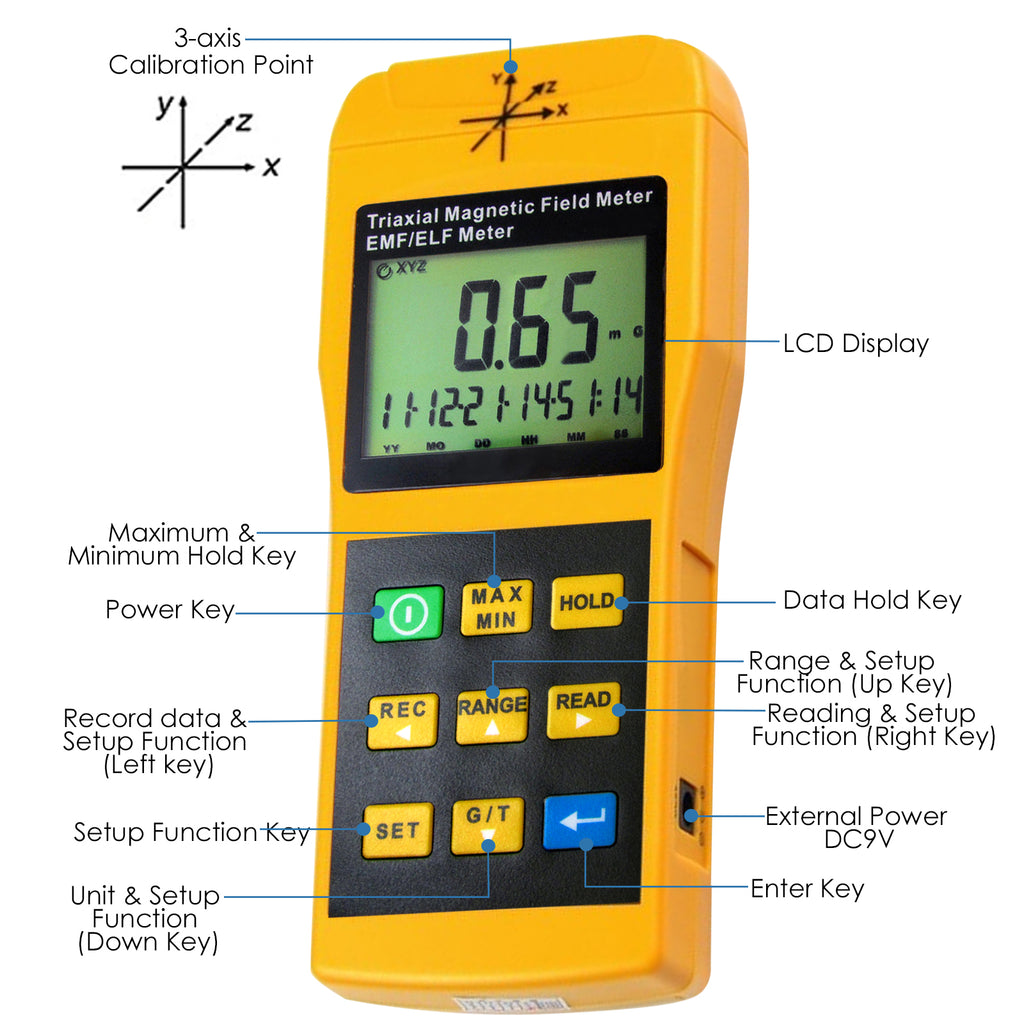
Measure first. Before buying shielding products, get a baseline reading of your specific vehicle. A gaussmeter like the TriField TF2 can measure low-frequency magnetic fields at different cabin positions. Test at the footwell, seat cushion level, chest height, and head height while parked, while driving at steady speed, and during acceleration. This tells you where your exposure actually is, rather than guessing based on general data.
Maximize distance from the floor. Since the battery pack is under the floor and the strongest fields are near the feet, anything that increases the distance between you and the floor helps. Thicker seat cushions, raised seat positions, and keeping your feet up on a footrest rather than flat on the floor all increase your distance from the strongest field zone. Even a few inches of additional distance can make a meaningful difference, since magnetic field strength drops rapidly with distance.
Magnetic shielding products. For low-frequency magnetic fields, you need materials specifically designed for magnetic shielding. Products made from mu-metal alloys or iron-nickel composites can attenuate magnetic fields. Companies like LessEMF offer magnetic shielding alloys (such as G-Iron Armoflex or Magnetic Shielding Foil) that can be positioned on the floor or under seats. The WOREMOR Magnetic Field and RF Protection Gel Seat Cushion from EMR Shielding Solutions combines magnetic shielding material with an ergonomic seat design. DefenderShield makes seat cushion shields and floor mat shields designed for vehicle use.
Important caveat: shielding low-frequency magnetic fields is significantly harder than shielding RF. A silver-fiber phone pouch that blocks 99% of RF will do essentially nothing against the 50 Hz to 1 kHz magnetic fields from an EV drivetrain. Make sure any product you buy specifically addresses magnetic (not just electric or RF) field attenuation, and ideally verify its performance with your own meter after installation.
Smooth driving habits. Since peak magnetic fields correlate with high traction currents during hard acceleration and braking, smoother driving directly reduces your exposure. Gentle acceleration, coasting to decelerate before applying regenerative braking, and maintaining steady highway speeds all keep traction currents (and magnetic fields) lower.
Charging awareness. If you are sitting in the vehicle while it Supercharges, you are exposed to the highest charging-related fields. Consider stepping out of the car during DC fast charging sessions. Home Level 2 charging generates lower fields, and you are typically not sitting in the car during home charging anyway.
How EV Cabin Fields Compare to Common Household Appliances
One useful way to put EV magnetic field readings into perspective is to compare them with the fields produced by common household appliances. These comparisons use published measurement data, primarily from utility company studies and government health agencies.
| Source | At 6 Inches | At 1 Foot | At 3 Feet |
|---|---|---|---|
| Electric can opener | 600 mG | 150 mG | 2 mG |
| Hair dryer | 300 mG | 1 mG | Up to 6 mG |
| Vacuum cleaner | 300 mG | 60 mG | Up to 40 mG |
| Microwave oven | 200+ mG | 40 mG | Up to 25 mG |
| Portable heater | 100 mG | 20 mG | 4 mG |
| Electric range/stove | 30 mG | 8 mG | 2 mG |
| Typical home background | 0.1 to 4 mG | ||
Context for EV readings: the BfS study found steady cruising magnetic fields of 20 to 105 milligauss at measurement positions near the cabin floor. At seat height and above, readings are generally lower. Community testing of Teslas typically shows 2 to 20 milligauss at seat level during normal driving, with footwell readings of 30 to 80 milligauss in some vehicles.
So in terms of magnetic field intensity at typical body distance, sitting in an EV during normal driving exposes you to fields that are broadly comparable to being a foot or two away from a running vacuum cleaner or microwave oven. The key difference is duration: you run a hair dryer for five minutes, but you might spend an hour or more in your EV daily. The research community has not yet established clear conclusions about whether chronic low-level exposure at these durations carries different risks than brief high-level exposure from appliances.
The ICNIRP reference level for general public exposure to magnetic fields at power-line frequencies is 100 microtesla (1,000 milligauss). The BfS study found that cruising-speed measurements stayed well below this threshold, though transient peaks during acceleration and braking can briefly exceed it before dropping back down.
Frequently Asked Questions
Do Teslas produce more EMF than other electric vehicles?
Not necessarily. Independent testing and the BfS study show significant variation between EV models regardless of brand. Tesla China’s published data shows head-level readings of 0.08 to 1.30 microtesla, which falls within the range observed in other EVs. Some forum users report higher footwell readings in specific Tesla models, but aggregated data does not consistently show Tesla as an outlier compared to other manufacturers.
Are EV magnetic fields dangerous to my health?
The honest answer is that we do not have enough research to say definitively either way for long-term chronic exposure. The International Agency for Research on Cancer (IARC) classifies ELF magnetic fields as “possibly carcinogenic” (Group 2B), but that classification was based on epidemiological studies of much higher exposures in occupational settings, not the levels found in vehicles. Formal studies show EV cabin fields within ICNIRP acute safety guidelines, but ICNIRP itself acknowledges these guidelines address short-term effects, not long-term chronic exposure.
Where are the strongest magnetic fields inside an EV?
Consistently across all published studies, the strongest readings come from the foot area of the front seats, directly above the battery pack and high-current cabling. The floor, footwells, and lower portions of the front seats are the highest-exposure zones. Upper body and head positions show significantly lower readings, often dropping to less than 2% of ICNIRP reference levels at head height according to the Vassilev study.
Does Supercharging produce higher magnetic fields than driving?
Yes. The Tesla Model Y study published in the Journal of Applied Biotechnology and Bioengineering found that EMF levels peaked during Supercharging sessions. DC fast charging pushes high currents into the battery pack, generating strong magnetic fields. If you are concerned about exposure, stepping out of the vehicle during Supercharging sessions is a simple precaution.
Can I shield myself from EV magnetic fields?
Partially. Low-frequency magnetic fields are harder to shield than RF. Standard RF-blocking fabrics and phone cases will not help. You need materials designed for magnetic shielding, such as mu-metal alloys or specialized iron-nickel composites. Products like magnetic shielding floor mats and seat cushions with integrated shielding material can reduce exposure, but verify effectiveness with a gaussmeter after installation. No product will eliminate the fields entirely.
Are EV magnetic fields a concern for people with pacemakers?
This is an area that warrants caution. The BfS 2025 study noted that while the tested vehicles met ICNIRP 2010 guidelines, they did not meet the older ICNIRP 1998 thresholds, which serve as the baseline for pacemaker susceptibility standards (ISO specifications). If you have an implanted medical device, consult your cardiologist and consider having your specific vehicle tested with a gaussmeter at the positions closest to your implant.
Do regenerative braking and acceleration really make a difference?
Yes, substantially. The BfS study documented that peak magnetic fields during dynamic driving (hard acceleration and braking) were dramatically higher than during constant-speed cruising. Cruising produced 2 to 10.5 microtesla, while aggressive acceleration and braking peaks reached up to 900 microtesla. Smoother driving directly reduces your peak magnetic field exposure.
Should I avoid buying an EV because of EMF concerns?
That is a personal decision based on your own risk tolerance. The available evidence shows that EV cabin magnetic fields during typical driving fall within international safety guidelines designed to prevent established health effects. The genuine uncertainty is about long-term chronic exposure, which has not been adequately studied in the EV context specifically. For most people, practical measures like smooth driving and seating position adjustments are reasonable middle-ground approaches.
The Bottom Line
Electric vehicles produce measurable magnetic fields inside the cabin that are higher than what you would find in a conventional gasoline car. The fields are strongest near the floor, in the footwell area directly above the battery pack, and spike during hard acceleration, aggressive regenerative braking, and DC fast charging.

The most rigorous study to date, the BfS 2025 research with nearly a million data points across 13 vehicles, found that EV magnetic fields comply with current ICNIRP 2010 acute safety guidelines. But it also documented peak readings during dynamic driving that are far above typical household background levels, and the researchers themselves noted that knowledge gaps remain around long-term chronic exposure and the significance of very brief, high-intensity peaks.
This is not a topic where the science is settled. The research base is thinner than what exists for RF exposure from phones and WiFi. Independent third-party testing of specific EV models is limited, and much of the available data comes from a small number of studies. The IARC “possibly carcinogenic” classification for ELF magnetic fields adds a layer of uncertainty that honest reporting cannot simply dismiss.
What you can say with confidence: if you drive an EV, your magnetic field exposure during typical driving is in a range comparable to being near common household appliances, but for longer durations. The exposure is real and measurable, not imaginary. It falls within current safety guidelines designed for acute effects. Whether current guidelines adequately address chronic, long-duration exposure is an open question the scientific community has not yet resolved.
For EV owners who want to take a precautionary approach, practical steps exist: measuring your specific vehicle, adjusting seat position and driving habits, using appropriate magnetic shielding products, and stepping out during Supercharging. These are reasonable, low-cost measures that do not require you to give up your EV.
These statements have not been evaluated by the Food and Drug Administration. This information is not intended to diagnose, treat, cure, or prevent any disease. Content is for informational purposes only and is not medical advice; consult a qualified healthcare provider before starting any supplement. As an Amazon Associate we earn from qualifying purchases.