LED and CFL bulbs contain electronic circuitry. In one small appliance study, compact fluorescent bulbs were among the main sources of high-frequency voltage transients on household wiring. Whether that noise affects health has not been shown [1][2].
The circuitry in question is the driver, a small power supply in the base of the bulb that turns wall current into what the lamp needs. A plain filament bulb has no driver at all, which is the entire argument for this swap.
Get our complete guide with room-by-room strategies and product recommendations.
Where the noise starts
Many drivers work by switching current on and off very rapidly. That is efficient, but each switching edge can travel back through the socket and out along the household wiring as high-frequency noise. A filament bulb draws current smoothly and has nothing that switches.
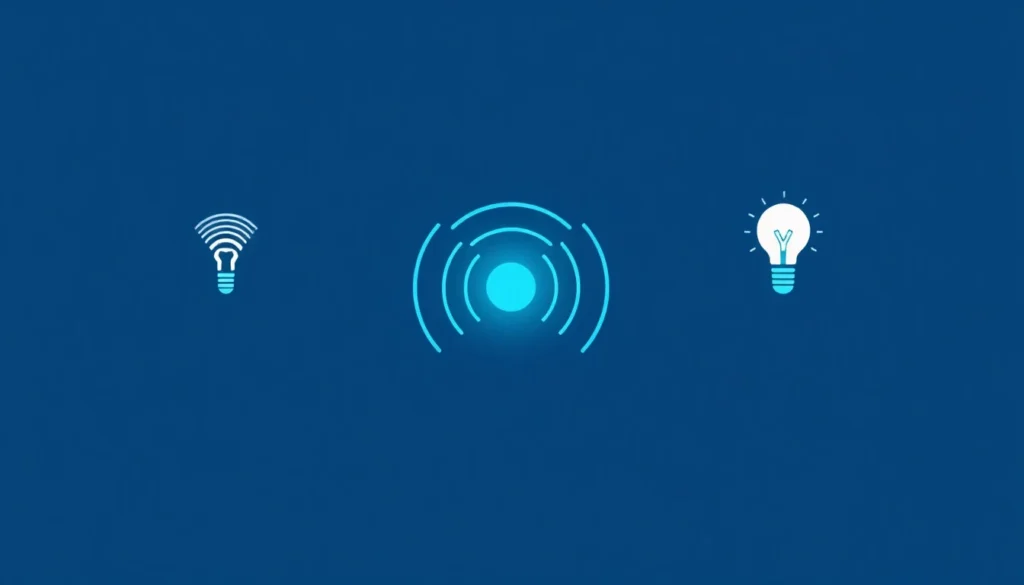
LED and CFL driver circuits can send noise back onto the wiring
The bulb's driver is the noise source.
Health effects of dirty electricity are not established; this shows the mechanism only.
Data table
| Step | Stage | What happens |
|---|---|---|
| 1 | Source | Dimmers, inverters, chargers and switching power supplies chop the waveform |
| 2 | On the wiring | High-frequency noise rides on the 60 Hz supply |
| 3 | Spread | It travels along circuits to other outlets in the home |
| 4 | Measure | Read it at the outlet with a line-noise meter, not a field meter |
| 5 | Reduce | Remove or replace the source first; filters treat what is left |
Chart: frequencyblockers.com: LED and CFL driver circuits can send noise back onto the wiring
Embed this chart
Free to reuse on your site. Copy the code below; please keep the credit link.
On a plain switch a filament bulb adds no switching noise to your wiring. On a dimmer the circuit can, because most dimmers chop the waveform.
The word to hold on to is some. Not every LED or CFL bulb is noisy, and the amount depends on the design of the driver. That is why measuring beats assuming.
Which bulbs to change first
- Begin with the lamps in the rooms where you spend the most hours, especially the bedroom and the spot where you sit in the evening.
- Bare-bulb fixtures and lamps near the bed come before closets, garages and hallways you pass through.
- Change one room, measure, and only then decide whether to carry on.
- Keep the old bulbs in a box. If the readings do not change, there is no reason to keep paying for the swap.
- Check the wattage rating on each socket before fitting a filament bulb, since they run hotter than the bulbs they replace.
Measuring before and after
Use a line-noise meter at an outlet on the same circuit as the lamps. Take a reading with the lamps lit and the old bulbs in, swap the bulbs, and read the same outlet again with the same devices running. Change only the bulbs between readings.
A gaussmeter and an RF meter are the wrong tools for this tip. They respond to fields in the air, while bulb driver noise travels through the wiring.
Incandescent Light Bulbs (Pack of 6)
Standard incandescent bulbs for the lamps you sit closest to. Start there rather than replacing every bulb in the house.


The evidence and the trade-offs
Keep in mind that a systematic review concluded the evidence for dirty electricity as a cause of human health effects does not stand up to scientific scrutiny, and an earlier review found only seven articles on it, all with significant methodological flaws [2][5].
Since the evidence is weak, this is a preference, and there are costs on the other side. A filament bulb produces more heat and uses more electricity for the same amount of light, and it will not last as long as most LED bulbs. If your meter shows your LEDs are quiet, there is no electrical reason to replace them.
Ready for More EMF Protection Tips?
Our complete guide includes 100 actionable strategies for every room in your home, plus product recommendations from our curated collection.
Frequently Asked Questions
What’s wrong with LED and CFL bulbs that makes incandescent bulbs a better choice?
LED and CFL bulbs contain electronic circuitry, and compact fluorescent bulbs were among the main sources of high-frequency voltage transients in one small appliance study. Incandescent bulbs have no electronics, so they avoid that. Blinded provocation studies of people who report EMF sensitivity found no robust evidence that fields trigger their symptoms, so this is a choice about line noise, not a proven safety gain [1][3].
Can switching to incandescent bulbs really reduce my EMF exposure?
It removes one possible source of high-frequency noise on your wiring; in one small appliance study that was mainly microwaves and compact fluorescent bulbs. It is a minor change next to your phone and other devices held close to the body, and evidence that this noise affects health is weak [1][4][2].
Are there any downsides to using incandescent bulbs instead of LED or CFL?
Incandescent bulbs are less energy-efficient and have shorter lifespans than LED and CFL alternatives, which may result in higher electricity costs and more frequent replacements. Whether avoiding dirty electricity brings any health benefit has not been shown, so weigh the higher electricity cost and shorter bulb life against that [2][5].
What does ‘dirty electricity’ mean in relation to light bulbs?
Dirty electricity refers to electromagnetic interference and harmonic distortions generated by the electronic circuitry in LED and CFL bulbs as they operate. This interference can spread through your home’s electrical system and potentially affect your overall EMF exposure levels throughout the day.
References
- Saban Selim Seker et al. Electromagnetic High-Frequency Transients Measurements of Some Household Devices. Emerging Science Innovation (2024). doi:10.46604/emsi.2023.12005
- de Vocht F et al. Systematic Review of the Exposure Assessment and Epidemiology of High-Frequency Voltage Transients. Frontiers in public health (2016). PMID 27066469
- Rubin GJ et al. Idiopathic environmental intolerance attributed to electromagnetic fields (formerly 'electromagnetic hypersensitivity'): An updated systematic review of provocation studies. Bioelectromagnetics (2010). PMID 19681059
- Aerts S et al. Emissions From Smart Meters and Other Residential Radiofrequency Sources. Health physics (2019). PMID 30883437
- de Vocht F "Dirty electricity": what, where, and should we care?. Journal of exposure science & environmental epidemiology (2010). PMID 20336048
These statements have not been evaluated by the Food and Drug Administration. This information is not intended to diagnose, treat, cure, or prevent any disease. Content is for informational purposes only and is not medical advice; consult a qualified healthcare provider before starting any supplement. As an Amazon Associate we earn from qualifying purchases.