Most people have no idea what their electromagnetic field exposure looks like at home. They might read about wireless radiation or power line fields and wonder whether their own living space has elevated levels, but without actually measuring, it stays a guessing game. A home EMF audit changes that. It gives you real numbers from real measurements, room by room, so you can make informed decisions about what (if anything) to change.
There are plenty of reasons to run an audit. Maybe you just moved into a new house and want a baseline. Maybe you are trying to optimize your bedroom for better sleep. Maybe you are considering buying shielding products and want to know whether you actually need them before spending money. Or maybe you are simply curious. Whatever your reason, the process is the same: grab a meter, walk your home systematically, write down what you find, and use the data to guide your next steps.
This guide walks you through the entire process from start to finish. No prior experience required.
What You Will Need for a Home EMF Audit
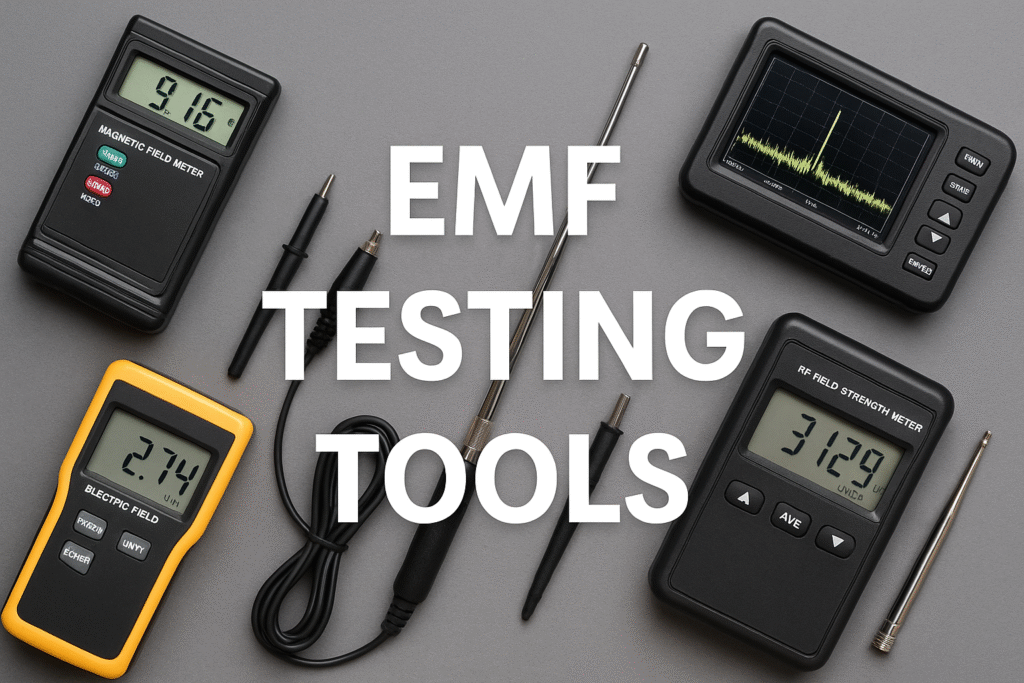
The single most important piece of equipment is an EMF meter. There are three main types of electromagnetic fields in a typical home, and ideally you want a meter (or combination of meters) that can measure all of them:
Editor’s Pick: TriField TF2 EMF Meter
A 3-in-1 meter measuring AC magnetic, AC electric, and RF fields in one device. The gold-standard pick building biologists and home inspectors reach for first.
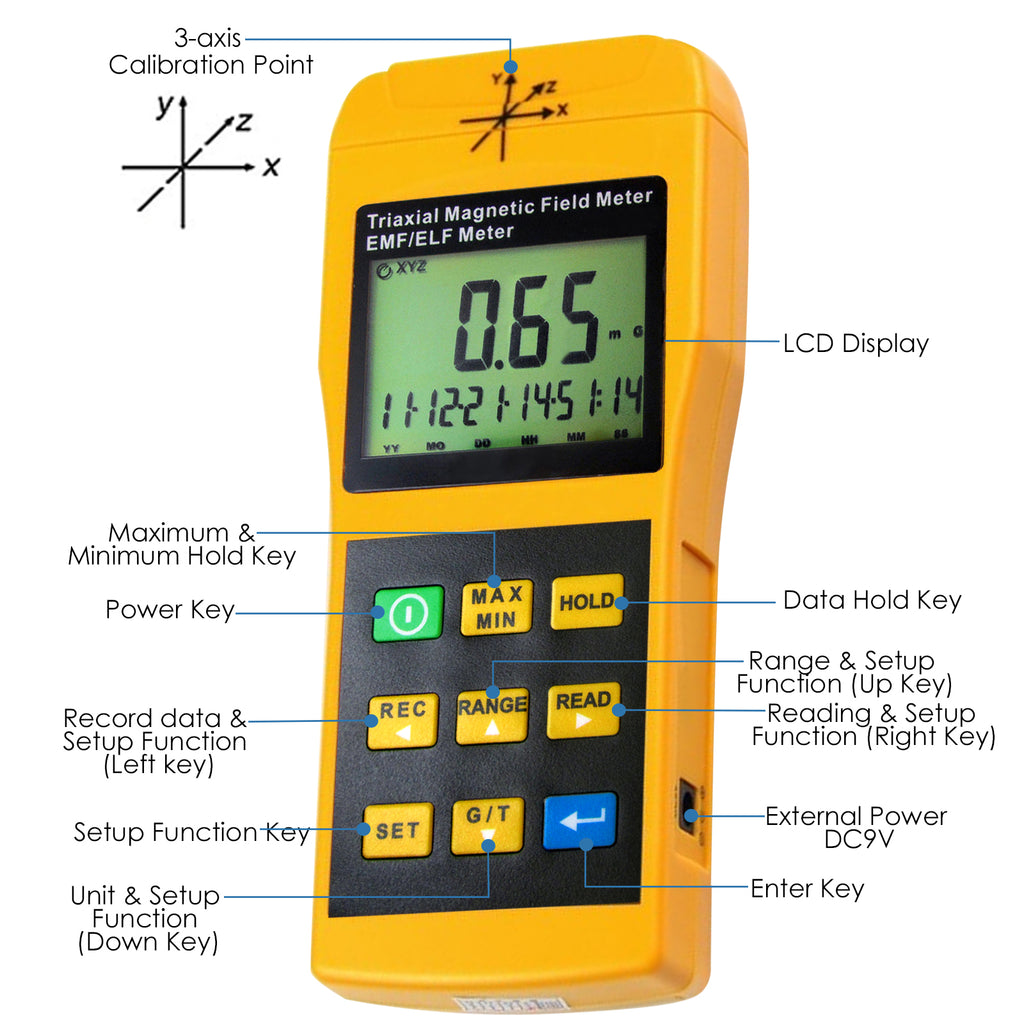
- AC Magnetic Fields (measured in milligauss or mG) produced by electrical wiring, appliances, and power lines
- Radiofrequency (RF) Fields (measured in microwatts per square meter or milliwatts per square meter) produced by WiFi routers, cell towers, smart meters, Bluetooth devices, and cordless phones
- AC Electric Fields (measured in volts per meter or V/m) produced by wiring in walls and cords, even when devices are turned off
Some popular all-in-one meters can measure all three types. The TriField TF2 (around $170) is one of the most widely used home audit meters because it covers RF, magnetic, and electric fields in a single device with a simple dial interface. The Cornet ED88T Plus (around $180) offers superior RF sensitivity and includes a frequency display showing which signals are strongest. The GQ EMF-390 (around $120) adds data logging capability so you can record readings over time. For budget-conscious testers, the Erickhill RT-100S (around $45) measures all three field types at a lower price point, though with reduced sensitivity.
If you want to measure dirty electricity as well (more on that in the steps below), you will need a separate plug-in meter like the Stetzerizer Microsurge Meter or the Greenwave Broadband EMI Meter. These plug into any standard outlet and give you a reading of electrical noise on that circuit.
Beyond the meter itself, you will want:
- A notebook or spreadsheet to log readings by room and location
- A pen or phone for notes about what was running at the time of each measurement
- 30 to 60 minutes of uninterrupted time to walk through your home
One important note: smartphone EMF apps are not a substitute for a real meter. Phone apps can only access the phone’s internal magnetometer and cannot detect WiFi, cellular, or other RF sources in your environment. For a legitimate audit, you need dedicated hardware.

Step-by-Step Home EMF Audit Walkthrough
Step 1: Establish a Baseline Outdoors
Before measuring anything inside, take your meter outside and get a baseline reading. Stand in your yard or on your sidewalk, at least 20 feet from your house, and take readings for RF, magnetic fields, and electric fields.
This outdoor baseline tells you what ambient levels exist in your area before your own home’s wiring and devices contribute anything. If your outdoor RF readings are already elevated (which can happen if you live near a cell tower or in a dense urban area), that context changes how you interpret your indoor readings. Similarly, if outdoor magnetic field readings are high, nearby power lines may be a factor that no amount of indoor changes will address.
Write down these baseline numbers. You will compare every indoor reading against them.
Step 2: Create a Room-by-Room Plan
Do not wander aimlessly. Before going inside, list every room and space you plan to test. A typical list might include:
- Bedrooms (all of them, starting with the master)
- Living room / family room
- Kitchen
- Home office or workspace
- Nursery or children’s rooms
- Basement (especially near the electrical panel)
- Garage
- Utility room
- Near the smart meter (exterior wall or meter closet)
Prioritize the rooms where you spend the most time, especially bedrooms. You spend roughly a third of your life sleeping, and that prolonged, continuous exposure window makes the bedroom the highest-priority room in any audit.
Step 3: Test Each Room Systematically
For each room on your list, follow a consistent measurement pattern. This prevents you from missing spots or accidentally comparing readings taken in different ways.
In every room, take readings at these locations:
- Center of the room at roughly waist height (your general ambient level for that space)
- Where you sit or sleep (desk chair position, couch position, pillow position on the bed)
- Near power outlets and cords (within 6 inches)
- Near any electronic devices (computers, TVs, baby monitors, smart speakers)
- Near the walls (to detect wiring in the wall or sources on the other side)
At each measurement point, record three separate readings: magnetic field (mG), electric field (V/m), and RF (the unit depends on your meter). Note whether devices were on or off at the time. If your meter has an audio mode, turn it on. The pitch and intensity of the audio feedback can help you locate sources by ear before you even look at the display.
Step 4: Give the Bedroom Extra Attention
Because you spend so many continuous hours in the bedroom, this room deserves more detailed testing than any other. Measure:
- At pillow level on each side of the bed
- Along the length of the bed (head, middle, foot)
- The bedside tables where phones charge overnight
- The wall behind the headboard (wiring in the wall can create elevated electric fields right where your head rests)
- Near alarm clocks and charging cables
Pay special attention to what is on the other side of your bedroom walls. Is the electrical panel on the other side? A smart meter? Your neighbor’s WiFi router in an adjacent apartment? Your meter will reveal sources you might not have considered.
For perspective on what you might find: ICNIRP guidelines set a general public magnetic field exposure limit at 2,000 milligauss (mG) at power line frequencies, and the FCC allows RF power densities up to 1,000 microwatts per square centimeter. However, these limits are designed to prevent acute thermal effects (tissue heating), not to address concerns about long-term, low-level exposure. Many independent researchers and organizations like the BioInitiative Working Group suggest much lower precautionary levels. Several European countries, including Switzerland, Italy, and Israel, maintain residential magnetic field limits of 3 to 4 milligauss for sensitive areas like homes and schools. Some building biology practitioners recommend keeping bedroom magnetic fields below 1 mG and RF levels well under 10 microwatts per square meter where practical.

Step 5: Check the Electrical Panel Area
Your home’s electrical panel (breaker box) is one of the strongest sources of magnetic fields in any house. The panel itself concentrates a large amount of electrical current in a small area, and magnetic field readings directly in front of a panel can easily reach tens or even hundreds of milligauss.
Measure at these distances from the panel:
- Directly in front of the panel (expect high readings)
- 3 feet away
- 6 feet away
- On the other side of the wall if there is a living space there
Magnetic field strength drops rapidly with distance. If your panel is in the basement and your living areas are a floor above, the fields may be negligible at that distance. But if the panel is on a wall shared with a bedroom or home office, you could be sitting or sleeping in an elevated magnetic field zone without realizing it. This measurement tells you whether furniture rearrangement might be worthwhile.
Step 6: Assess Your WiFi Router Placement
WiFi routers are typically one of the strongest continuous RF sources inside a home. Take readings at the following distances from your router:
- Within 1 foot (expect the highest readings)
- 3 feet
- 6 feet
- 10 feet
- Across the room or in an adjacent room
RF readings near a WiFi router can range from 50,000 to 150,000 microwatts per square meter or higher within a foot or two, dropping significantly with distance. By 10 to 15 feet, levels typically drop to a small fraction of what they are at close range.
Document where your router sits relative to where people spend time. If the router is on a desk three feet from where someone works all day, or on a nightstand in a bedroom, the audit data will make the case for relocating it. Even moving a router to a hallway, closet shelf, or centrally mounted high on a wall (which often improves coverage anyway) can reduce exposure in occupied areas substantially.
Step 7: Test the Smart Meter Area
If your home has a wireless smart meter (most homes built or updated in the last decade do), find it and take RF measurements at the same distance intervals: directly at the meter, 3 feet, 6 feet, 10 feet, and through the wall on the interior side.
Smart meters transmit RF data in brief bursts, typically totaling less than one to two minutes per day of actual transmission time. During these short transmission bursts, readings at contact distance can be significant. However, EMF levels from smart meters decrease rapidly with distance. Measurements drop by roughly 75% at just 3 feet away, and most emissions become negligible beyond 20 to 30 feet. Exterior walls further reduce readings by 50 to 90 percent on the interior side.
The concern with smart meters is not so much the average exposure (which is quite low due to the short duty cycle) but rather the placement. If a smart meter is mounted on the exterior wall directly behind a bed headboard or home office desk, even intermittent bursts at close range could be worth addressing. In apartment buildings, a bank of smart meters for the whole building can produce more cumulative RF than a single residential unit.

Since smart meters transmit in bursts rather than continuously, you may need to hold your meter in position for 30 to 60 seconds to catch a transmission. Some meters, like the Cornet ED88T Plus, have a peak-hold or histogram mode that captures the highest reading over a time window, which is useful for intermittent sources like smart meters.
Step 8: Check for Dirty Electricity
Dirty electricity refers to high-frequency voltage transients and harmonics that ride on your home’s standard 60 Hz (or 50 Hz) electrical wiring. Sources include dimmer switches, certain LED and CFL bulbs, solar inverters, variable-speed motors in appliances, and some types of chargers and power supplies.
To measure dirty electricity, you need a dedicated plug-in meter. The Stetzerizer Microsurge Meter (around $100 to $150) reads in proprietary Graham-Stetzer (GS) units in the 10 kHz to 150 kHz frequency range. Generally, readings below 25 GS units are considered low, and readings above 50 GS units suggest notable noise on that circuit. The Greenwave Broadband EMI Meter (around $130) reads in millivolts (mV) across a wider frequency range (3 kHz to 10 MHz), with readings below 25 mV considered the manufacturer’s target and readings above 100 mV considered elevated.
Note that the two meters use different scales, so their numbers are not directly comparable.

Test outlets in each room, prioritizing bedrooms and workspaces. To get a true baseline, try testing once with all devices running normally, and once with everything unplugged and non-essential breakers turned off. The second reading tells you how much dirty electricity is entering from outside your home (from the grid or neighbors). If your baseline with everything off is already high, the source is external and internal changes alone will not fully resolve it.
Step 9: Document Everything
As you go, write down every reading in a structured format. A simple spreadsheet or table works well:
| Room | Location | Magnetic (mG) | Electric (V/m) | RF (units) | Notes |
|---|---|---|---|---|---|
| Master Bedroom | Pillow (left side) | 0.3 | 8.2 | 12 µW/m² | Phone charging on nightstand |
| Master Bedroom | Pillow (right side) | 1.8 | 22.5 | 10 µW/m² | Wall shares panel |
| Home Office | Desk (seated position) | 2.1 | 15.0 | 4,200 µW/m² | Router on desk 2 ft away |
(The readings in this table are illustrative examples, not benchmarks. Your readings will vary based on your home’s wiring, devices, and surroundings.)
Good documentation turns a one-time audit into something you can reference later. If you make changes (move the router, turn off a breaker at night, rearrange furniture), you can re-measure and compare against your original numbers to verify whether the change actually made a difference.
Step 10: Prioritize Fixes by Exposure Level and Time Spent
Once your audit is complete, rank your findings by two factors: the magnitude of the reading and the amount of time you spend in that location.

A high reading in a room you rarely enter is less of a practical concern than a moderate reading in the room where you sleep eight hours every night. Focus on the intersections of higher readings and longer exposure times first. These are your highest-priority action items.
Sort your results into three categories:
- High priority: Elevated readings in bedrooms and workspaces (places where you spend hours at a time)
- Medium priority: Elevated readings in living rooms, kitchens, and common areas
- Low priority: Elevated readings in rooms you pass through but do not occupy for extended periods (hallways, garages, utility rooms)
Common Mistakes When Auditing
Even with a good meter and a systematic approach, certain mistakes can undermine your results. Watch out for these:
Only testing with everything turned off. Some guides recommend shutting everything down before testing. While a “baseline with everything off” measurement is useful (especially for dirty electricity), it does not reflect your actual daily exposure. Test under normal operating conditions first, then optionally test with things off to isolate sources.
Holding the meter wrong. For magnetic field readings, many meters are directional. The TriField TF2, for example, uses a single-axis sensor for its standard magnetic mode, meaning you should slowly rotate the meter to find the peak reading at each location. Some meters have a “weighted” or “omnidirectional” mode that handles this automatically. Check your meter’s manual.
Ignoring time-varying sources. Some EMF sources are intermittent. A smart meter transmits in bursts. A refrigerator compressor cycles on and off. A neighbor’s device might be on a schedule. If you take a single snapshot reading, you might miss the peak. For intermittent sources, hold the meter in position for at least 30 to 60 seconds and note the peak value, not just the instantaneous reading.
Testing only one spot in a room. EMF fields can vary dramatically within the same room. A reading in the center of a bedroom might be very different from a reading at the headboard if there is wiring in the wall behind it. Test multiple locations in every room.
Confusing your phone’s EMF with ambient EMF. Your own smartphone is a powerful RF transmitter. If you are holding your phone in the same hand as your meter or have it in your pocket right next to the meter, you will get inflated RF readings. Put your phone in airplane mode or leave it in another room while taking RF measurements.
Comparing readings across different meters. If you borrow a friend’s meter to verify your results, understand that different meters may give different numbers for the same field. Calibration, sensor type, frequency response, and measurement technique all vary between models. Trends and relative comparisons (“this spot is higher than that spot”) are more reliable than absolute numbers across different devices.

What to Do With Your Results
An audit without action is just an academic exercise. Here is how to translate your findings into practical changes, starting with the easiest and cheapest options:
Distance and placement changes (free). For many of the highest-priority findings, simply increasing distance is the most effective solution. Move the WiFi router away from desks and beds. Rearrange furniture so your bed or desk is not against a wall that shares the electrical panel. Move charging cables and alarm clocks away from the pillow. Stop sleeping with your phone on the nightstand (or switch it to airplane mode at night). These changes cost nothing and can dramatically reduce exposure at the locations where it matters most.
Behavior changes (free). Turn off WiFi at night with a simple outlet timer. Use wired ethernet connections for desktop computers and streaming devices instead of WiFi where practical. Replace cordless DECT phones with corded phones. Unplug devices that are not in use. Switch dimmer switches to standard on/off switches to reduce dirty electricity.
Dirty electricity filters (moderate cost). If your dirty electricity readings are elevated, plug-in filters from Stetzerizer or Greenwave can reduce high-frequency noise on specific circuits. Measure before and after installing filters to verify they are actually making a difference on your circuits.
Shielding products (higher cost). If you have confirmed elevated RF levels from external sources (cell towers, neighbor’s equipment, smart meter banks), shielding materials like RF-blocking paint, window film, or fabric canopies may be appropriate. However, shielding is only worth investing in after you have verified the issue with actual measurements and exhausted simpler solutions first. Shielding without measuring first is like buying prescription glasses without getting an eye exam.
Professional assessment. If your audit reveals complex situations (multiple external sources, very high readings you cannot explain, or you want certified measurements), consider hiring a professional EMF consultant or building biologist. They bring calibrated, professional-grade equipment and experience interpreting results in context.
Frequently Asked Questions
How often should I repeat a home EMF audit?
A full audit once a year is reasonable for most households. You should also re-test after any significant changes: a new WiFi router or mesh system, a smart meter installation, adding solar panels, new construction or wiring work in the house, or if a cell tower goes up nearby. Quick spot checks of high-priority areas like the bedroom can be done anytime.
Can I use my smartphone as an EMF meter?
No. Smartphone EMF apps only access the phone’s internal magnetometer, which measures the phone’s own magnetic sensor for compass functionality. These apps cannot detect WiFi, cellular RF, electric fields, or any external EMF source with meaningful accuracy. For a real audit, you need a dedicated EMF meter with proper sensors and calibration.

What EMF levels are considered safe?
There is no single universally agreed-upon “safe” level. The ICNIRP guideline for general public magnetic field exposure is 2,000 mG, designed to prevent acute thermal effects. Several European countries set precautionary limits of 3 to 4 mG for residential areas. Some building biology practitioners recommend keeping bedroom magnetic fields below 1 mG. For RF, the FCC allows up to 1,000 microwatts per square centimeter, while independent groups like the BioInitiative Working Group recommend levels under 0.1 microwatts per square centimeter. The science around long-term low-level exposure is still evolving.
Do I need separate meters for different EMF types?
Not necessarily. All-in-one meters like the TriField TF2, Cornet ED88T Plus, or GQ EMF-390 measure RF, magnetic, and electric fields in a single device. However, dedicated single-purpose meters (like the Safe and Sound Pro II for RF) offer greater sensitivity and accuracy for their specific field type. For a first home audit, an all-in-one meter is sufficient. You can add specialized meters later if your audit reveals specific areas of concern that need more precise measurement.
Should I be worried about 5G signals in my home audit?
Mid-band 5G signals (around 3.5 GHz) fall within the detection range of most quality EMF meters, including the TriField TF2 (up to 6 GHz) and the Cornet ED88T Plus (up to 8 GHz). High-band millimeter wave 5G (24 to 40 GHz) requires specialized equipment that most consumer meters cannot detect, but millimeter wave 5G has very limited range and does not penetrate walls effectively. For a home audit, a standard meter covering up to 6 to 8 GHz will capture the 5G frequencies most likely to be present indoors.
My readings are low everywhere. Was the audit a waste of time?
Not at all. Confirming that your levels are low is genuinely useful information. It means you can skip expensive shielding products and focus your energy elsewhere. It also gives you a documented baseline so that if anything changes in the future (new cell tower, new smart meter, electrical work), you can compare against known-good numbers and catch any meaningful increase immediately.
How long does a full home EMF audit take?
For a typical three-bedroom home, plan on 45 to 90 minutes for a thorough audit covering all rooms, the exterior smart meter area, and dirty electricity testing on key circuits. A quick audit focusing only on the bedroom and primary workspace can be done in 15 to 20 minutes. The first audit takes longer because you are learning the meter and developing your process. Subsequent audits go faster.
Do EMF levels change throughout the day?
Yes. RF levels fluctuate based on which devices are active, how many neighbors are using WiFi, and cell tower load patterns. Magnetic fields change based on electrical consumption (running the dryer or oven increases current flow in wiring). Electric fields remain more constant since they are present whenever wiring is energized, regardless of load. For the most representative picture, consider measuring during both daytime and evening hours when household electrical usage patterns differ.

Conclusion
A home EMF audit is not about finding a reason to panic. It is about replacing assumptions with data. Once you have real numbers for each room, you can make clear-headed decisions about what is worth changing and what is already fine. Most people who run an audit find that a handful of simple, free adjustments (moving a router, switching a phone to airplane mode at night, rearranging a desk away from a panel wall) address their highest-priority findings without spending a dollar on products.
The audit itself is straightforward: grab a meter, follow the ten steps above, document what you find, and prioritize by exposure time. The hardest part is just getting started. Once you have your first round of readings on paper, everything else follows logically from the data.
These statements have not been evaluated by the Food and Drug Administration. This information is not intended to diagnose, treat, cure, or prevent any disease. Content is for informational purposes only and is not medical advice; consult a qualified healthcare provider before starting any supplement. As an Amazon Associate we earn from qualifying purchases.