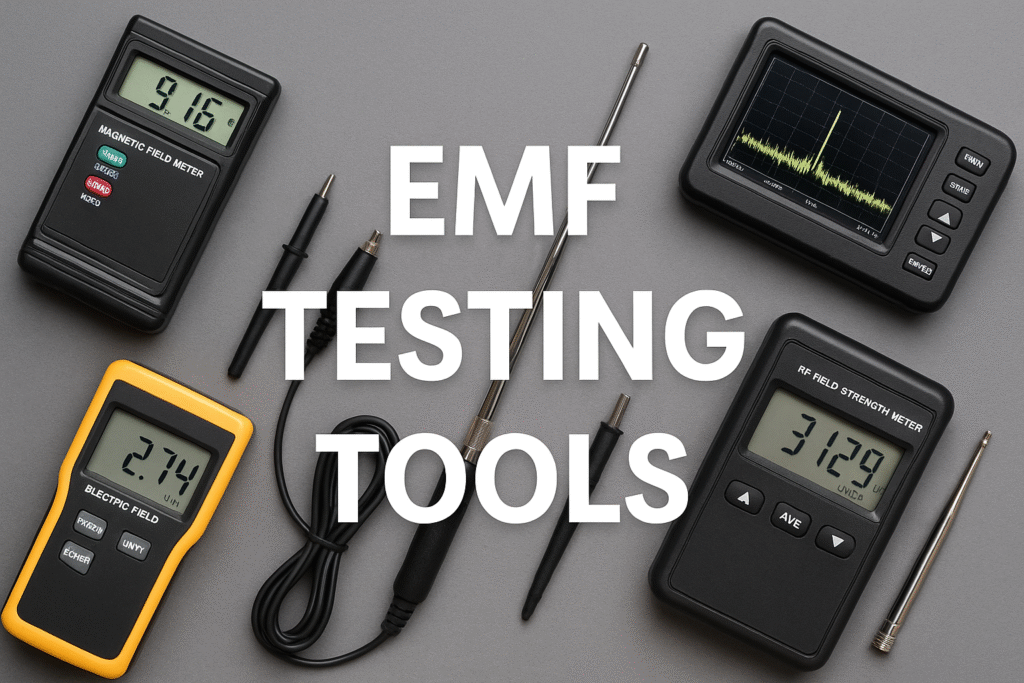
You do not need to spend $200 on a TriField TF2 to find out whether your microwave is leaking or which wall in your bedroom has elevated magnetic fields. If you are a curious first-timer who wants a rough picture of what is happening in your home, a budget EMF meter under $50 can get you there.
But you need to go in with the right expectations. At this price point, you are buying a screening tool, not a calibrated instrument. These meters will tell you “something is here” and give you a ballpark number. They will not give you the lab-grade accuracy or broad frequency coverage of professional equipment. That is a fair trade for most people who just want to identify hotspots around appliances, wiring, and wireless devices.
We looked at the most popular budget EMF meters currently available, checked their real specs against manufacturer documentation, and identified what each one actually measures (and what it misses). Here is what we found.
Quick Comparison: Budget EMF Meters Under $50
| Meter | What It Measures | Approx. Price | Key Limitation |
|---|---|---|---|
| ERICKHILL RT-100S | Electric field, magnetic field, RF | ~$45 | Single-axis; cannot detect 5 GHz WiFi |
| TESMEN Hound-200 | Electric field, magnetic field, RF | ~$40 | Requires 3 AAA batteries; single-axis |
| RDINSCOS RD630 | Electric field, magnetic field, RF | ~$35 | Lower RF sensitivity (max 19.99 mW/m²); requires hand contact for EF accuracy |
| K-II (K2) EMF Meter | Magnetic field only | ~$40–55 | No RF or electric field detection; LED-only display (no numerical readings) |
1. ERICKHILL RT-100S: Best Overall Budget Pick
The ERICKHILL RT-100S is the meter we would recommend to most people shopping under $50. It is a 3-in-1 detector that measures electric fields (EF), magnetic fields (MF), and radio frequency radiation (RF) simultaneously, displaying all three readings on screen at the same time.
Key specs from the manufacturer:
- Electric field range: 1 V/m and up, alarm threshold at 40 V/m
- Magnetic field range: 0.01 µT minimum (switchable between µT and mG), alarm at 0.4 µT (4 mG)
- RF measurement in mW/m², minimum detection 0.01 mW/m²
- Color-coded LCD display: green (safe), orange (caution), red (high)
- Built-in 1200 mAh rechargeable battery with USB-C charging, approximately 8 hours of use
- Auto shutoff after 5 minutes of inactivity
- 3-year warranty
What we like: The rechargeable battery is a genuine convenience advantage over the competition. You do not need to keep a stash of 9V or AAA batteries. The simultaneous three-field display means you can sweep a room once and get a quick picture of EF, MF, and RF without switching modes. The triple-alert system (sound, screen color, and indicator light) makes it easy to spot hotspots without staring at numbers.
What to know: This is a single-axis meter, which means you need to rotate and point it directly at the source for the most accurate reading. Professional meters use tri-axis sensors that capture all three directions at once. Additionally, the RT-100S cannot detect 5 GHz WiFi signals. It picks up 2.4 GHz WiFi and sub-6 GHz 5G signals, but the 5 GHz band used by many modern routers falls outside its detection range. If your primary concern is 5 GHz WiFi exposure, you will need a more expensive meter.
2. TESMEN Hound-200: Best Battery-Powered Alternative
The TESMEN Hound-200 is another 3-in-1 meter that covers electric fields, magnetic fields, and RF. It competes directly with the ERICKHILL RT-100S at a slightly lower price point, typically around $40.
Key specs from the manufacturer:
- RF range: 0.001 to 200 mW/m²
- Magnetic field range: 0.01 to 200 µT (or 0.1 to 2000 mG)
- Electric field range: 1 to 2000 V/m
- RF detection covers WiFi and 5G signals below 3.5 GHz
- 2.26-inch LCD with three-color backlight
- MAX measurement, Peak measurement, and Data Hold functions
- Powered by 3 AAA batteries (included)
- Auto power-off after 15 minutes of inactivity
- Dimensions: 2.17 x 1.18 x 5.51 inches; weight: 0.46 lb
What we like: The Hound-200 has a notably wide measurement range for this price tier, particularly the RF ceiling of 200 mW/m² and magnetic field range up to 200 µT. The MAX and Peak measurement modes are useful for catching intermittent spikes that a single reading might miss. It also ships with a storage case, which is a nice touch for a sub-$50 meter. The 15-minute auto-off timer is more generous than the ERICKHILL’s 5-minute window, giving you more time during extended sweeps.
What to know: The AAA battery requirement is a minor inconvenience compared to USB-C rechargeable meters. If you plan to use this regularly, you will want rechargeable AAAs. Like most budget meters, this is single-axis, and the RF detection tops out below 3.5 GHz, so 5 GHz WiFi is not covered. The display is slightly smaller than some competitors, though still readable.
3. RDINSCOS RD630: Lowest Price 3-in-1 Option
The RDINSCOS RD630 is the most affordable 3-in-1 EMF meter we found, typically available for around $35. It covers electric fields, magnetic fields, and RF in a compact package.
Key specs from the manufacturer:
- Bandwidth: 50 Hz to 3500 MHz
- Electric field range: 1 to 1999 V/m
- Magnetic field range: 0.1 to 999.9 mG (or 0.01 to 99.99 µT)
- RF range: 0.01 to 19.99 mW/m²
- Tri-color LCD display with audible alarm
- 9V battery powered
- Dimensions: 12 x 5 x 3.8 cm; weight: 249 g
- Auto power-off after 15 minutes (can be disabled)
- Remembers sound alarm preference between power cycles
What we like: At around $35, this is one of the cheapest ways to get a 3-in-1 EMF reading. The one-button operation makes it genuinely simple to use. The alarm-preference memory is a small but welcome detail; you do not need to silence the beeper every time you turn it on. The RD630C variant includes a carrying case.

What to know: The RF range tops out at just 19.99 mW/m², which is noticeably lower than the TESMEN Hound-200’s 200 mW/m² ceiling. If you are measuring near a cell tower or a powerful router, the RD630 may max out where the Hound-200 would still give you a number. You also need to hold the device in your hand for accurate electric field readings, because the human body acts as a grounding reference for the EF sensor. This is normal for budget meters, but worth knowing.
4. K-II (K2) EMF Meter: Magnetic Fields Only, but Proven
The K-II meter is one of the most recognizable EMF meters on the market, largely because of its popularity in paranormal investigation communities. It is made in the USA, and it has been around for years. It is not a 3-in-1 meter. It measures magnetic fields only.
Key specs from the manufacturer:
- Detection range: 0 to 20+ milliGauss
- Frequency range: 50 Hz to 20,000 Hz (ELF and VLF bands)
- Accuracy: ±5% at 50-60 Hz
- Display: 5 LED lights (green, green, yellow, orange, red) indicating milliGauss ranges
- Single 9V battery
- Designed and manufactured in the USA
- Deluxe version includes push-on/push-off switch (standard version requires holding the button)
What we like: The K-II is extremely responsive to magnetic field fluctuations. It lights up instantly when you move near a source, which makes it excellent for quickly scanning a room to find magnetic field hotspots around wiring, motors, and appliances. It is simple enough that anyone can use it without reading a manual. The LED display works well in both dark and bright conditions. Build quality is solid, and the made-in-USA manufacturing is a legitimate quality indicator for this particular product.
What to know: The K-II does not measure electric fields, and it does not detect RF radiation at all. If you want to check WiFi routers, cell phones, or smart meters for RF output, you need a different meter. The LED display gives you a general range, not a precise number. You will see “mid” or “high” rather than “4.7 mG.” Pricing varies quite a bit depending on the seller; the standard model can be found around $40, while the deluxe version with the on/off switch runs closer to $50-55. Be cautious about cheap knockoffs sold on marketplace sites; the genuine K-II is made by K-II Enterprises.

What You Give Up at This Price Point
Budget meters are useful screening tools, but honesty matters here. There are real differences between a $35 meter and a $175 TriField TF2 or a $120 GQ EMF-390.
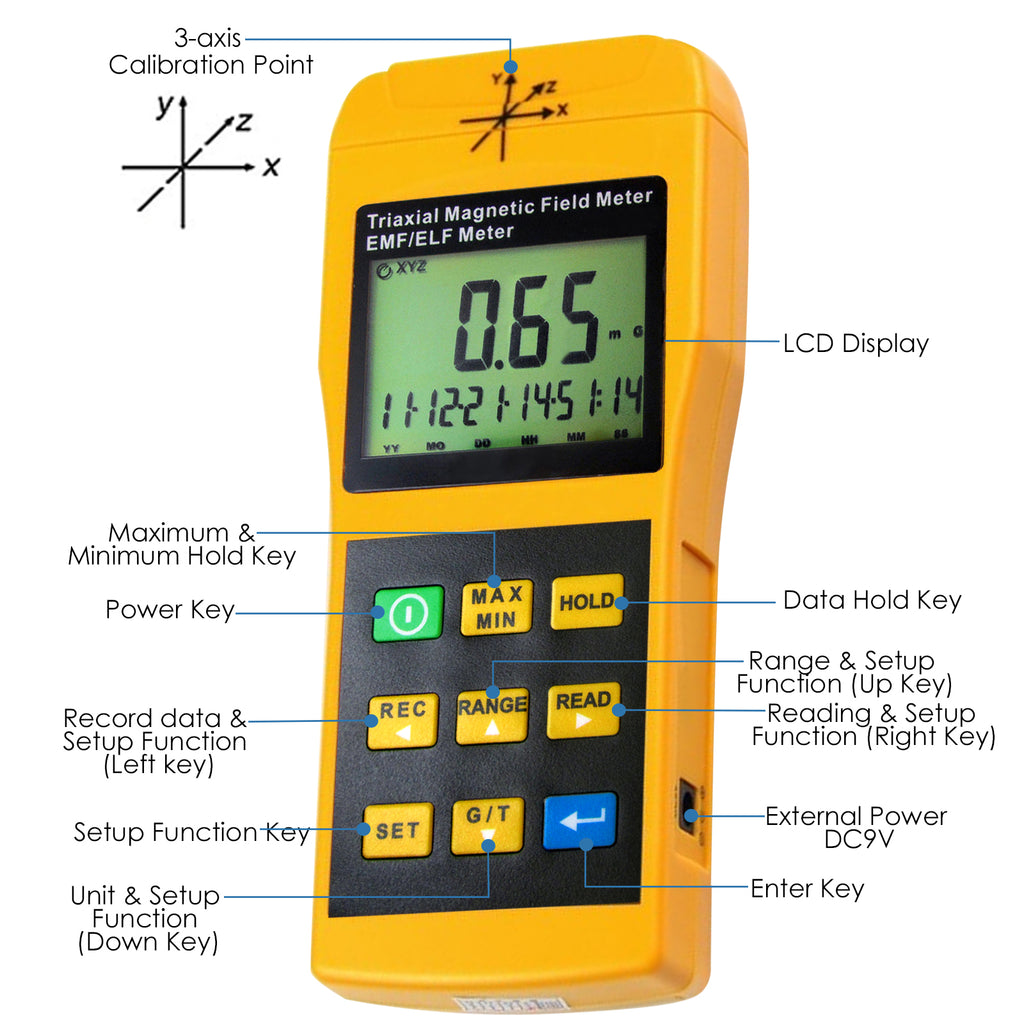
Single-axis vs. tri-axis sensors. Every meter on this list uses a single-axis sensor for magnetic field measurement. That means you have to rotate the meter in three orientations and take the highest reading. A tri-axis meter like the TriField TF2 captures all three axes simultaneously and gives you the true combined reading. Single-axis meters can underreport by a significant margin if you do not rotate carefully.
Narrower RF frequency coverage. Budget meters typically cover RF up to about 3.5 GHz. That catches 2.4 GHz WiFi, Bluetooth, sub-6 GHz 5G, and most cellular bands. But it misses 5 GHz WiFi entirely, and none of these meters can detect millimeter-wave 5G (24-39 GHz). A meter like the GQ EMF-390 (around $120) covers up to 10 GHz, giving you substantially broader RF visibility.
No calibration certificate. Professional meters come with factory calibration documentation and some offer recalibration services. Budget meters are assembled in bulk, and while they are reasonably consistent unit to unit, you have no formal verification that your specific device reads accurately. For home curiosity, this is fine. For any professional or legal purpose, it is not.
Lower sensitivity floors. Budget meters cannot detect very low levels of EMF that might still be relevant in certain contexts. The minimum detection thresholds (for example, 1 V/m for electric fields or 0.01 µT for magnetic fields) are adequate for identifying obvious sources, but they will not pick up the faint background readings that a Gigahertz Solutions meter would register.
Build quality and longevity. These are plastic consumer devices, not ruggedized test instruments. The sensors can drift over time, especially if the meter is dropped or stored in extreme temperatures. Expect a useful lifespan of a few years with careful handling.
Is a Budget EMF Meter Worth It?
Yes, with the right expectations.

A budget EMF meter is worth it if you want to answer questions like: “Is there elevated EMF near my bed?” or “Which of my appliances puts out the most magnetic field radiation?” or “Is my microwave leaking?” These meters will reliably show you the difference between a low-EMF area and a high-EMF area. They will help you identify which devices and wiring runs are the biggest contributors.
A budget meter is not the right tool if you need precise measurements for a building biology assessment, if you are trying to verify compliance with specific exposure standards, or if you need to identify and measure specific frequency sources. For those use cases, you need something in the $100-$300 range (the GQ EMF-390 and TriField TF2 are the most common recommendations at those price points).
Think of a budget meter like a kitchen thermometer versus a lab thermometer. The kitchen thermometer will tell you whether your chicken is cooked. It might be off by a degree or two. That is fine for cooking. It is not fine for calibrating industrial equipment. Same principle here.
Frequently Asked Questions
Can a budget EMF meter detect WiFi radiation?
The 3-in-1 meters on this list (ERICKHILL RT-100S, TESMEN Hound-200, RDINSCOS RD630) can all detect 2.4 GHz WiFi signals in their RF mode. However, none of them detect 5 GHz WiFi, which is the band used by most modern dual-band routers for faster connections. The K-II meter does not detect any RF radiation at all. If 5 GHz WiFi measurement is important to you, you will need to step up to a meter like the GQ EMF-390.
What is the difference between single-axis and tri-axis?
A single-axis meter measures the magnetic field in one direction at a time. To get an accurate reading, you need to rotate the meter in three orientations (X, Y, Z) and use the highest reading, or calculate the combined value. A tri-axis meter measures all three directions simultaneously and gives you the true total field strength. Every meter under $50 uses single-axis sensors. Tri-axis meters generally start around $100 and up.
Do budget EMF meters detect 5G?
Budget meters with RF capability can detect sub-6 GHz 5G signals, which is the band used by most 5G cell towers in the US for broad coverage. They cannot detect millimeter-wave (mmWave) 5G, which operates at 24-39 GHz and is used for high-density urban deployments. No consumer-grade EMF meter under $300 can measure mmWave 5G signals.
How accurate are budget EMF meters?
Budget meters are generally accurate enough to distinguish between low, moderate, and high EMF areas. The K-II claims plus or minus 5% accuracy at 50-60 Hz. The 3-in-1 budget meters do not typically publish detailed accuracy specifications. Expect readings that are in the right ballpark but may differ from a calibrated professional meter by a meaningful margin. For identifying hotspots and comparing relative levels around your home, this level of accuracy is adequate.
Should I buy a 3-in-1 meter or a magnetic-field-only meter?
For most people, a 3-in-1 meter offers better value because it lets you check electric fields, magnetic fields, and RF with one device. The K-II meter is a solid choice only if you specifically want to measure magnetic fields and do not care about RF or electric field detection. If you are concerned about wireless devices (routers, cell phones, smart meters), you need a meter with RF capability, which means one of the 3-in-1 options.
Can I use a budget EMF meter to test my smart meter?
A 3-in-1 budget meter can detect RF pulses from a smart meter. Smart meters typically transmit in the 900 MHz or 2.4 GHz range, both of which fall within the RF detection range of the meters on this list. Keep in mind that smart meters transmit in short bursts rather than continuously, so you may need to hold the meter near the smart meter for a minute or two to catch a transmission. The reading will give you a general sense of the RF output level, though not a precise measurement of peak power.
Our Top Pick
The ERICKHILL RT-100S is the best budget EMF meter under $50 for most people. It measures all three types of EMF (electric, magnetic, and RF), has a rechargeable battery with USB-C charging, and displays all readings simultaneously on a color-coded screen. At around $45, it offers the best combination of features, usability, and value in this price range.
If you want to save a few more dollars, the RDINSCOS RD630 at around $35 covers the same three measurement types but with a lower RF ceiling and a 9V battery instead of rechargeable. The TESMEN Hound-200 at around $40 splits the difference with wider measurement ranges than the RD630 and a compact form factor.
Whichever meter you choose, remember that you are buying a screening tool. Use it to identify the hotspots, then decide whether you want to invest in a more precise meter for follow-up measurements. For most people doing their first home EMF check, any of these four meters will get the job done.
These statements have not been evaluated by the Food and Drug Administration. This information is not intended to diagnose, treat, cure, or prevent any disease. Content is for informational purposes only and is not medical advice; consult a qualified healthcare provider before starting any supplement. As an Amazon Associate we earn from qualifying purchases.