If you have recently spotted a new 5G tower near your house, you are not alone in wanting to understand what it means for your home environment. Across the country, wireless carriers are rolling out thousands of new antenna installations, from tall macro towers to small cell units mounted on utility poles right in residential neighborhoods. Whether you are simply curious or actively concerned about radio frequency exposure, the practical question is the same: how much RF energy is reaching your living space, and what can you do about it?
This guide walks through the three types of 5G infrastructure, how to find out exactly what is installed near you, how to measure RF levels inside your home, what the regulatory limits actually say, and the shielding options that can meaningfully reduce your exposure.
The Three Types of 5G: What Is Actually Near Your Home
Not all 5G is the same. Carriers deploy three distinct spectrum bands, and each one behaves very differently when it comes to range, signal strength, and how much RF energy reaches the inside of a building. Understanding which type of 5G tower is near your house helps you gauge what kind of exposure you are actually dealing with.
Low-Band 5G (600 to 900 MHz)
Low-band 5G operates in the 600 to 900 MHz range and behaves similarly to existing 4G LTE signals. A single tower can cover hundreds of square miles, making it the backbone of rural and suburban 5G coverage. These lower frequencies penetrate buildings effectively, reaching basements and interior rooms with relative ease. Speeds top out around 100 Mbps, which is only modestly faster than 4G. If you live in a suburban or rural area, the 5G infrastructure near your home is most likely operating on low-band spectrum.
Mid-Band 5G / C-Band (1 to 6 GHz)
Mid-band 5G, including the heavily deployed C-band around 3.7 GHz, is what most urban and suburban users experience as “real 5G” today. It delivers noticeably faster speeds (up to roughly 1 Gbps) with lower latency than low-band. Coverage per tower is moderate, not nearly as far-reaching as low-band, but still capable of serving entire neighborhoods. Mid-band signals do penetrate buildings, though not as effectively as low-band. Walls, low-E glass, and insulation reduce signal strength measurably. This is the most common type of new 5G tower installation in populated areas.
High-Band / mmWave 5G (24 GHz and Above)
Millimeter wave (mmWave) 5G operates at frequencies above 24 GHz, typically at 28 or 39 GHz. It delivers the fastest speeds (potentially several gigabits per second) but has extremely limited range and very poor building penetration. Trees, vehicles, heavy rain, and even standard window glass block mmWave signals substantially. Carriers deploy mmWave almost exclusively in dense urban pockets like stadiums, airports, and busy downtown corridors, not in residential neighborhoods. If you see a small cell unit on a utility pole near your home, it is far more likely to be a mid-band installation than mmWave.
The practical takeaway: the type of 5G signal most likely to reach the inside of your house is low-band or mid-band. MmWave, despite generating the most dramatic headlines, struggles to get through a standard exterior wall.
How to Find Out If There Is a 5G Tower or Small Cell Near You
Before investing in testing equipment or shielding products, it helps to confirm exactly what infrastructure is nearby. There are several ways to do this.
FCC Antenna Structure Registration Database
The FCC maintains a public Antenna Structure Registration (ASR) database that logs registered towers and antenna structures across the United States. You can search by geographic coordinates or within a radius of your address using the ASRN Within a Radius tool on the FCC website. Each result includes the structure’s location, height, and registration details. Keep in mind that smaller structures (like small cells on utility poles) may not always appear in the ASR database if they fall below registration thresholds, but it remains the most authoritative starting point.
Third-Party Tower Maps
Sites like AntennaSearch and CellTowerInfo pull from FCC data and overlay tower locations on maps, making it easier to visualize what is near your home. Some also include carrier-specific information, so you can see which provider operates each site.
City and County Permit Records
Many municipalities require permits for new antenna installations. Check your city or county planning department’s website for recent wireless infrastructure permits. Small cell installations on utility poles often require local permits, and these records can tell you when equipment was installed, which carrier filed, and the type of equipment approved.
Visual Inspection
Small cell equipment is typically a rectangular box (roughly the size of a large pizza box or small suitcase) mounted on a utility pole, streetlight, or traffic signal pole. They often have associated cables running down the pole and a small power supply at the base. If you notice new equipment appearing on poles in your neighborhood, that is likely a small cell installation rather than a traditional macro tower.
How to Test Your Home’s RF Exposure
Once you know what is nearby, the next step is measuring what is actually reaching the inside of your home. RF levels vary significantly based on distance, building materials, time of day, and network load. The only way to know your actual exposure is to measure it.
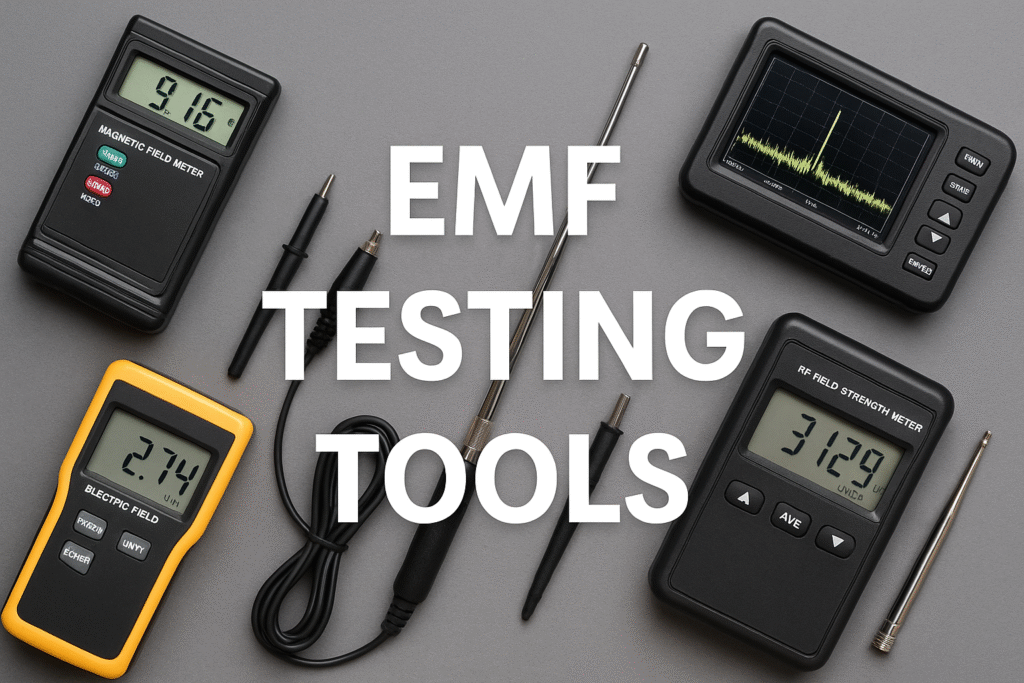
Choosing an RF Meter
There are two main categories of meters for home use:
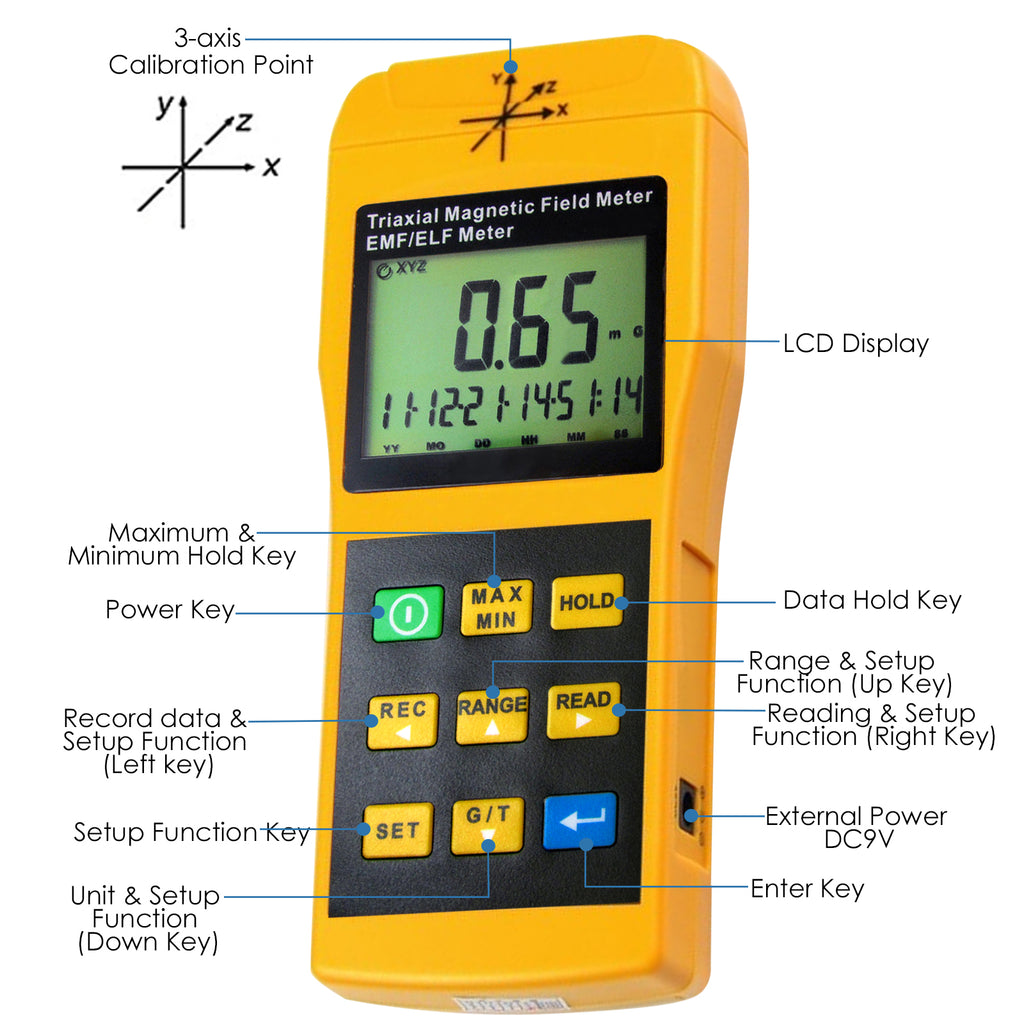
Combo meters like the TriField TF2 (around $170) or the Cornet ED88T Plus (around $180) measure multiple field types: AC magnetic, AC electric, and RF radiation. The TriField TF2 covers the RF range from 20 MHz to 6 GHz, which includes Wi-Fi, Bluetooth, 4G, and most low-band and mid-band 5G frequencies. These are the best starting point for most homeowners because they give you a broad picture of your electromagnetic environment in a single device.
Dedicated RF meters like the Safe and Sound Pro II (around $400) or the Acoustimeter AM-10 offer greater sensitivity and accuracy for wireless radiation specifically. If your primary concern is cell tower exposure, a dedicated RF meter will give you more reliable readings at the lower power levels you are likely measuring indoors. The Acoustimeter also provides audio feedback that makes it easier to identify and locate specific RF sources.

How to Conduct a Home RF Survey
A systematic room-by-room approach gives you the most useful data:
Start in the bedroom. This is where cumulative exposure matters most since you spend a third of your day there. Take readings at pillow height on both sides of the bed and near any electronics within a few feet of where you sleep.
Measure at windows facing the tower. Windows are the weakest point in most buildings for RF shielding. Glass transmits RF energy far more readily than brick, concrete, or insulated walls. Stand directly at the window, then step back in measured increments to see how readings change with distance.
Check multiple times of day. Cell tower output varies with network demand. Rush hour and evening streaming peaks can produce noticeably higher readings than early morning or midday. Take readings during both high and low traffic periods for a realistic picture.
Note your meter’s orientation. Many consumer RF meters, including the TriField TF2, use a single-axis RF antenna. Point the front of the meter toward the suspected source, and avoid standing between the meter and the tower. Moving the meter in a slow figure-eight pattern can help ensure you capture the peak reading.
Record peak and average values. RF signals from cell towers pulse and fluctuate. The peak reading tells you the maximum exposure, while the average reading over 30 seconds to a minute gives you a more representative picture of typical exposure levels.
Understanding the Regulatory Limits
Understanding what the numbers on your meter mean requires knowing what the regulatory bodies have set as their limits, and why those limits are debated.
FCC and ICNIRP Guidelines
In the United States, the FCC’s maximum permissible exposure (MPE) limits for the general public are codified in 47 CFR 1.1310. For frequencies between 30 and 300 MHz (where the body absorbs RF energy most efficiently), the limit is 0.2 mW/cm2. For frequencies from 1,500 MHz to 100 GHz, which covers most 5G bands, the limit is 1.0 mW/cm2. For localized exposure above 6 GHz (relevant to mmWave), the limit is 4 mW/cm2. All of these are averaged over 30 minutes. Internationally, the ICNIRP sets similar guidelines, with a general public limit of 10 W/m2 (equivalent to 1 mW/cm2) at 2 GHz.
These limits were adopted by the FCC in 1996 based on recommendations from the National Council on Radiation Protection (NCRP) and the IEEE, and they are designed to prevent established thermal effects: the heating of body tissue by RF energy.

The Ongoing Debate
Whether these limits are conservative enough is a genuinely open question with credible voices on both sides.
On one side, organizations like the ICNIRP and the IEEE maintain that the extensive body of research supports the conclusion that RF exposure within their guidelines does not cause adverse health effects. Their standards are built on established, replicated biological effects and include substantial safety margins.
On the other side, groups like the BioInitiative Working Group and the International Commission on the Biological Effects of EMF (ICBE-EMF) argue that current standards only account for thermal (heating) effects and do not adequately address potential non-thermal biological effects reported in some research, such as oxidative stress and cellular changes. The BioInitiative Working Group, which reviewed over 3,800 studies, recommends exposure limits several orders of magnitude lower than current FCC and ICNIRP guidelines.
This is not a settled scientific debate. What you can say with confidence is that typical residential RF levels from a nearby cell tower are generally well below even the current FCC limits. Whether those limits themselves are set at the right level is a question that research continues to investigate.
Home Protection Options: Reducing RF Exposure
If your testing reveals RF levels you want to reduce, or if you simply prefer to minimize exposure as a precaution, there are several proven shielding approaches. These work on straightforward physics: conductive materials reflect and absorb RF energy.
RF Shielding Window Film
Windows are the primary entry point for RF energy in most homes. Standard glass does very little to attenuate radio frequency signals. RF shielding window film contains embedded metallic elements, typically copper, silver, or aluminum, arranged in microscopic patterns that reflect and absorb RF energy while still allowing visible light through.
Quality RF window films provide 20 to 50 dB of RF attenuation depending on the product. For reference, 20 dB equals a 99% reduction in signal power, 30 dB equals 99.9%, and 40 dB equals 99.99%. Products like the Signal Defense Window Film and Blocsilver 80 are well-regarded options in this category. Most films also provide UV protection and solar heat rejection as secondary benefits.
Proper installation matters significantly. Gaps around window frames and unsealed edges can allow RF to bypass the shielded glass. Professional installation with proper edge sealing typically achieves 80 to 90% of the film’s rated attenuation.
EMF Shielding Curtains
Shielding curtains are made from fabric woven with metallic threads, usually silver, copper, or nickel blended with polyester. When closed, they can provide 15 to 30 dB of RF reduction, with higher-end products like the Mission Darkness TitanRF line claiming 80 dB or more of attenuation using military-grade Faraday fabric.
Curtains have the advantage of flexibility. You can open them during the day and close them at night. For maximum effectiveness, use full-length curtains that reach the floor and overlap by at least six inches in the center to prevent leakage around the edges. Shielding curtains work particularly well in combination with window film for layered protection.
EMF Shielding Paint
For the wall (or walls) that face the tower, shielding paint is one of the most effective single interventions available. These paints contain conductive particles, typically carbon black or nickel, suspended in a standard latex or acrylic base. When applied and properly grounded, they create a continuous conductive layer that reflects RF radiation.
Quality shielding paints like YShield HSF54 or CuPro-Cote provide 20 to 40+ dB of RF reduction per coat, effective across frequencies from roughly 50 MHz to 18 GHz or higher. One to two coats are typically sufficient. The paint can be covered with standard interior paint or wallpaper without losing effectiveness. For best results, the conductive layer should be electrically grounded by connecting it to your home’s grounding system.
Distance and Room Reallocation
The simplest and least expensive approach is often the most overlooked: rearrange how you use your rooms. RF energy follows the inverse square law, meaning intensity drops rapidly with distance. If your bedroom has a direct line of sight to a nearby cell tower, consider swapping your bedroom with another room on the opposite side of the house. Moving your bed away from the tower-facing wall, even by a few feet, can reduce exposure meaningfully. This costs nothing and can be done immediately while you evaluate other options.
A Layered Approach
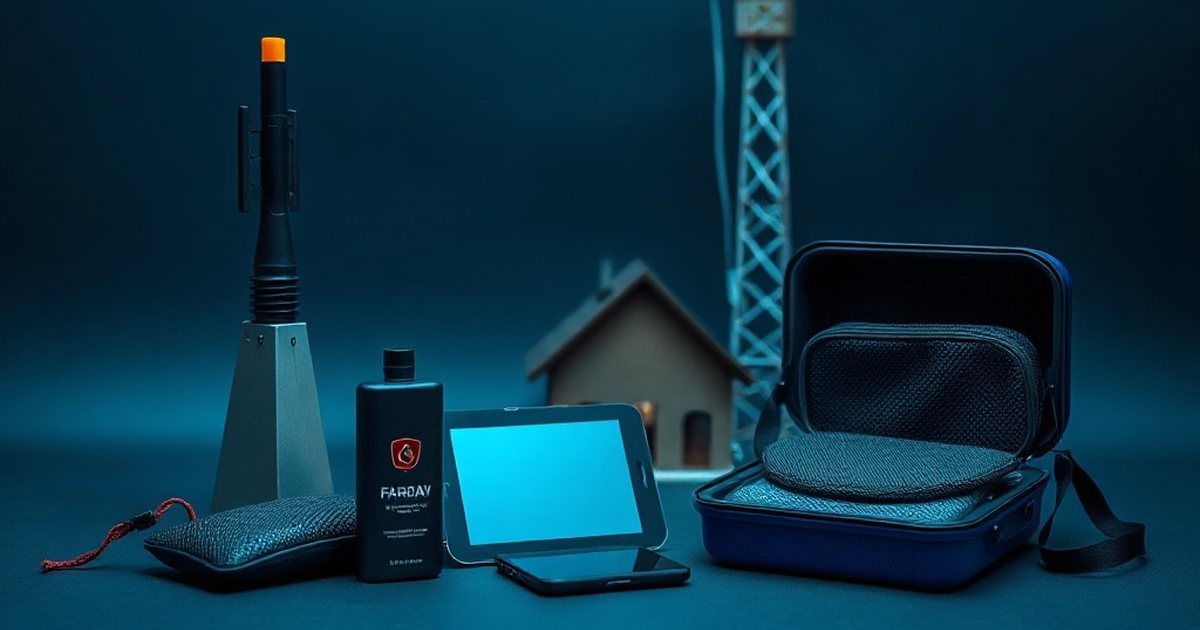
The most effective strategy combines multiple methods. Apply shielding paint to the tower-facing wall, install RF window film on the windows in that wall, and add shielding curtains for additional nighttime protection. Together, these create a substantially shielded boundary on the side of your home closest to the tower, without requiring you to turn your entire house into a Faraday cage.
Frequently Asked Questions
How close is too close to a 5G tower?
There is no universally agreed-upon safe distance because RF exposure depends on tower power output, frequency band, antenna direction, and your building’s construction. The only reliable way to assess exposure is to measure it with an RF meter inside your home. Many people living within a few hundred feet of a small cell find that indoor readings remain well below FCC limits, especially in well-insulated homes.
Can 5G signals go through walls?
It depends on the frequency band. Low-band 5G (600 to 900 MHz) penetrates walls readily, similar to 4G. Mid-band 5G (1 to 6 GHz) penetrates moderately but is reduced by exterior walls, insulation, and low-E glass. High-band mmWave 5G (24 GHz and above) has very poor wall penetration and is largely blocked by standard building materials, including regular window glass.
Do 5G small cells on utility poles emit more radiation than macro towers?
Small cells actually operate at lower power levels than traditional macro towers. However, they are often mounted much closer to homes, sometimes just 30 to 50 feet from a building. The combination of lower power but closer proximity means the RF levels at your home could be comparable to, or in some cases higher than, what you would receive from a distant macro tower.
What RF levels should I be concerned about in my home?
The FCC’s general public limit for frequencies above 1,500 MHz is 1.0 mW/cm2 averaged over 30 minutes. Most building biology practitioners recommend substantially lower levels, particularly in sleeping areas. The Building Biology Institute suggests levels below 10 microwatts per square meter in sleeping areas as a precautionary target. Your RF meter readings will help you determine where your home falls relative to these reference points.
Will shielding my home block my cell phone and Wi-Fi signal?
If you shield all walls and windows, yes, indoor cell reception and Wi-Fi from outside sources will be reduced. Most people shield only the tower-facing wall and its windows, which reduces exposure from that direction while leaving the rest of the home open for cellular reception. Your own indoor Wi-Fi router will continue to work normally since it is inside the shielded area.
Is the TriField TF2 good enough for 5G testing?
The TriField TF2 covers frequencies up to 6 GHz, which includes low-band and most mid-band 5G frequencies. It will not detect mmWave 5G signals (24 GHz and above), but those frequencies do not penetrate buildings well and are rarely deployed in residential areas. For most homeowners concerned about a nearby 5G tower, the TF2 provides a solid starting point at a reasonable price.
Does EMF shielding paint really work?
Yes. Quality EMF shielding paint uses conductive particles (carbon, nickel, or copper) that create a continuous conductive barrier when applied. Independent testing shows 20 to 40+ dB of RF attenuation per coat across a wide frequency range. Unlike some products in the EMF space that rely on unverifiable claims, shielding paint works on well-established electromagnetic principles. The key is proper application: full coverage without gaps, and electrical grounding for optimal performance.
Should I hire a professional EMF consultant?
If you are unsure about interpreting your meter readings, or if you want a comprehensive assessment of all EMF sources in your home (not just RF from cell towers), a certified Building Biology Environmental Consultant can provide a thorough evaluation with professional-grade equipment. They can also design a targeted shielding plan specific to your home’s construction and the direction of the RF source. This is especially worthwhile if you are considering significant investments in shielding paint or window film.
Taking Control of Your Home RF Environment
Having a 5G tower near your house does not automatically mean your indoor RF exposure is high. Building materials, distance, antenna direction, and the frequency band in use all play significant roles in determining what actually reaches your living space. The steps outlined in this guide give you a clear path forward: identify what is nearby, measure what is reaching your home, understand the regulatory landscape and its limitations, and take targeted action where your readings suggest it is warranted.
Start with the least expensive steps first. Check the FCC database and your local permit records. Borrow or purchase a basic RF meter and survey your home. If the readings concern you, shielding the tower-facing wall and its windows with paint, film, and curtains can provide meaningful reduction. The technology behind RF shielding is well-established, and the products available today make it accessible for any homeowner willing to invest a weekend and a modest budget.
These statements have not been evaluated by the Food and Drug Administration. This information is not intended to diagnose, treat, cure, or prevent any disease. Content is for informational purposes only and is not medical advice; consult a qualified healthcare provider before starting any supplement. As an Amazon Associate we earn from qualifying purchases.