Calls are the one thing most people do with a phone pressed against the side of the head. Changing how you take them changes where the phone’s antenna sits relative to you.
Holding a phone to your head puts the antenna as close to your head as it can get: RF absorption is greatest on the side of the head where the phone is held and falls to less than one-tenth on the opposite side [1].
Watch our quick tip on YouTube Shorts
Get our complete guide with room-by-room strategies and product recommendations.
Why a few inches of air changes the picture
A phone’s antenna is a small radio transmitter, and the energy it sends out is strongest right at the antenna and falls away fast as you move from it. When the phone is flat against your ear, the nearest tissue sits as close to that antenna as it can. Move the phone even a short way off and the same transmission lands on far less of you.
Speaker or a headset puts distance between the phone and your head
Add distance during calls.
Household appliances measured in Japan; the authors found fields fall drastically with distance and do not track the appliance's power rating. Radio sources fall off with distance too, though more gradually. Source: IEEJ Transactions on Fundamentals and Materials (2009)
Data table
| Item | Value |
|---|---|
| Hairdryer at 3 cm | 16.34 µT |
| Hairdryer at 30 cm | 0.16 µT |
| Hairdryer at 60 cm | 0.02 µT |
| Vacuum cleaner at 3 cm | 15.98 µT |
| Vacuum cleaner at 30 cm | 0.97 µT |
| Vacuum cleaner at 60 cm | 0.04 µT |
Chart: frequencyblockers.com: Speaker or a headset puts distance between the phone and your head
Embed this chart
Free to reuse on your site. Copy the code below; please keep the credit link.
A WHO-commissioned review found moderate certainty that head-held phone use likely does not increase the risk of glioma in adults [2]. Your phone’s own manual recommends keeping the device 5-15mm from your head: holding it against your ear provides 0mm of distance.
That is the logic behind the tips below: you are not blocking anything, you are just adding distance, which is free and works for any phone.
Ways to take calls without holding the phone to your head
- Use speakerphone whenever you are somewhere you can talk openly, and hold the phone in front of you or set it on a table.
- Use wired earphones with a built-in microphone. Air tube headphones carry the sound through a hollow tube, so the part near your ear has no radio in it.
- Text or send a voice message when a call is not needed, so the phone stays in a bag or pocket.
- Set calls to switch to speaker automatically so the habit does not rely on remembering.
On iPhone, you can set calls to automatically switch to speaker mode: Settings > Accessibility > Touch > Call Audio Routing to Speaker.
DefenderShield Air Tube Headphones
Air tube headphones let you take calls with the phone held away from your head, and the hollow tube means no wire runs right up to the ear.
Wireless earbuds are a trade, not a solution: the radio simply moves from the phone to the earpiece, and the earpiece sits in your ear. That is why wired options are the ones this tip recommends.


How to check the effect
An RF meter held at ear position will show the difference between a call on speaker and a call held up, but only roughly: the phone changes its own power depending on signal, so take a few readings in the same spot and compare the pattern, not a single number. Check the setup against what you actually do on a typical day rather than a one-off test.
What the research says about call habits
Research note: The FCC’s general-population SAR limit is 1.6 W/kg as a peak spatial average over any 1 gram of tissue, plus 0.08 W/kg averaged over the whole body [8].
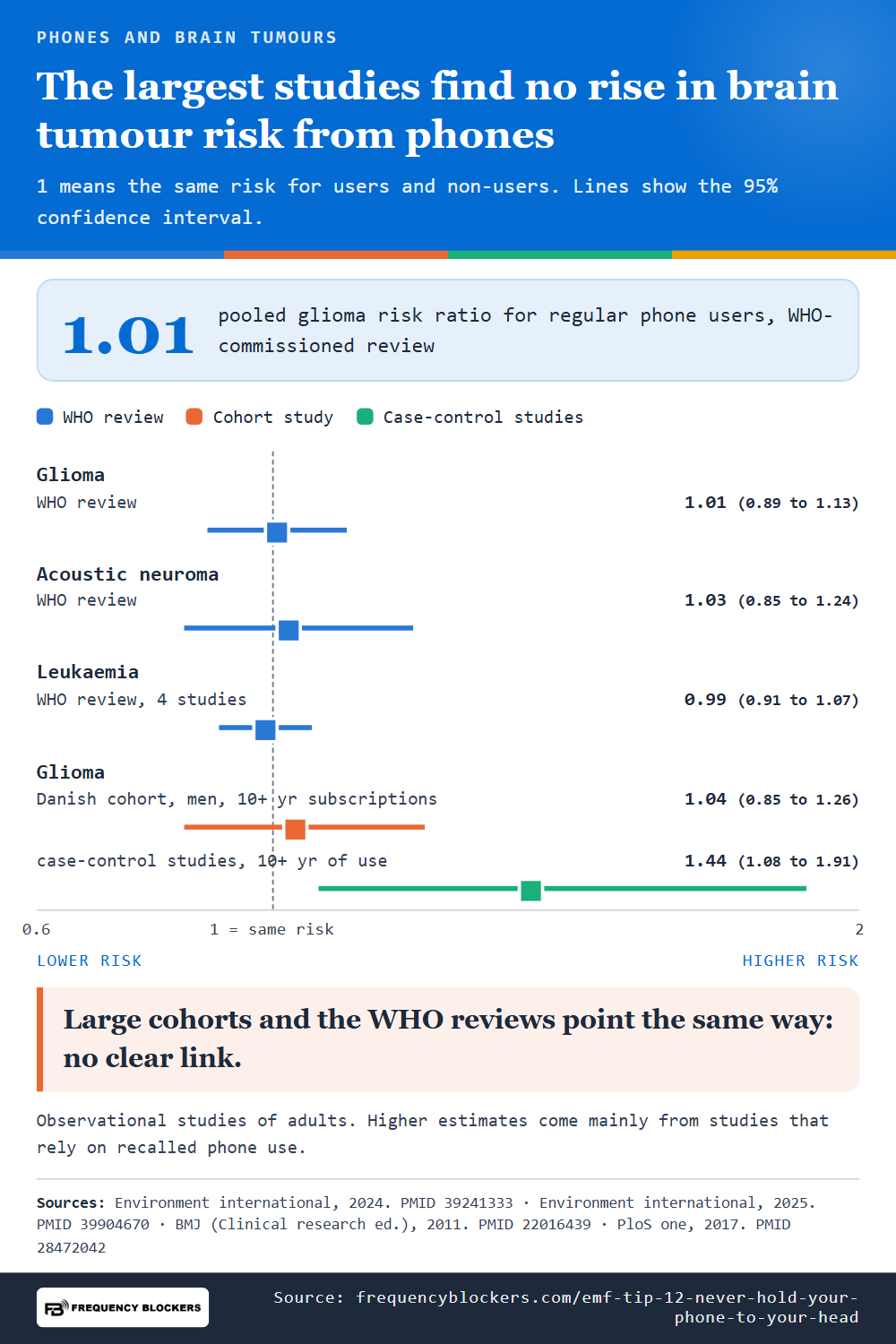
Infographic: frequencyblockers.com: The largest studies find no rise in brain tumour risk from phones
Embed this infographic
Free to reuse on your site. Copy the code below; please keep the credit link.
For context on the cancer question: the COSMOS cohort of 264,574 participants found no association between cumulative call time and glioma, meningioma or acoustic neuroma. Some case-control studies reported higher odds in the heaviest users, for example an odds ratio of 1.40 in INTERPHONE top decile of recalled call time (1640 hours or more), but the authors flagged implausible reported use in that group [5][6].
The IARC rating rested on limited evidence about brain cancer risk. A later WHO-commissioned meta-analysis found that ever or regular mobile phone use was not associated with glioma risk (pooled relative risk 1.01, confidence interval 0.89-1.13), and the US National Cancer Institute says the evidence to date suggests cell phone use does not cause brain or other kinds of cancer in humans [3][2][7].
Taken together, the evidence does not show a harm from taking calls normally. Holding the phone away from your head is a cheap precaution that costs nothing and is easy to keep up, and it is worth judging on those terms.

Ready for More EMF Protection Tips?
Our complete guide includes 100 actionable strategies for every room in your home, plus product recommendations from our curated collection.
Frequently Asked Questions
What are the health risks of holding your phone to your head?
When you hold your phone against your head, you’re exposing your brain to RF (radiofrequency) radiation from a microwave transmitter. Research dating back to the 1960s by Allan Frey showed that RF exposure can affect the blood-brain barrier, which is why reducing this direct contact is crucial for your health.
What practical solutions can I use instead of holding my phone to my ear?
The simplest solution is to use air tube headphones, which deliver sound through hollow tubes rather than electromagnetic radiation. You can also use your phone on speakerphone, hold it away from your head during calls, or use text-based communication whenever possible to implement the DISTANCE principle of EMF protection.
How does the distance principle help reduce EMF exposure?
The DISTANCE principle works because electromagnetic field strength decreases significantly the farther you move away from the source. By keeping your phone away from your head rather than pressed directly against your skull, you can dramatically reduce your daily RF exposure without requiring special equipment or lifestyle changes.
Is there scientific evidence that holding phones to your head causes harm?
Not clearly. A WHO-commissioned meta-analysis found that ever or regular mobile phone use was not associated with glioma risk (pooled relative risk 1.01, confidence interval 0.89-1.13), and IARC rated radiofrequency fields as possibly carcinogenic (Group 2B) on limited evidence about brain cancer [2][3][4]. While studies continue, the existing evidence from decades of research supports taking precautions like avoiding direct phone-to-head contact as a reasonable protective measure.
References
- ICNIRP (International Commission for Non-Ionizing Radiation Protection) Standing Committee on Epidemiology: et al. Epidemiology of Health Effects of Radiofrequency Exposure. Environmental Health Perspectives (2004). PMID 15579422
- Karipidis K et al. The effect of exposure to radiofrequency fields on cancer risk in the general and working population: A systematic review of human observational studies – Part I: Most researched outcomes. Environment international (2024). PMID 39241333
- Mireille B. Toledano et al. Cohort profile: UK COSMOS, a UK cohort for study of environment and health. International Journal of Epidemiology (2015). PMID 26534947
- International Agency for Research on Cancer IARC classifies radiofrequency electromagnetic fields as possibly carcinogenic to humans (Press release 208). International Agency for Research on Cancer (2011). source
- Feychting M et al. Mobile phone use and brain tumour risk – COSMOS, a prospective cohort study. Environment international (2024). PMID 38458118
- International journal of epidemiology Brain tumour risk in relation to mobile telephone use: results of the INTERPHONE international case-control study. International journal of epidemiology (2010). PMID 20483835
- US National Cancer Institute Cell Phones and Cancer Risk. US National Cancer Institute (current). source
- US Electronic Code of Federal Regulations (FCC) 47 CFR 1.1310 Radiofrequency radiation exposure limits. US Electronic Code of Federal Regulations (FCC) (current). source
These statements have not been evaluated by the Food and Drug Administration. This information is not intended to diagnose, treat, cure, or prevent any disease. Content is for informational purposes only and is not medical advice; consult a qualified healthcare provider before starting any supplement. As an Amazon Associate we earn from qualifying purchases.