Spectrum Scanners: A Complete Guide to Advanced Wireless Signal Detection
Wireless environments are becoming increasingly complex. Homes, offices, schools, and public spaces contain dozens—sometimes hundreds—of simultaneous wireless transmissions. Wi-Fi mesh networks, Bluetooth devices, cellular 4G/5G bands, IoT devices, baby monitors, security systems, and industrial wireless nodes all contribute to the RF landscape. For users who need to identify, analyze, and visualize these signals with precision, Spectrum Scanners provide one of the most advanced tools available.
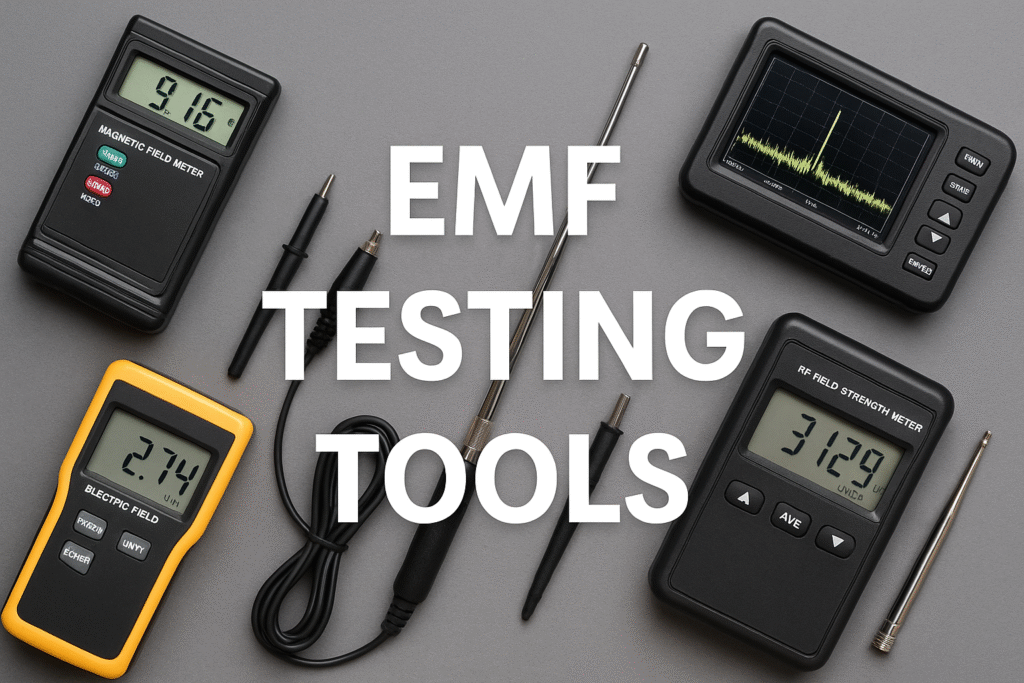
Spectrum Scanners allow you to see the RF spectrum in real time, identifying individual signals, their strength, their frequency location, and how they behave over time, using RF spectrum measurement techniques consistent with those established by national metrology bodies.[1] These tools are widely used by EMF consultants, researchers, RF engineers, and advanced home assessors. For a complete overview of EMF testing equipment, visit:
https://frequencyblockers.com/emf-testing-tools/
What Spectrum Scanners Measure
Spectrum Scanners scan wireless frequencies to detect:
- Wi-Fi (2.4 GHz, 5 GHz, 6 GHz)
- Bluetooth signals
- Cellular bands (700 MHz–6 GHz)
- Smart meters
- IoT devices
- RF interference patterns
- Wireless cameras and baby monitors
- Radar-based technologies
- Nearby 5G infrastructure (sub-6 GHz, depending on scanner range)
Core measurable properties include:
1. Frequency Location
Identifies exactly where signals appear in the spectrum.
2. Signal Strength
Shows amplitude in dBm or power density metrics.
3. Modulation Characteristics
Provides information about how data is encoded.
4. Duty Cycle
Indicates how often each signal transmits.
5. Spectrum Occupancy
Shows which frequencies are most congested.
6. Timing & Burst Patterns
Essential for characterizing smart meters and pulsed wireless systems.
Spectrum Scanners provide unmatched visibility into RF environments.
Why Spectrum Scanners Are Essential for EMF Diagnostics
1. Identify Specific Wireless Sources
Many RF tools measure only overall intensity. Spectrum Scanners reveal which signals contribute most to indoor exposure.
2. Ideal for Dense Urban Environments
Schools, apartment buildings, and office complexes often contain dozens of networks—Spectrum Scanners help navigate this complexity.
3. Reveal Hidden Devices
Including:
- Wireless cameras
- IoT hubs
- Broadcasting smart appliances
- Mesh repeaters
- Unauthorized transmitters
4. Evaluate RF Shielding Effectiveness
After applying shielding paint, window film, or conductive fabrics, Spectrum Scanners confirm whether specific frequencies were reduced.
5. Diagnose Interference Issues
Useful in environments where wireless problems affect:
- Computers
- Smart TVs
- Home automation systems
- Industrial equipment
6. Assist in Regulatory or Compliance Analysis
Some RF exposure assessments require frequency-specific data.
How Spectrum Scanners Work
Spectrum Scanners contain RF front-ends similar to those used in professional radio equipment.
Key internal components include:
1. Wideband Antenna
Captures incoming RF signals.
2. Tuner / Local Oscillator
Selects the frequency range for analysis.
3. Mixer & IF Stage
Down-converts RF signals into measurable intermediate frequencies.
4. DSP (Digital Signal Processing)
Performs Fourier transforms to create spectrum graphs.
5. Display or Software Interface
Visualizes signal amplitude vs. frequency.
6. Logging & Screenshot Features
Allow long-term study and documentation.
Spectrum Scanners are available as:
- Handheld standalone analyzers
- USB dongles paired with software
- Laboratory-grade instruments
- Integrated modules within RF analysis suites
Applications for Spectrum Scanners
1. Home EMF Assessments
Reveal:
- Which Wi-Fi channels are active
- Neighboring networks entering the home
- Smart meter burst patterns
- RF activity from smart appliances
2. Office & Commercial Testing
Detect:
- Wireless access point behavior
- Overlapping frequencies
- IoT congestion
- RF interference issues
3. Industrial Diagnostics
Identify malfunctioning transmitters, interference between systems, and spectrum congestion.
4. Engineering & Product Development
Used during testing of:
- Wireless modules
- RF boards
- Antennas
- IoT devices
- Wireless prototypes
5. Shielded Room Verification
Confirms whether shielded chambers block signals as intended.
6. Troubleshooting Wireless Problems
Helps diagnose poor performance, dropouts, or unusual RF behavior.
How to Use Spectrum Scanners Effectively
1. Select an Appropriate Antenna
Directional antennas help isolate sources; omnidirectional antennas provide general overview.
2. Choose the Frequency Range
Start with broad sweeps and zoom into interesting bands.
3. Adjust the Resolution Bandwidth
Smaller RBW gives more detailed analysis; larger RBW speeds up scanning.
4. Observe Live Spectrograms
These show how signals evolve over time.
5. Identify Dominant Peaks
These correspond to the strongest transmitters in the area.
6. Perform Room-to-Room Comparisons
Exposure varies dramatically depending on distance, walls, and reflective surfaces.
7. Document Findings
Screenshots and logs help produce detailed assessment reports.
Understanding Spectrum Scanner Displays
Spectrum Scanners typically display:
1. Amplitude vs. Frequency Graphs
Shows intensity at each frequency.
2. Waterfall / Spectrogram Views
Reveals patterns over time, such as:
- Pulsing
- Channel hopping
- Duty cycles
- Burst transmissions
3. Occupancy Charts
Show how heavily used certain bands are.
4. Peak Hold Data
Stores the strongest observed signals.
5. Marker & Delta Features
Allow precise evaluation of individual frequencies.
Types of Spectrum Scanners
1. Portable Handheld Spectrum Scanners
- Easy to carry
- Ideal for EMF consultants
- Immediate on-screen visualization
2. USB-Based Spectrum Scanners
- Affordable and powerful
- Require laptop software
- Excellent for detailed analysis
3. Wideband Spectrum Scanners
- Cover huge ranges, often up to 18 GHz or more
- Used in engineering and advanced diagnostics
4. Real-Time Spectrum Scanners
- Capture transient events without missing peaks
- Best for smart meters, radar pulses, and rapid bursts
5. Multi-Antenna Scanner Kits
Used for direction finding and triangulation.
Price Ranges for Spectrum Scanners
| Category | Typical Price | Best For |
|---|---|---|
| Entry-Level USB Scanners | $120–$300 | Basic RF visibility |
| Mid-Range Handheld Scanners | $300–$900 | EMF consultants & home assessors |
| Professional Scanners | $900–$2,500+ | Engineers & technical diagnostics |
| Real-Time Wideband Scanners | $2,500–$10,000+ | Research labs & industrial testing |
Higher-end models offer faster sweep speed, finer detail, and better dynamic range.
Advantages of Spectrum Scanners
- Reveal individual wireless signals
- Provide clear visualizations of RF environments
- Essential for identifying unknown transmitters
- Critical for evaluating RF shielding
- More precise than broadband meters
- Helpful for diagnosing complex interference
- Offer long-term insight through spectrograms and logs
Limitations of Spectrum Scanners
- More expensive than basic RF tools
- Require technical understanding
- May need external antennas for full accuracy
- Not ideal for extremely close-range testing (use near-field probes instead)
Still, Spectrum Scanners remain one of the most powerful RF diagnostic tools available.
Spectrum Scanners vs. RF Spectrum Analyzers
Many people use the terms interchangeably. The key differences are:
| Spectrum Scanners | RF Spectrum Analyzers |
|---|---|
| Often simplified for field use | Engineering-grade detail |
| Faster and easier to interpret | Precise lab-quality analysis |
| Good for overall visibility | Ideal for exact calibration and tuning |
| Portable and user-friendly | Typically more expensive |
Both serve critical but distinct roles.
Common Mistakes When Using Spectrum Scanners
- Using incorrect antennas
- Misreading noise floor as real signals
- Scanning too slowly (missing bursts)
- Scanning too quickly (missing frequency detail)
- Standing too close to reflective surfaces
- Ignoring peak-hold data
Practice improves accuracy dramatically.
FAQs About Spectrum Scanners
Can Spectrum Scanners detect 5G?
Yes—if their frequency range includes 5G bands (sub-6 GHz or higher for mmWave).
Do Spectrum Scanners show exposure levels?
They show signal amplitude, not direct exposure; pair with broadband RF meters for exposure assessments.
Are Spectrum Scanners difficult to use?
Basic models are user-friendly; advanced models require RF knowledge.
Do they replace near-field antennas?
No—they complement each other.
Key Takeaways
- Spectrum Scanners provide real-time visualization of RF signals across wide frequency ranges, making them essential for advanced EMF assessments.
- They identify unknown transmitters, evaluate shielding, diagnose interference, and reveal patterns that broadband RF meters cannot display.
- While more technical than consumer RF tools, Spectrum Scanners offer unmatched clarity and insight into wireless environments.
- For a complete list of EMF testing tools, visit:
https://frequencyblockers.com/emf-testing-tools/
References
- NIST – Electromagnetic Compatibility and Telecommunications LAP
- Frequency Blockers – EMF Testing Tools Overview
Recommended EMF Testing Equipment
Ready to start testing? Check out our top-rated EMF meters:
- Safe and Sound Pro II RF Meter
- Safe and Sound Classic II RF Meter
- Safe and Sound Pro mmWave 20GHz Meter
Browse all EMF protection products →
Frequently Asked Questions
What can a spectrum scanner actually measure in my home?
Spectrum scanners measure frequency location, signal strength, modulation characteristics, duty cycle, spectrum occupancy, and timing patterns of wireless signals. This allows you to identify exactly which devices are transmitting and how much RF energy they’re producing in your living space.

How do spectrum scanners help with EMF diagnostics and shielding verification?
Spectrum scanners enable you to identify specific wireless sources causing EMF exposure, reveal hidden devices you weren’t aware of, and evaluate how effectively your RF shielding products like Faraday bags are actually working. You can test before and after installing shielding to confirm real protection.
Why would someone need spectrum scanner technology instead of simpler EMF meters?
While basic EMF meters show general radiation levels, spectrum scanners provide precise frequency analysis, modulation details, and visual representations of the wireless landscape around you. This advanced capability is essential for diagnosing interference issues, locating specific problem devices, and conducting thorough home or office assessments in today’s complex wireless environments.
What are the main internal components that allow spectrum scanners to detect signals?
Spectrum scanners use a wideband antenna to capture signals, a tuner and mixer to isolate specific frequencies, digital signal processing (DSP) to analyze the data, and a display interface to show you the results. Together, these components allow real-time visualization and logging of RF activity across multiple frequency bands simultaneously.
These statements have not been evaluated by the Food and Drug Administration. This information is not intended to diagnose, treat, cure, or prevent any disease. Content is for informational purposes only and is not medical advice; consult a qualified healthcare provider before starting any supplement. As an Amazon Associate we earn from qualifying purchases.