Conductive Paint: Turn Your Walls into EMF and RF Shielding Barriers
Introduction
As modern homes and workplaces fill with smart technology, Wi-Fi routers, and 5G signals, more people are seeking ways to reduce electromagnetic field (EMF) and radio frequency (RF) exposure. While small shielding fabrics and wearable solutions protect the body, conductive paint allows for whole-room or building-level protection — creating a powerful, invisible barrier against unwanted signals.
This article explains what conductive paint is, how it works, where it’s used, and how it transforms ordinary surfaces into effective electromagnetic shields.
What Is Conductive Paint?
Conductive paint, sometimes called RF shielding paint or EMF blocking paint, is a carbon-based or metal-filled coating that conducts electricity across a surface. When applied to walls, ceilings, or other structures, it forms a continuous conductive layer that can block or absorb electromagnetic radiation.
Once grounded, the surface acts as a Faraday shield, reflecting incoming RF waves and preventing them from passing through the material. This makes it ideal for homes, offices, laboratories, and secure facilities where both health and data protection are priorities.
How Conductive Paint Works
Conductive paint uses fine conductive particles — typically carbon, graphite, nickel, copper, or silver — suspended in a binder (like acrylic or latex). When the paint dries, these particles form an interconnected network that conducts electricity and redistributes electromagnetic fields.
The Shielding Process
- Reflection: RF and EMF energy are reflected away from the surface.
- Absorption: A portion of the signal energy is absorbed and dissipated as heat.
- Grounding: The painted surface can be connected to a ground line, channeling residual currents safely into the earth.
When applied properly, conductive paint can achieve 40–100 dB attenuation, effectively blocking 99% to 99.9999% of RF radiation across a wide frequency range (from 100 MHz to 40 GHz).
Applications of Conductive Paint
1. Residential EMF Protection
Homeowners use conductive paint to shield:
- Bedrooms and nurseries from cell tower radiation
- Home offices from Wi-Fi and 5G exposure
- Smart meter walls and exterior facades
It provides a seamless and aesthetic solution, often finished with a normal latex topcoat for appearance.
2. Corporate and Data Security
In corporate environments, conductive paint is used to create RF-secure meeting rooms and server spaces, preventing data leaks or wireless interception (TEMPEST protection).
3. Medical and Laboratory Use
Hospitals and labs use shielding paint to prevent RF interference with sensitive equipment such as:
- EEG and ECG monitors
- MRI scanners
- Wireless medical sensors
4. Industrial and Government Facilities
Used in military, aerospace, and forensics environments, conductive coatings help maintain signal isolation, data security, and EMP protection.
Common Types of Conductive Paint
| Type | Main Conductive Ingredient | Typical Use | Notes |
|---|---|---|---|
| Carbon-Based Paint | Carbon or graphite particles | Residential EMF protection | Low-cost, easy to apply |
| Nickel-Coated Paint | Nickel flake composite | Professional-grade shielding | Higher conductivity, durable |
| Copper Paint | Pure copper particles | Technical or industrial environments | Excellent shielding and grounding |
| Silver-Coated Paint | Silver or silver-nickel blend | High-performance applications | Maximum attenuation and stability |
Carbon-based paints are the most common for home and office EMF reduction, while nickel and silver paints are preferred for laboratory or defense applications.
Installation and Grounding Guidelines
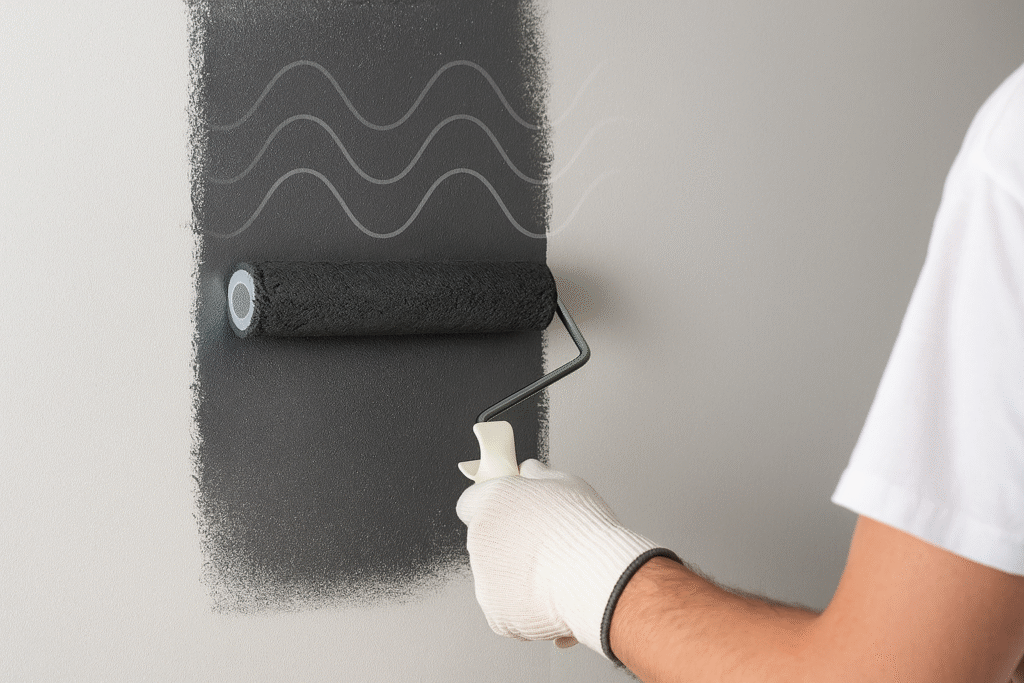
Proper installation determines how well the paint performs. Follow these steps carefully for maximum effectiveness:
- Surface Preparation: Clean, dry walls; remove existing wallpaper, loose paint, or greasy residue. The surface must be dust-free. Wipe down with a damp cloth and allow to dry fully before painting.
- Priming: Use a bonding primer if applying to porous surfaces like bare drywall or plaster. On previously painted walls, priming is optional but improves adhesion and coverage.
- Application: Apply 2 uniform coats using a short-nap roller or airless sprayer. Avoid leaving gaps, brush strokes, or uneven edges at wall junctions. Allow each coat to dry for 2–4 hours before applying the next.
- Grounding: Before the topcoat, attach copper grounding tape or 14–12 AWG copper wire to the painted surface using conductive adhesive or staples. Run the wire to the building’s earth ground. Test continuity with a multimeter — resistance across the entire painted surface should be under 1,000 ohms.
- Topcoat (optional): Apply 1–2 coats of standard water-based latex paint in your chosen colour. Oil-based paints are not recommended as they can form a barrier affecting long-term adhesion.
Common Installation Mistakes to Avoid
- Leaving gaps at corners and junctions: EMF will penetrate any break in the conductive layer. Overlap paint 2–3 cm at every corner, window frame, and door edge.
- Skipping the ground connection: An ungrounded conductive surface provides significantly reduced shielding and may re-radiate absorbed energy.
- Applying too few coats: One coat is rarely sufficient. Two coats minimum; three for high-attenuation targets above 50 dB.
- Not testing conductivity: Use a multimeter in resistance mode to verify the surface is electrically continuous before finishing.
Tip: For whole-room shielding, treat all four walls, the ceiling, and if possible the floor. Any untreated surface is a potential entry point for RF signals.
Popular Brands and Product Examples
The following manufacturers are known for reliable and tested conductive paints:
- YShield® HSF54 / HSF64 – Carbon-based EMF paint providing 39–90 dB attenuation; non-toxic, low odor, and water-based.
- LessEMF® Shielding Paint – Carbon paint for residential EMF reduction with easy grounding compatibility.
- Safe Living Technologies Shielding Paint – Professional-grade coating for home and lab applications.
- Aaronia AG Shielding Paint – High-performance nickel-based paint for RF-secure facilities.
- Mission Darkness™ TitanRF Paint (custom project coating) – Derived from TitanRF materials for laboratory and defense-grade use.
All of these are independently tested to IEEE 299-2006 or MIL-STD-285 standards for verified shielding effectiveness.
Advantages of Conductive Paint
- Invisible protection: Looks like a normal painted wall after finishing.
- Customizable coverage: Apply only where needed (walls, ceilings, or specific rooms).
- High shielding efficiency: Reduces exposure to EMF, Wi-Fi, 5G, and Bluetooth radiation.
- Compatible with other materials: Works with conductive fabrics, grounding tapes, and mesh.
- Long-lasting: Once applied and grounded, it provides durable, passive shielding for years.
Limitations
- Must be properly grounded for full effectiveness.
- Not suitable for damp or outdoor areas unless specified.
- Requires multiple coats for higher attenuation.
- Professional installation is recommended for large-scale or mission-critical setups.
Health and Safety Considerations
Conductive paints are generally non-toxic and water-based, but users should always:
- Wear gloves and masks during application.
- Ensure ventilation during drying.
- Avoid using near sensitive electronics until fully cured.
When properly applied, they are safe, odorless, and environmentally friendly.
How Much Does Conductive Paint Cost?
Cost varies significantly by the type of conductive material used. Here is a breakdown of typical pricing and coverage rates for the most common options:
| Type | Price per Litre | Coverage per Coat | Coats Needed | Best For |
|---|---|---|---|---|
| Carbon-Based | $30–$60 | 5–8 m² | 2 | Home bedrooms, offices |
| Nickel-Based | $80–$150 | 4–6 m² | 2 | Professional, lab use |
| Copper-Based | $100–$180 | 4–6 m² | 2–3 | Industrial, high-shielding |
| Silver-Based | $200–$400 | 3–5 m² | 1–2 | Defense, maximum attenuation |
Estimated Cost for a Standard Bedroom
For a typical 12 m² bedroom (shielding two exterior walls and the ceiling — approximately 30 m² of surface area at 2 coats):
- Carbon-based paint: 8–10 litres → approximately $300–$600 total
- Nickel-based paint: 10–15 litres → approximately $800–$2,000 total
- Silver-based paint: 12–20 litres → approximately $2,400–$8,000 total
For most residential applications, carbon-based paint delivers the best cost-to-performance ratio. Professional installation adds roughly $200–$500 depending on room size and grounding complexity.
Frequently Asked Questions
Does conductive paint actually block EMF?
Yes — when properly applied and grounded, conductive paint achieves 40–100 dB of RF attenuation, which equates to blocking 99% to 99.9999% of incoming electromagnetic radiation across the 100 MHz to 40 GHz frequency range. Independent testing to IEEE 299-2006 and MIL-STD-285 standards confirms these results. Effectiveness depends on full surface continuity and a proper earth ground connection.
Does conductive paint need to be grounded?
Yes. Grounding is essential. Without an earth ground connection, the conductive layer reflects some radiation but does not dissipate it effectively — and can in some cases re-radiate signals. Grounding is done by attaching a copper grounding tape or braided wire to the painted surface and connecting it to a building earth ground (the same ground as your electrical outlets). Most residential installations use 16–12 AWG copper wire for this connection.
How many coats of conductive paint do I need?
Most manufacturers recommend 2 coats for residential use, which delivers approximately 30–50 dB attenuation with carbon-based paints. For higher shielding (60+ dB), a third coat or an upgrade to nickel or silver formulations is required. Allow full drying time between coats — typically 2–4 hours — and test conductivity with a multimeter before applying the decorative topcoat.
Can you paint over conductive paint with regular paint?
Yes. Applying a standard latex or emulsion topcoat over cured conductive paint does not reduce shielding effectiveness. The conductive layer sits beneath the decorative finish and continues to function. Use a water-based (not oil-based) topcoat to avoid any potential chemical interaction with the conductive binder. Most homeowners apply 1–2 coats of their chosen wall colour over the black or dark grey conductive layer.
How long does conductive paint last?
When properly applied on interior walls and protected with a topcoat, conductive paint lasts 10–20+ years. The conductive particles do not degrade under normal indoor conditions. However, moisture infiltration (from leaks or condensation) can disrupt particle connectivity over time. Outdoor or damp environments require moisture-resistant formulations. Periodic conductivity testing with a multimeter is recommended every 3–5 years.
Is conductive paint safe to use indoors?
Yes. Leading brands such as YShield are water-based, non-toxic, and low-odour. Carbon and graphite formulations are the safest for residential use. Nickel and silver paints may contain trace amounts of metal particles — wear an N95 mask and ensure ventilation during application and for 24 hours while drying. Once cured and topcoated, all approved formulations are safe for occupied rooms including bedrooms and nurseries.
What is the best conductive paint for home use?
YShield HSF54 is the most widely recommended conductive paint for residential EMF shielding. It is carbon-based, water-soluble, independently tested to 39 dB attenuation (HSF54) and 90 dB (HSF64), non-toxic, and compatible with standard latex topcoats. For budget-conscious homeowners, LessEMF Carbon Paint is a reliable alternative at a lower price point. For professional or high-attenuation applications, Aaronia AG nickel-based formulations are preferred.
Key Takeaways
- Conductive paint transforms ordinary walls into EMF and RF shielding barriers using carbon, nickel, or silver-based particles.
- Ideal for homes, offices, labs, and secure rooms seeking long-term protection.
- Effectiveness depends on proper application and grounding.
- Reliable brands include YShield, LessEMF, Safe Living Technologies, and Mission Darkness.
- Aesthetically invisible and scientifically proven — conductive paint is the cornerstone of modern low-EMF living design.
References
- YShield – EMF Shielding Paints
- LessEMF – Shielding Paints and Coatings
- Safe Living Technologies – RF Shielding Paint
- Aaronia AG – Shielding Solutions
- Mission Darkness – TitanRF Materials
- IEEE 299-2006 – Standard for Measuring RF Shielding Effectiveness
Featured Products
Looking for quality EMF protection? Check out these recommended products:
Frequently Asked Questions
How effective is conductive paint at blocking EMF and RF signals?
When properly applied and grounded, conductive paint can achieve 40 to 100 dB of attenuation, effectively blocking 99% or more of electromagnetic radiation from passing through treated surfaces. The level of protection depends on the paint’s composition, application thickness, and proper grounding to earth.
Can you apply conductive paint yourself, or do you need a professional?
You can apply conductive paint yourself, but proper grounding is essential for maximum effectiveness. The painted surface must be connected to a ground line to channel residual currents safely into the earth, which may require professional installation if you’re unfamiliar with electrical grounding procedures.
What surfaces in my home or office can be protected with conductive paint?
You can apply conductive paint to walls, ceilings, and other structural surfaces to create whole-room or building-level EMF shielding. This makes it ideal for bedrooms, home offices, nurseries, and any space where you want to reduce exposure to Wi-Fi, 5G signals, and other electromagnetic fields.
What are the main ingredients in conductive paint that make it work?
Conductive paint contains fine conductive particles such as carbon, graphite, nickel, copper, or silver suspended in a binder like acrylic or latex. When the paint dries, these particles form an interconnected network that conducts electricity and redirects electromagnetic radiation through reflection and absorption.