You spend roughly a third of your life in your bedroom. That simple fact makes it the single most important room to think about when it comes to electromagnetic field (EMF) exposure. While you sleep, your body cycles through critical repair processes, and your phone, Wi-Fi router, smart devices, and even the wiring behind your walls are often just inches away, running all night long.
The question of whether EMF affects sleep is genuinely complicated. The research is mixed, the mechanisms are still being studied, and strong opinions exist on both sides. This article walks through what the science actually says, identifies the most common bedroom EMF sources, and lays out practical steps you can take to reduce exposure while you sleep, starting with changes that cost nothing.
What Research Says About EMF and Sleep
Before jumping into solutions, it helps to understand what the scientific literature actually shows. The honest answer: findings are mixed, and the field is still developing. Some studies suggest measurable effects on sleep biology, while others find no significant association at everyday exposure levels.
The EEG Evidence
One of the more consistent findings in controlled laboratory studies involves changes to the sleep electroencephalogram (EEG). Researchers have observed that exposure to pulse-modulated radiofrequency signals, similar to those from 2G through 4G mobile phones, can increase power in the spindle frequency range (roughly 11 to 16 Hz) during non-REM sleep. A 2011 study by Lowden and colleagues at Stockholm University, published in Bioelectromagnetics, found this pattern after subjects were exposed to 884 MHz GSM signals before sleep. The researchers noted that pulse modulation of the signal appeared to be critical to producing these EEG changes.
What remains unclear is whether these EEG alterations translate into meaningful sleep quality differences for the people experiencing them. Changes in brainwave patterns during sleep do not automatically mean someone sleeps worse or feels less rested. The researchers themselves noted that it “remains unclear whether these changes in sleep EEG indicate adverse health effects or detrimental sleep quality.”
The Melatonin Hypothesis
Melatonin, the hormone that regulates your sleep-wake cycle, is the leading proposed mechanism for how EMF might affect sleep. A 2026 systematic review published in Sleep and Biological Rhythms examined 55 studies (22 in vitro, 21 animal, and 12 human) that met inclusion criteria from an initial pool of 892 records. The review reported that 88% of high-quality animal studies showed some degree of melatonin suppression associated with EMF exposure.
However, the picture in human studies is far less clear. An earlier review published in ScienceDirect noted that while some studies indicated EMF may have a suppressive effect on melatonin, “the results cannot be generalized because of the large variability in exposure conditions and other factors that may influence melatonin.” In short, the animal data is suggestive, but translating that directly to humans at typical household exposure levels requires caution.

Epidemiological and Survey Studies
When researchers look at large populations rather than controlled lab conditions, the results become even more mixed. A cross-sectional study by Hutter and colleagues at the Medical University of Vienna, published in Occupational and Environmental Medicine in 2006, examined 365 people living near mobile phone base stations. Despite finding some associations with headaches and other symptoms, the study found no significant changes in sleep quality related to proximity to base stations.
A prospective cohort study by Mohler and colleagues, published in PLOS ONE in 2012, followed participants over time and found that neither operator-recorded nor self-reported mobile phone use was associated with sleep disturbances or daytime sleepiness in their longitudinal analyses.
On the other hand, a study of electric power plant workers published in PLOS ONE in 2014 found that poor sleep quality was significantly associated with daily electromagnetic field exposure time. Workers with longer daily EMF exposure showed a notably higher risk of poor sleep quality. This suggests that higher, sustained occupational exposure may have different effects than the lower, intermittent exposure most people experience at home.
5G and Newer Research
A 2024 pilot study published in Frontiers in Public Health used a randomized, double-blind, crossover design to investigate the effect of 2.45 GHz radiofrequency exposure during sleep on 12 healthy adults. This type of rigorous study design is encouraging for the field, though the small sample size limits how broadly the findings can be applied. Separately, a 2025 study published in ScienceDirect examined 5G radiofrequency effects on sleep EEG for the first time, noting that prior generations of RF-EMF had demonstrated effects on the spindle frequency range, but that the impact of 5G signals on sleep remained largely unexplored.
The Bottom Line on the Science
The International Agency for Research on Cancer (IARC), part of the World Health Organization, classified radiofrequency electromagnetic fields as “possibly carcinogenic to humans” (Group 2B) in 2011. This classification is based on limited evidence and does not mean RF-EMF definitively causes harm, but it signals that the question is not fully settled.
For sleep specifically, the research suggests that controlled EEG changes can occur under laboratory conditions, that melatonin disruption is plausible (especially based on animal data), and that occupational-level exposure may carry more risk than typical home exposure. But the evidence is not strong enough to make definitive cause-and-effect claims about EMF and everyday sleep problems. Many people report better sleep after reducing bedroom EMF, and the practical steps involved, like moving your phone away from your bed, are sensible habits regardless of where the science ultimately lands.
Common Bedroom EMF Sources
Understanding where EMF comes from in your bedroom is the first step toward reducing it. Most bedrooms have more sources than people realize, and several of them sit just inches from where you lay your head.
Your Phone Charging on the Nightstand
This is the most common and closest source. A smartphone charging on your nightstand emits both radiofrequency radiation (from its cellular, Wi-Fi, and Bluetooth antennas) and extremely low frequency (ELF) magnetic fields from the charging circuit. If you use it as an alarm clock, it stays active and connected all night, often less than a foot from your head.
Wi-Fi Router
If your router is in or near the bedroom, it transmits radiofrequency signals continuously, even when no one is actively using the internet. Routers broadcast beacon signals roughly ten times per second to announce the network’s presence. The closer the router is to your sleeping position, the higher the exposure.
Smart Home Devices
Smart speakers, smart plugs, baby monitors, and other IoT devices maintain persistent wireless connections. Many communicate using Wi-Fi, Bluetooth, or Zigbee protocols around the clock. A bedroom with a smart speaker on the nightstand, a connected thermostat, and a smart plug may have three or four always-on wireless transmitters in a small space.
Electric Blankets and Heated Mattress Pads
Electric blankets and heated mattress pads produce ELF magnetic fields from the current running through their heating wires. Because they are in direct contact with your body, the proximity is as close as it gets. Even when turned off but left plugged in, some models still produce measurable electric fields.
Bedside Alarm Clocks and Lamps
Plug-in alarm clocks, especially older models with transformers, can produce localized magnetic fields. Bedside lamps with dimmers can also generate higher levels of “dirty electricity” (high-frequency voltage transients on the wiring). These are low-level sources, but their proximity to your head makes them worth considering.
Wiring in Walls
The electrical wiring behind your bedroom walls produces electric and magnetic fields. The strength depends on the wiring configuration, the load on the circuit, and the age and condition of the wiring. In most homes these fields drop off quickly with distance, but the wall directly behind your headboard can be a notable source if it carries high-load circuits.
Practical Fixes Ranked by Effort and Cost
The good news is that many of the most effective steps to reduce bedroom EMF cost nothing and take less than a minute. Start with the free behavior changes and work your way up only if you want to go further.
Free: Behavior Changes
- Move your phone across the room. This is the single highest-impact change you can make. EMF intensity drops sharply with distance (following the inverse square law for RF sources). Moving your phone from the nightstand to a dresser six feet away dramatically reduces your exposure. Use a battery-powered alarm clock instead.
- Switch to airplane mode at night. If you prefer keeping your phone nearby, turning on airplane mode disables the cellular, Wi-Fi, and Bluetooth radios. This eliminates the RF emissions while still letting your alarm work. Make sure to disable Wi-Fi and Bluetooth separately if your phone re-enables them in airplane mode.
- Use a router timer or turn the router off at night. Most people do not need Wi-Fi while they sleep. A simple outlet timer (mechanical ones cost a few dollars) can shut your router off at bedtime and turn it on in the morning. Alternatively, many routers have scheduling features built into their admin settings.
- Unplug bedside devices. Unplugging your alarm clock, lamp, and any chargers eliminates the electric fields from those devices entirely. This is especially worthwhile for older devices with external transformers.
- Pull your bed away from the wall. Even six inches of space between your headboard and the wall behind it increases your distance from in-wall wiring. This is particularly relevant if the wall carries circuits for other rooms.
Low Cost: Simple Products ($20 to $100)
- Battery-powered alarm clock. Eliminates the need to keep your phone or a plug-in clock next to your head. Simple, reliable, and removes one source entirely.
- Router guard or router cage. A mesh metal enclosure placed over your router reduces the RF output. These typically reduce signal strength by 90% or more while still allowing devices to connect (at reduced range). Useful if you cannot move the router out of the bedroom or turn it off overnight.
- Grounding or earthing sheets. Some people report improved sleep using conductive bedsheets designed to connect you to electrical ground. The theory is that grounding reduces the body’s exposure to ambient electric fields. Research on grounding and sleep is limited and preliminary, so results may vary.
- Shielding fabric for smart devices. Small shielding pouches or fabric wraps can reduce RF output from devices you want to keep in the room but do not need constantly connected.
Moderate Cost: Targeted Upgrades ($100 to $500)
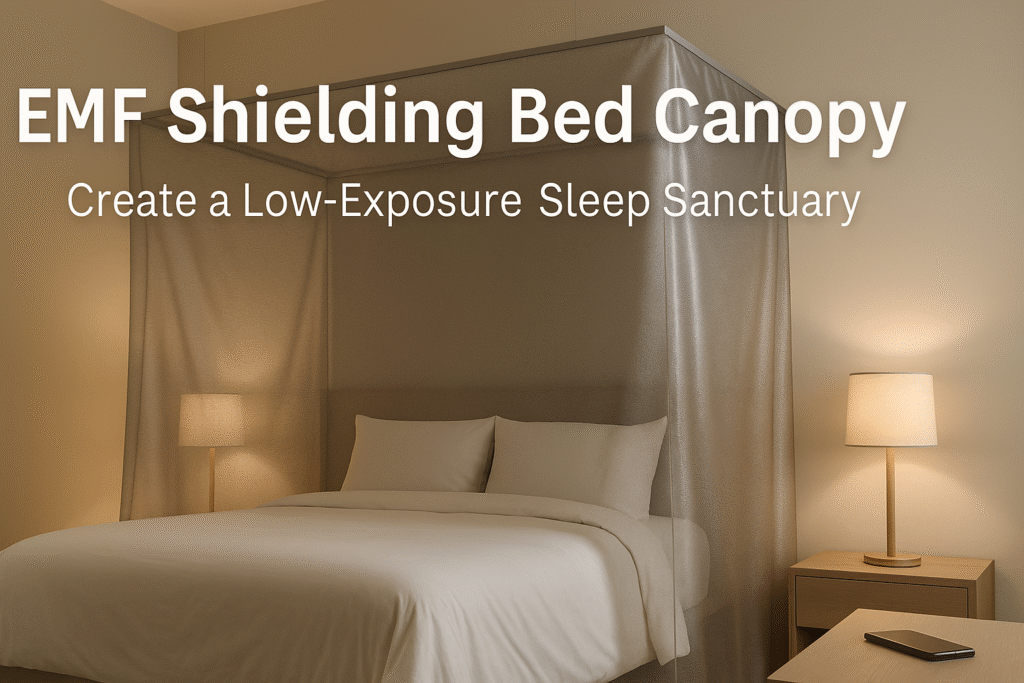
- Bed canopy made from shielding fabric. A canopy constructed from silver-threaded or copper-mesh fabric can create a low-EMF sleeping environment by blocking RF from all directions. These require proper grounding and installation to be effective. They range from around $150 to $500 depending on size and material quality.
- Demand switch (circuit cutoff switch). A demand switch installed in your electrical panel automatically cuts power to your bedroom circuits when no current is being drawn. This eliminates electric fields from wiring in the walls while you sleep. When you turn on a light or plug something in, the circuit reactivates automatically. Installation requires an electrician.
- Wired internet setup. Running an Ethernet cable to your bedroom allows you to turn off Wi-Fi entirely. Most modern laptops and desktops support Ethernet directly or with a USB adapter. This eliminates the largest RF source in most homes.
Higher Investment: Structural Changes ($500+)
- EMF shielding paint. Carbon-based shielding paint can be applied to bedroom walls and ceiling to block RF from external sources (cell towers, neighbors’ routers). It must be grounded and covered with a finish coat. Professional application is recommended. Expect to spend $500 to $1,500 or more depending on room size.
- Rewiring. Older homes with unshielded wiring or knob-and-tube wiring can produce significantly higher EMF. Upgrading to modern shielded wiring reduces both electric and magnetic fields from the walls. This is a major renovation project and is only worth pursuing if an EMF assessment reveals unusually high levels from the existing wiring.
Building a Low-EMF Sleep Routine
Reducing bedroom EMF is most effective when it becomes part of a consistent nightly routine rather than a one-time project. Here is a sample evening sequence that incorporates the practical steps above.
60 minutes before bed: Set your phone to airplane mode (or leave it charging in another room). This also eliminates the temptation to scroll, which has its own well-documented negative effects on sleep quality from blue light and mental stimulation.
30 minutes before bed: Turn off or unplug bedside electronics. If you use a router timer, confirm it is set correctly. If you have a demand switch, verify the indicator shows the bedroom circuit is off.
At bedtime: Your bedroom should now be free of active wireless transmitters. If you use a shielding canopy, close it fully. Use your battery-powered alarm clock.
In the morning: Re-enable your devices as needed. If you use a demand switch, power returns automatically when you flip a light switch.
The goal is not perfection. Even implementing two or three of these steps meaningfully reduces your overall nighttime exposure. Many people who reduce bedroom EMF also report improvements they attribute to the routine itself: less screen time before bed, a darker room, and fewer interruptions from notifications.
It is worth noting that the behavioral changes, especially removing the phone from the bedroom and cutting screen time before sleep, overlap heavily with standard sleep hygiene recommendations. Some of the benefit people experience may come from better sleep habits generally, rather than EMF reduction specifically. Either way, the outcome is better sleep.
Frequently Asked Questions
Does airplane mode completely stop EMF from my phone?
Airplane mode disables the cellular, Wi-Fi, and Bluetooth radios, which are the primary sources of radiofrequency emissions. However, the phone still produces small ELF fields from its processor and battery circuits. For the lowest possible emissions, turn the phone off entirely or leave it in another room.
Is sleeping next to a charging phone worse than a non-charging phone?
A charging phone produces additional ELF magnetic fields from the charging circuit and the power adapter. Wireless (Qi) chargers produce higher magnetic fields than wired chargers because they use electromagnetic induction. If you must charge your phone at night, use a wired charger and place it as far from your bed as the cable allows.
Should I worry about the Wi-Fi router if it is in another room?
RF signal strength decreases significantly with distance and drops further through walls. A router in another room, especially with a wall between it and your bedroom, produces much lower exposure at your bed than one on the nightstand. If you want to go further, a router timer that shuts it off overnight is a simple, low-cost solution.
Do EMF shielding products actually work?
Products that use conductive metals (silver, copper, nickel) or carbon-based shielding paint do attenuate (reduce) RF signals. Their effectiveness depends on the material, coverage, and whether they are properly grounded. Poorly designed or improperly installed shielding can reflect signals and create higher exposure inside the shielded area. Look for products with published attenuation data in decibels (dB).

Can EMF actually cause insomnia?
The current research does not support a direct causal link between typical household EMF levels and insomnia. Some controlled studies have observed changes in sleep brainwave patterns during RF exposure, and animal studies suggest melatonin suppression is possible, but epidemiological studies in the general population have produced mixed or null results. Some individuals may be more sensitive than others, which is an area still under investigation.
What is a demand switch and do I need one?
A demand switch (also called a circuit cutoff switch) is installed in your electrical panel and automatically cuts power to a circuit when no devices are drawing current. It eliminates the electric fields produced by energized wiring in your bedroom walls. It is a moderate investment ($200 to $400 installed) and is most beneficial if an EMF assessment shows elevated electric field levels from your bedroom wiring.
Are children more affected by bedroom EMF than adults?
Some researchers have suggested that children may absorb more RF energy relative to their body mass due to thinner skulls and higher tissue water content. The WHO and various health agencies acknowledge that children could be a more vulnerable population but note that definitive evidence is still lacking. As a precautionary step, many parents choose to keep wireless devices out of children’s bedrooms.
Is it worth buying an EMF meter to test my bedroom?
An EMF meter can be a useful tool to identify the highest sources in your bedroom and prioritize which changes to make first. Entry-level meters that measure RF, magnetic fields, and electric fields start around $150 to $200. They are especially useful for checking whether in-wall wiring or a specific device is producing unexpectedly high readings. For most people, however, the free behavioral changes (phone out of the room, router off, devices unplugged) will produce the biggest reduction without needing to measure first.
Conclusion
The relationship between EMF and sleep is an area where the science is genuinely still developing. Controlled lab studies show measurable changes in sleep brainwave patterns during RF exposure. Animal research suggests melatonin disruption is plausible. But population-level studies have not consistently linked everyday EMF levels to sleep problems, and the gap between “detectable biological effect” and “meaningful sleep disruption” has not been fully bridged by current research.
What makes the EMF-and-sleep question practical, regardless of where you land on the science, is that the most effective steps overlap with good sleep hygiene. Moving your phone out of the bedroom, cutting screen time before bed, removing unnecessary electronics, and sleeping in a quieter electrical environment are all low-cost, low-risk actions. If they help you sleep better, the mechanism matters less than the result.

Start with the free changes. Most people find that just removing the phone and turning off the router at night makes a noticeable difference in how quickly they fall asleep and how rested they feel in the morning. From there, you can decide whether additional steps like shielding products or a demand switch are worth the investment based on your own experience.
These statements have not been evaluated by the Food and Drug Administration. This information is not intended to diagnose, treat, cure, or prevent any disease. Content is for informational purposes only and is not medical advice; consult a qualified healthcare provider before starting any supplement. As an Amazon Associate we earn from qualifying purchases.