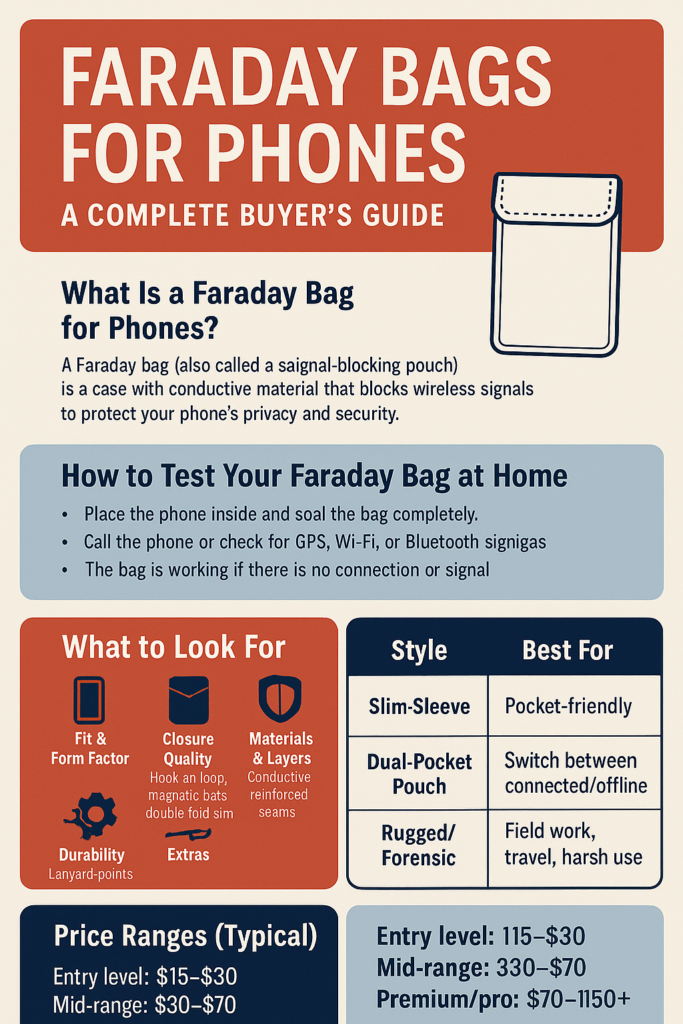
Faraday bags and faraday cages both protect against electromagnetic fields, wireless communication, and signal-based attacks, but they accomplish this in different ways. While both rely on the same scientific principle, their construction, shielding performance, and practical uses differ significantly.
This guide breaks down the differences between faraday bags and traditional faraday cages so you can choose the right solution for privacy, security, and RF shielding in 2026.
For a complete overview of faraday bags, see the comparison guide here:
https://frequencyblockers.com/best-faraday-bags-2026/
What Is a Faraday Cage?
A faraday cage is a rigid or semi-rigid enclosure made from metal mesh or solid conductive material. The cage surrounds the protected object and blocks external electromagnetic fields by redirecting them across the conductive surface.
Faraday cages are commonly used for:
- Military and government communications
- Laboratory EMC testing
- Large-scale RF shielding
- Data centers
- High-security rooms
- Shielded enclosures for servers or test equipment
- RF isolation in industrial settings
They provide strong, stable shielding but are not portable.
You also offer a category of larger enclosures here:
https://frequencyblockers.com/faraday-tents/
What Are Faraday Bags?
Faraday bags are flexible, portable enclosures made from layered conductive fabrics. They work like miniature faraday cages but are designed for everyday use, field applications, travel, and digital privacy.
Faraday bags are designed to block the following when properly sealed and tested for the band in question: [4][1]
- Cellular signals
- Wi-Fi
- Bluetooth
- GPS
- RFID and NFC
- 5G frequencies
- Key fob relay attacks
Common use cases include:
- Phone and laptop privacy
- Vehicle key protection
- Protecting digital evidence
- Shielding GPS trackers
- International travel
- Anti-stalking protection
- EMP or solar event preparedness
Your detailed guide for digital privacy is here:
https://frequencyblockers.com/faraday-bags-for-digital-privacy-2026-guide/
How Do Faraday Bags and Faraday Cages Work?
Both tools rely on the same physics principle known as the Faraday cage principle, which states that a conductive enclosure blocks external electric fields and, when it is sealed with no gaps, attenuates RF signals entering or leaving at the frequencies the material was built for [1][2][3].
Bags and cages both reflect and absorb energy, and both leak at gaps
A conductive layer bounces RF
Metal-coated fabric, foil, mesh and conductive paint reflect most incoming radio-frequency energy.
Some energy is lost inside
Thicker or multi-layer materials also absorb part of the signal as it passes through.
Gaps let signals through
Seams, open weaves, zips and unsealed edges leak, and short wavelengths slip through smaller gaps.
Low-frequency magnetic fields pass
Thin fabric or paint does little against 50/60 Hz magnetic fields; distance or special high-permeability metal is needed.
The difference is mostly size and construction.
How well a material shields depends on the frequency and on how completely it covers the space.
Chart: frequencyblockers.com: Bags and cages both reflect and absorb energy, and both leak at gaps
Embed this chart
Free to reuse on your site. Copy the code below; please keep the credit link.
Faraday Cages Work By:
- Using rigid metal or mesh walls
- Creating a stable conductive surface around the interior
- Providing high attenuation across a broad frequency range
Faraday Bags Work By:
- Using flexible conductive fabrics (nickel-copper, silver, aluminum)
- Layering multiple materials for improved attenuation
- Creating 360° enclosure when sealed properly
While the principles are the same, the execution is different.
Durability and Construction Differences
Faraday Cages
- Rigid
- Heavy-duty metal materials
- Long lifespan (10 to 20 years for professional cages)
- Suitable for stationary environments
- High shielding for large equipment
Faraday Bags
- Flexible
- Lightweight
- Can degrade from bending and moisture
- Lifespan typically 1 to 6 years depending on usage
- Best for mobile devices and travel
For a full breakdown of faraday bag lifespan, see why faraday bags stop working.
Shielding Strength Comparison
| Feature | Faraday Bags | Faraday Cages |
|---|---|---|
| Portability | Excellent | Very poor |
| Shielding Strength | Moderate to high (30 to 90 dB) | Extremely high (up to 100+ dB) |
| Frequency Coverage | Wide (cellular, Wi-Fi, RFID, GPS) | Extremely wide |
| Durability | Moderate | Very high |
| Ideal For | Phones, laptops, key fobs, trackers | Rooms, servers, lab equipment |
| Cost | Low to moderate | High to very high |
A high-end faraday bag can provide enough shielding to block tracking, communication, and many signal-based attacks when it is sealed correctly [4][1], but faraday cages excel in environments where constant, high-power, and professional-grade RF isolation is required.
When to Use Faraday Bags Instead of Faraday Cages
Use faraday bags when:
- You need portability
- You want personal device privacy
- You are traveling or commuting
- You need to store key fobs safely
- You must block tracking devices (AirTags, Tiles)
- You need a low-cost shielding solution
Common faraday bag use cases include:
- Digital privacy
- Law enforcement evidence handling
- Drone security
- Personal security and anti-stalking
- EMP preparedness
Browse the category here:
https://frequencyblockers.com/faraday-bags/
When to Use Faraday Cages Instead of Faraday Bags
Use faraday cages when:
- You require continuous RF isolation
- Large equipment must be shielded
- You’re working in a lab or industrial setting
- You need standardized attenuation levels (MIL-STD, IEEE)
- Device size exceeds portable bag capacity
Examples include:
- Shielding an entire room
- Protecting servers in mission-critical facilities
- Conducting EMC laboratory testing
- Shielding sensitive scientific instruments
For portable large-scale shielding, you already offer:
https://frequencyblockers.com/faraday-tents/
Do You Need Both?
Some environments benefit from using both faraday bags and faraday cages:
- Law enforcement agencies use faraday bags in the field and cages in evidence labs.
- Corporate security teams use faraday bags during meetings and cages for secure facilities.
- Preppers store devices in faraday cages at home but keep faraday bags for travel.
Both tools complement each other, not replace each other.
Key Takeaways
- Faraday bags are portable, flexible shielding solutions ideal for smartphones, laptops, key fobs, trackers, and travel security.
- Faraday cages offer stronger, more durable shielding and are used for large equipment, secure rooms, and lab environments.
- Both rely on the same electromagnetic principle but serve different use cases.
- Faraday bags are the best choice for personal privacy, digital security, and mobile-device protection.
- Faraday cages are necessary for high-power, industrial, and professional RF shielding applications.
Product References
- Andrew C. Marvin et al. A Method for the Measurement of Shielding Effectiveness of Planar Samples Requiring No Sample Edge Preparation or Contact. IEEE Transactions on Electromagnetic Compatibility (2009). doi:10.1109/temc.2009.2015147
- M. Zucca et al. Open Screens for Local Magnetic Shielding at Low Frequencies. IEEE Transactions on Magnetics (2014). doi:10.1109/tmag.2014.2330002
- Satpute N et al. Manufacturing of Pure Iron by Cold Rolling and Investigation for Application in Magnetic Flux Shielding. Materials (Basel, Switzerland) (2022). PMID 35407962
- Eric Katz et al. A field test of mobile phone shielding devices. Purdue e-Pubs (Purdue University System) (2011). source
Featured Products
Looking for quality EMF protection? Check out these recommended products:
Frequently Asked Questions
What’s the main difference between a Faraday bag and a Faraday cage?
Faraday bags are portable, flexible enclosures made from layered conductive fabrics designed for everyday use and travel, while Faraday cages are rigid or semi-rigid metal mesh structures built for stationary, high-security applications like laboratories and data centers. Both use the same electromagnetic blocking principle but serve different purposes based on your need for portability versus maximum shielding strength.
When should I use a Faraday bag instead of a Faraday cage for EMF protection?
You should choose a Faraday bag when you need portable RF shielding for smartphones, tablets, or laptops during travel, in public spaces, or for daily privacy. Faraday cages are better suited for stationary installations where you need permanent, industrial-grade protection in fixed locations.
Do Faraday bags block all types of wireless signals?
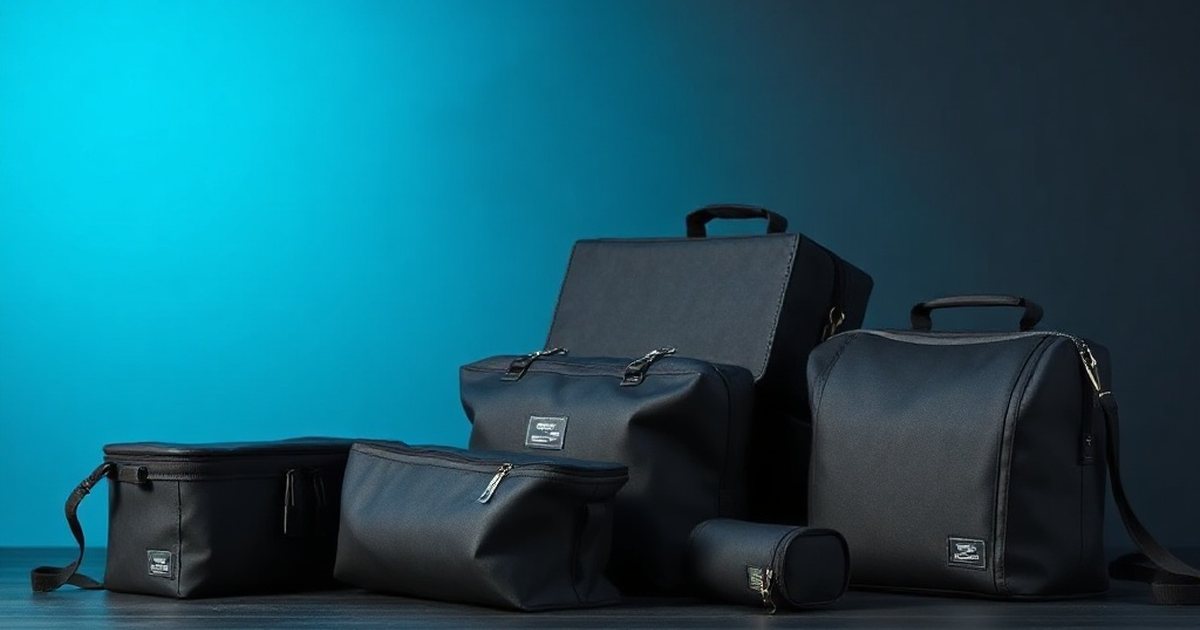
Not all of them. Faraday bags are designed to block cellular signals, Wi-Fi, Bluetooth, and other RF signals by redirecting electromagnetic fields across their conductive fabric layers, but thin conductive fabric does little against low-frequency magnetic fields, and a bag that is not fully sealed lets signal through [2][3][4][1]. However, shielding effectiveness depends on the quality of materials and construction, so premium bags provide stronger protection than basic options.

Can I use a Faraday bag instead of a Faraday cage for my home office?
Faraday bags work well for protecting individual devices like phones or laptops in your home office, but if you need to shield an entire room or multiple devices simultaneously, a Faraday cage or tent enclosure would be more practical and cost-effective. Your choice depends on whether you’re protecting portable items or creating a permanent shielded workspace.
These statements have not been evaluated by the Food and Drug Administration. This information is not intended to diagnose, treat, cure, or prevent any disease. Content is for informational purposes only and is not medical advice; consult a qualified healthcare provider before starting any supplement. As an Amazon Associate we earn from qualifying purchases.