HF Analyzers: A Complete Guide to High-Frequency EMF Measurement and Diagnostics
High-frequency electromagnetic fields are among the most common and complex forms of EMF exposure today. Wi-Fi routers, smart meters, 5G systems, cordless phones, Bluetooth devices, and countless wireless networks produce RF signals that vary widely in frequency, modulation, and transmission patterns. To evaluate these emissions accurately—especially across broad frequency ranges—professionals and serious home assessors rely on HF Analyzers, advanced tools designed to measure and diagnose high-frequency electromagnetic fields with precision.
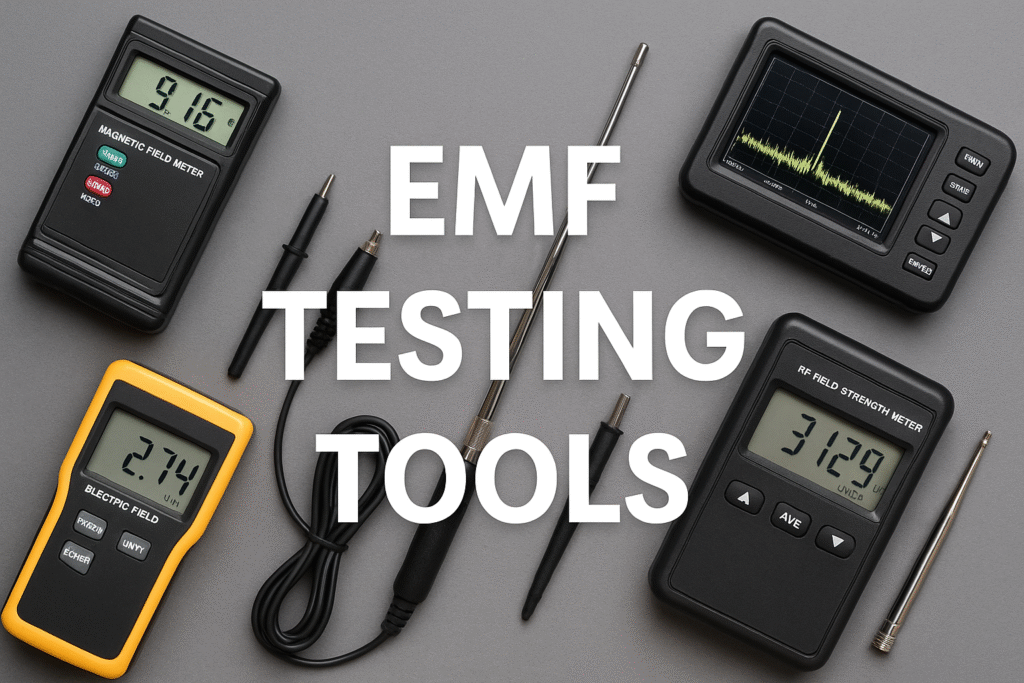
HF Analyzers provide far more detail than basic broadband RF meters, offering frequency-specific insights, directional measurements, and advanced visualization. This makes them foundational tools for RF assessments in homes, offices, schools, and industrial environments. For a complete overview of all EMF testing tools, visit:
https://frequencyblockers.com/emf-testing-tools/
What HF Analyzers Measure
HF Analyzers are specialized instruments that measure radiofrequency (RF) signals across a wide bandwidth. Depending on the device, they typically cover:
- 700 MHz to 6 GHz (cellular, Wi-Fi, Bluetooth, IoT)
- 2.4 GHz and 5 GHz Wi-Fi bands
- Smart meter transmissions
- DECT cordless phones
- Baby monitors
- Wireless alarm systems
- Radar-based devices
- Lower 5G frequencies
More advanced HF Analyzers extend well beyond 6 GHz, depending on the application.
Core measurement capabilities include:
- Power density (µW/m² or mW/m²)
- Frequency identification
- Duty cycle analysis
- Peak/average RF levels
- Modulation pattern interpretation
- Directional RF detection (via antennas)
HF Analyzers allow you to understand not just how strong a signal is—but what it is and where it is coming from.
Why HF Analyzers Are Essential for RF Assessments
1. Frequency-Specific Data
Unlike broadband RF detectors, HF Analyzers break down RF emissions by frequency, enabling users to differentiate between:
- Cell tower signals
- Wi-Fi routers
- Bluetooth devices
- Smart meters
- Wireless cameras
- IoT networks
2. Ideal for Complex Environments
Apartments, schools, offices, and high-density neighborhoods often contain dozens of overlapping RF sources. HF Analyzers clarify the picture.
3. Directional Measurement
Paired with directional antennas, HF Analyzers reveal the strongest angle of RF arrival—critical for diagnosing cell tower influence.
4. Accurate Shielding Evaluation
HF Analyzers confirm the performance of shielding paint, RF curtains, or conductive window films.
5. Professional-Grade Diagnostics
Used by:
- EMF consultants
- Building biologists
- RF engineers
- Compliance testers
- Technical inspectors
These tools provide the precision needed for serious analysis.
How HF Analyzers Work
HF Analyzers rely on tunable receivers similar to spectrum analyzers, scanning across frequency ranges to detect RF energy.
Key components include:
1. Wideband RF Receiver
Captures signals across the assigned spectrum.
2. Local Oscillator & Mixer
Down-convert high-frequency RF signals to an intermediate frequency for analysis.
3. IF Filters
Remove unwanted frequencies and refine accuracy.
4. Detector and Processing Unit
Calculate peak, average, RMS, and other metrics.
5. Display or Software Interface
Shows frequency, amplitude, modulation, and duty cycle.
Many HF Analyzers work as standalone handheld units, while others connect to computers for advanced visualization.
Applications for HF Analyzers
1. Home EMF Assessments
HF Analyzers help evaluate the influence of:
- Wi-Fi routers and mesh networks
- Smart TVs
- Wireless appliances
- Smart thermostats
- Baby monitors
- Bluetooth devices
2. Evaluating Cell Tower Proximity
Directional antennas help pinpoint the strength and angle of incoming tower signals.
3. Smart Meter Testing
HF Analyzers detect pulsing patterns unique to smart meters.
4. Office and Commercial Building Testing
These environments contain dozens or hundreds of RF devices—HF Analyzers help map hotspots.
5. Troubleshooting Interference
HF Analyzers reveal:
- Overlapping channels
- Microwave leakage
- Harmonics and secondary transmissions
- Faulty wireless devices
6. Shielding Verification
They quantify RF reduction after:
- Shielding paint
- Window film
- Canopies
- Faraday materials
How to Use HF Analyzers Correctly
1. Choose the Correct Antenna
Directional antennas isolate sources; omnidirectional antennas reveal overall levels.
2. Scan the Frequency Range
Use wide sweeps first, then zoom in on specific peaks.
3. Measure Peak and Average Values
Both metrics provide critical insights into RF behavior.
4. Identify Dominant Sources
Peaks often correspond to nearby wireless devices or external towers.
5. Compare Measurements Across Locations
Test:
- Bedrooms
- Offices
- Living rooms
- Outdoor areas
- Neighbor-facing walls
6. Perform Day/Night Comparisons
Cell networks and Wi-Fi loads vary dramatically throughout the day.
7. Document Every Reading
HF Analyzers produce detailed logs that support mitigation decisions.
Interpreting HF Analyzer Readings
HF Analyzers reveal:
1. Frequency Peaks
Each RF source produces a unique frequency pattern.
2. Duty Cycle
Indicates how often a device transmits (e.g., smart meters pulse briefly but intensely).
3. Modulation Type
Certain wireless systems use distinct modulation schemes.
4. Field Strength
Measured in µW/m² or V/m.
5. Angle of Arrival
Directional antennas show where the strongest RF originates.
These insights help users decide where and how to apply mitigation.
Types of HF Analyzers
1. Handheld RF Analyzers
Portable and user-friendly.
Ideal for home assessments and consulting work.
2. Professional Spectrum-Based HF Analyzers
Higher dynamic range and frequency accuracy.
Used by engineers and building biologists.
3. Software-Connected HF Analyzers
USB devices that rely on computer visualization.
Affordable and powerful.
4. Multi-Tool HF Analyzer Kits
Often bundled with antennas and accessories for pre-compliance testing.
Price Ranges for HF Analyzers
| Category | Typical Price | Best For |
|---|---|---|
| Entry-Level | $150–$350 | Basic RF identification |
| Mid-Range | $350–$900 | Professional home & office assessments |
| High-End | $900–$4,000+ | Advanced diagnostics & engineering |
Price depends on frequency range, sensitivity, and included antennas.
Advantages of HF Analyzers
- Identify specific RF frequencies
- Reveal detailed wireless behavior
- Provide directional insights
- Support professional reporting
- Validate shielding performance
- Essential for complex RF environments
Limitations of HF Analyzers
- More expensive than broadband tools
- Require some technical learning
- May need external antennas
- Not suitable for very close-range diagnostics (use near-field antennas instead)
Despite these limitations, HF Analyzers are the gold standard for high-frequency EMF evaluations.
HF Analyzers vs. Broadband RF Detectors
| HF Analyzers | Broadband RF Detectors |
|---|---|
| Frequency-specific | Overall exposure only |
| Professional-grade | Consumer-friendly |
| Directional analysis | No directionality |
| More expensive | Budget-friendly |
| Ideal for troubleshooting | Ideal for quick scans |
Most EMF professionals use both for complete assessments.
Common Mistakes When Using HF Analyzers
- Using the wrong antenna
- Misinterpreting peaks
- Scanning too quickly
- Testing only once
- Standing too close to devices
- Failing to record settings
Consistency is critical for accurate readings.
FAQs About HF Analyzers
Do HF Analyzers detect 5G?
Yes—if they have the appropriate frequency range.
Are HF Analyzers safe to use?
Yes—they passively measure RF fields.
Do they require calibration?
High-quality units should be factory-calibrated, with optional recalibration for accuracy.
Can HF Analyzers replace spectrum analyzers?
They perform similar functions but are optimized for EMF assessment rather than engineering detail.
Key Takeaways
- HF Analyzers provide detailed, frequency-specific measurement of high-frequency RF fields, making them essential for modern EMF assessments.
- They reveal not only the strength of RF signals but also their origin, pattern, and behavior.
- Paired with the correct antennas, HF Analyzers deliver unparalleled insight into wireless exposure.
- For a full overview of EMF testing tools, visit:
https://frequencyblockers.com/emf-testing-tools/
References
- National Institute of Standards and Technology (NIST) — RF Signal Measurement
https://www.nist.gov - Frequency Blockers — EMF Testing Tools Overview
https://frequencyblockers.com/emf-testing-tools/
Recommended EMF Testing Equipment
Ready to start testing? Check out our top-rated EMF meters:
- Safe and Sound Pro II RF Meter
- Safe and Sound Classic II RF Meter
- Safe and Sound Pro mmWave 20GHz Meter
Browse all EMF protection products →
Frequently Asked Questions
What exactly do HF Analyzers measure and why would I need one?
HF Analyzers measure high-frequency electromagnetic fields from sources like Wi-Fi routers, smart meters, 5G systems, and Bluetooth devices. You need one if you want to accurately assess RF exposure in your home or office and identify which specific frequencies and sources are affecting your environment.
Can I use an HF Analyzer to verify if my Faraday bags and shielding products are actually working?
Yes, HF Analyzers are specifically designed for shielding verification. You can measure RF field strength before and after implementing shielding solutions, allowing you to quantify exactly how much protection your Faraday bags or other shielding materials are providing.
How much do HF Analyzers typically cost and are they worth the investment?
HF Analyzer prices vary widely based on type and capabilities, ranging from mid-range handheld units to professional spectrum-based models costing significantly more. For serious home assessments or if you’re sensitive to EMF, the investment provides valuable frequency-specific data and professional-grade diagnostics that simpler meters cannot offer.
What’s the difference between a handheld HF Analyzer and professional spectrum-based models?
Handheld RF Analyzers are portable and user-friendly, making them suitable for basic home assessments, while professional spectrum-based HF Analyzers offer broader frequency ranges, more precise measurements, and advanced diagnostic features for complex environments. Your choice depends on whether you need quick consumer-level readings or detailed technical analysis.