What Is Anti Radiation Clothing and Does It Really Work Against EMF & RF Exposure?
Anti radiation clothing is sold to people who want to reduce the radio signals reaching their body. This article explains what it is, what it can and cannot block, how it works, show real-world product examples, and explore how you can incorporate it into your everyday life.
What Is Anti Radiation Clothing?
Anti radiation clothing refers to garments designed to reduce exposure to electromagnetic fields (EMF) and radiofrequency (RF) radiation. These garments typically incorporate conductive materials (silver-coated fibers, copper, stainless steel threads) woven into fabric so that the body is shielded from ambient RF emissions from devices like routers, cell towers, smart-meters, WiFi, Bluetooth, etc.
The goal is not to make you immune to all radiation: think of it as mitigation rather than elimination. It’s one piece in a larger strategy of EMF reduction and mindful exposure.
Why People Are Using Anti Radiation Clothing
- Our modern environment has more wireless signals than ever: 5G antennas, WiFi routers, Bluetooth devices, smart-home sensors. This increases ambient RF exposure.
- While mainstream regulatory bodies say that low-level RF exposure from wireless devices hasn’t been definitively proven to cause harm for average users, many choose a precautionary lifestyle approach, especially for sleep, children, or sensitive individuals.
- Some individuals report symptoms they associate with electromagnetic exposure (“electro-hypersensitivity”) and choose anti radiation clothing as one aspect of comfort or risk-management.
- For those already pursuing low-EMF home environments, wearing shielding apparel can feel like a tangible, wearable layer of defense.
How Anti Radiation Clothing Works
How It Works
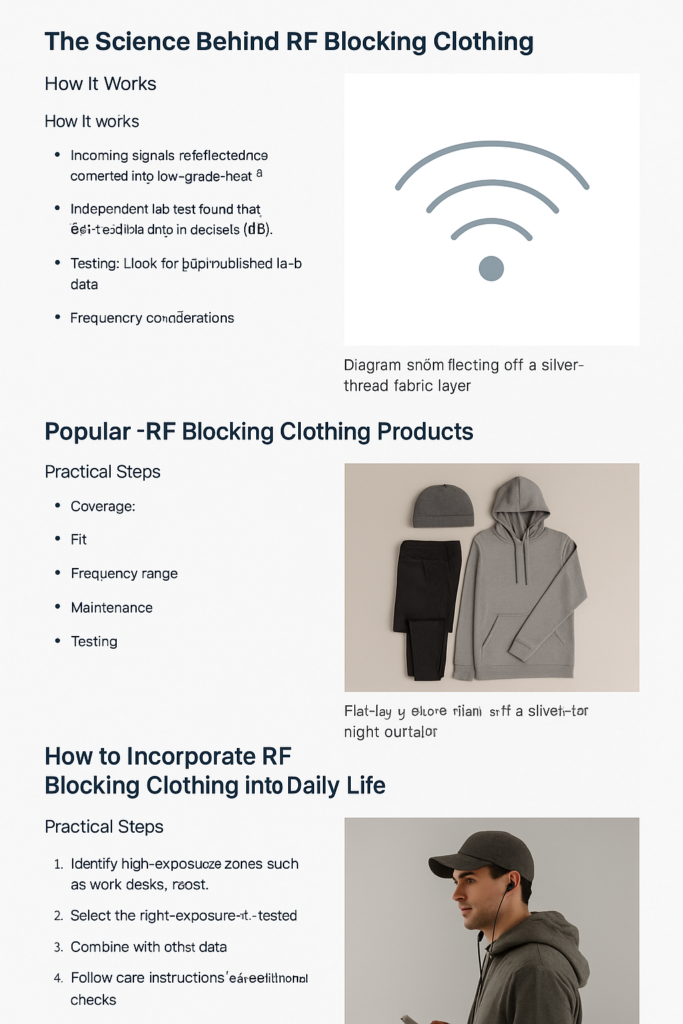
- Conductive fibers in the fabric act partly like a Faraday cage: they reflect or absorb some RF energy so less reaches the body. In simulations of anti-radiation pregnancy bands the average field fell by no more than 30 percent even with a gap-free band, and the maximum field rose in more than 90 percent of the scenarios [4].
- The shielding effectiveness (often measured in decibels, dB) depends on material conductivity, thread density/coverage, frequency range, garment fit, and continuity of the conductive layer. For example, one study showed knitted fabrics could reduce electromagnetic radiation in the 100 MHz-1000 MHz range. PMC
- Some brands publish testing figures: for example, one German-brand states 10 dB reduction (≈ 90% of incident power blocked) in the 10 MHz-4 GHz range for silver-coated fibre clothing. Conscious Spaces
Anti radiation clothing is a conductive layer, so coverage and frequency matter
A conductive layer bounces RF
Metal-coated fabric, foil, mesh and conductive paint reflect most incoming radio-frequency energy.
Some energy is lost inside
Thicker or multi-layer materials also absorb part of the signal as it passes through.
Gaps let signals through
Seams, open weaves, zips and unsealed edges leak, and short wavelengths slip through smaller gaps.
Low-frequency magnetic fields pass
Thin fabric or paint does little against 50/60 Hz magnetic fields; distance or special high-permeability metal is needed.
Check what it covers and what it blocks
How well a material shields depends on the frequency and on how completely it covers the space.
Embed this chart
Free to reuse on your site. Copy the code below; please keep the credit link.
Key Considerations
- Coverage area: A hat shields the head; a full jacket or hoodie provides more body coverage. More surface = more potential shielding.
- Fit and continuity: Loose seams or open gaps reduce effectiveness because RF can penetrate through cracks or openings.
- Frequency specificity: Materials may perform differently at WiFi (2.4–5GHz), cellular (≈ 600 MHz–3.5 GHz) or mmWave 5G (>24GHz). Ensure the product is tested or rated across relevant frequencies.
- Material durability & care: Conductive threads may degrade over time or with improper washing. Choosing quality brand and following care instructions matters.
- Realistic expectations: Shielding reduces exposure, at the covered area and does not eliminate it, and results vary with frequency. It’s a mitigation strategy, not a guarantee [2][3].
Product Examples
Here are selected anti radiation clothing items available today, with distinguishing features:

At a glance:
- WOREMOR EMF & 5G Shielding Silver Hoodie: Premium silver-elastic hoodie made in Canada, designed for full upper-body coverage, blocking up to ~99.99% signals.
- DefenderShield EMF Radiation Protection Hooded Jacket: Stylish jacket with silver-lining, blocking claimed up to 99% of RF from 300 Hz-10 GHz.
- HAVN WaveStopper T-Shirt 2.0: Everyday T-shirt with inner 360° silver lining, designed for torso coverage with ~99.7% blocking.
- RadEnergy EMF‑Blocking Snapback Cap: Entry-level headwear shielding accessory, with Faraday-style lining.
- WOREMOR Silver+ T‑Shirt: Everyday silver-fiber tee, budget option for torso coverage with shielding performance.
- e‑SMOG Men’s 5G/EMF Wave Defense Tank: Lower-body / torso tank option, budget friendly for partial coverage.
- EMF Protection Zip‑Up Hoodie: Mid-price zip hoodie with silver fiber blend for upper-body protection.
- WOREMOR EMF & 5G Shielding Silver Pants: Lower-body silver-elastic pants designed for shielding from knees to waist.
What to note when comparing:
- Higher coverage = higher price.
- Upper-body (hoodies, jackets) protect more than accessories (caps, tanks).
- Brands that publish attenuation specs and frequency ranges offer more transparency.
- Comfort, style and wearability matter: you’ll use it more often if it fits your lifestyle.
How to Use Anti Radiation Clothing in Everyday Life
Practical Steps
- Identify your priority exposure times/areas, e.g., working on a laptop near WiFi, sitting next to a smart-meter wall, sleeping near a router.
- Choose appropriate garment type, for example: a hoodie or jacket for general wear; a cap for commuting/travel; tanks or pants for home/relaxation.
- Wear it when exposure is highest, commuting, travel, near multiple wireless sources. You may not need it at all times, but strategic use can matter.
- Maintain garment integrity, follow washing instructions (gentle cycle, no bleach, low-heat dry) to ensure the conductive fibers retain performance.
- Combine with environmental strategies, anti radiation clothing is a layer in a broader low-EMF lifestyle: use wired connections, reduce screen time, increase distance from antennas, consider shielding fabrics in the home.
Lifestyle Integration
- Choose styles that fit your wardrobe (think subtle, casual, modern) not obviously “radiation-gear”.
- Rotate garments: wear the heavy shielding hoodie when exposure is higher; lighter options when less.
- Use it as part of your wellness toolkit. Just like good sleep hygiene or dietary practices, wearing considerate apparel can reinforce a balanced mindset.
- Communicate with household members, if you live with others who don’t share the exact concern, explain that this is about limiting cumulative exposure, not fear or alarm.
Common Mistakes & FAQs
Mistakes to Avoid
- Expecting perfect protection: No clothing blocks 100% of all radiation. It’s about reduction and balance.
- Ignoring garment fit: A loose hoodie or gaps around the head/neck reduce effectiveness.
- Skipping care: Conductive fibers degrade over time if washed improperly.
- Relying solely on clothing: Environmental exposure reduction (distance, device management) remains essential.
- Choosing style over substance: A garment that looks good but has no published shielding data may underperform.
Frequently Asked Questions
Q: Does anti radiation clothing eliminate RF exposure?
A: No. It reduces exposure by attenuating or redirecting RF waves, but it does not create a perfect shield like an industrial Faraday enclosure.
Q: Is it safe to wear all day?
A: Generally yes, assuming the garment is properly fitted and comfortable. If you feel heat, restricted movement or discomfort, choose a lighter option.
Q: How do I know a brand is trustworthy?
A: Look for published lab test results (attenuation in dB, frequency ranges), transparent materials specs, return policy, and brand longevity.
Q: Does clothing matter more than other strategies (reducing device use, increasing distance)?
A: Clothing is one pillar. Environmental strategies (turning off devices, wired connections, shielding fabrics) are foundational. Clothing augments them.
Key Takeaways
- Anti radiation clothing uses conductive fibers to reduce exposure to EMF and RF radiation: think reduction, not insulation.
- It’s becoming increasingly relevant as wireless density increases and wellness-oriented individuals seek proactive exposure management.
- Science supports the concept: conductive fabrics have been shown to attenuate electromagnetic radiation in lab tests.
- There is a wide range of product pricing: from entry accessories to full upper-body garments and beyond.
- Integrate anti radiation clothing into your broader low-EMF lifestyle: habitually wear when exposure is highest, maintain garment care, and apply environmental mitigation.
Further Reading
- Pušić, T. et al. “Electromagnetic Shielding Properties of Knitted Fabric for Protection Against Electromagnetic Radiation.” PMC. PMC
- Avloni, J. et al. “Electromagnetic shielding with polypyrrole-coated fabrics.” ArXiv. arXiv
- Silver25® “5G EMF Protection Clothing (Silverwave®)”, ConsciousSpaces. Conscious Spaces
- HAVN “How Do EMFs Impact Our Health?” White Paper. HAVN
- EMF Health & Apparel: Mission Darkness™ collection. mosequipment.com
Featured Products
Looking for quality EMF protection? Check out these recommended products:
Frequently Asked Questions
What materials are used in anti radiation clothing to block EMF and RF exposure?
Anti radiation clothing uses conductive materials woven into fabric, including silver-coated fibers, copper, and stainless steel threads. These materials work together to shield your body from ambient RF emissions from common sources like WiFi routers, cell towers, and Bluetooth devices.
Does anti radiation clothing completely eliminate all radiation exposure?
No, anti radiation clothing is designed for mitigation rather than complete elimination of radiation exposure. Think of it as one layer of protection in a broader EMF reduction strategy, not a cure-all solution.
Who should consider wearing anti radiation clothing?
Privacy-conscious consumers and health-focused people concerned about prolonged wireless exposure sometimes choose anti radiation clothing. People who report electromagnetic hypersensitivity also use it, although a review of 46 blinded provocation studies with 1175 volunteers found no robust evidence that the fields trigger their symptoms [1]. It’s particularly popular among those who want extra protection during sleep, for their children, or in high-RF environments.
Is there scientific evidence that anti radiation clothing works?
While conductive materials do have documented RF shielding properties, mainstream regulatory bodies have not definitively proven that low-level RF exposure from wireless devices causes harm to average users. Many people adopt anti radiation clothing as a precautionary measure based on personal preference rather than conclusive scientific evidence.
References
- Rubin GJ et al. Idiopathic environmental intolerance attributed to electromagnetic fields (formerly 'electromagnetic hypersensitivity'): An updated systematic review of provocation studies. Bioelectromagnetics (2010). PMID 19681059
- Pušić T et al. Electromagnetic Shielding Properties of Knitted Fabric Made from Polyamide Threads Coated with Silver. Materials (Basel, Switzerland) (2021). PMID 33800263
- Ming Li Jiao et al. Electromagnetic Interference Shielding Properties of Silver-Plated Polyester Fabric. Applied Mechanics and Materials (2012). doi:10.4028/www.scientific.net/amm.239-240.310
- Fatemeh Dehrouyeh et al. On the Shielding Effectiveness of Anti-Electromagnetic-Radiation Clothes for Pregnant Females. (2023). doi:10.36227/techrxiv.22890860.v1
- Deprez K et al. IN-SITU 5G NR BASE STATION EXPOSURE OF THE GENERAL PUBLIC: COMPARISON OF ASSESSMENT METHODS. Radiation protection dosimetry (2022). PMID 35511688
- Tell RA et al. Characterization of radiofrequency field emissions from smart meters. Journal of exposure science & environmental epidemiology (2013). PMID 23131714
- Evelyn Mohler et al. Exposure to Radiofrequency Electromagnetic Fields and Sleep Quality: A Prospective Cohort Study. PLoS ONE (2012). PMID 22624036
These statements have not been evaluated by the Food and Drug Administration. This information is not intended to diagnose, treat, cure, or prevent any disease. Content is for informational purposes only and is not medical advice; consult a qualified healthcare provider before starting any supplement. As an Amazon Associate we earn from qualifying purchases.