Shungite for EMF Protection: What the Research Actually Shows
Shungite occupies an odd position in the EMF world. Search for it and you will find pyramids, pendants, and phone stickers sold on the promise that a piece of Karelian rock will neutralise the radiation around you. Search the materials-science journals for the same word and you will find something different but genuinely interesting: peer-reviewed measurements showing that shungite, prepared the right way, really does attenuate microwave radiation, and by a lot.
Both of those things are true at once, and the gap between them is the whole story. This guide covers what shungite is, what the shielding research measured, why those numbers do not transfer to a stone on your desk, and how to test any shielding claim yourself before you spend money on it.
What Is Shungite?
Shungite is a carbon-bearing rock from Karelia in northwestern Russia, formed from organic-rich sediments laid down roughly two billion years ago. Nearly all commercial material comes from the Zazhoginskoye deposit. What makes it unusual among rocks is simply how much carbon it contains, and carbon is what conducts.
The trade splits it into grades by carbon content:
- Type I, sold as “elite” or “noble” shungite, runs roughly 90 to 98% carbon and has a bright metallic sheen. It is a small fraction of what comes out of the ground, which is why it costs what it costs.
- Types II and III are the ordinary black material, roughly 30 to 60% carbon. The rest is a silicate mineral matrix, dominated by quartz, with mica, carbonates, and a small amount of sulphur [6].
That structure matters for shielding. A rock that is half conductive carbon and half insulating quartz is, in engineering terms, a natural carbon-mineral composite [1]. Synthetic shielding materials are built the same way on purpose: conductive filler dispersed through a non-conductive binder. Shungite just got there without a factory.
The Fullerene Claim, Examined
Most shungite marketing leans on fullerenes, the soccer-ball-shaped carbon molecules whose discovery won a Nobel Prize. Shungite is frequently described as the world’s only natural source of them.
The careful version is narrower. Shungite carbon is best described as fullerene-like: it is non-graphitising carbon built from curved graphene fragments, which is structurally distinct from both graphite and ordinary amorphous carbon. Whether discrete C60 molecules are actually present, and in what quantity, has been argued in the literature since the mid-1990s [2], and the concentrations reported are trace amounts at best. The eye-catching percentages that appear on retail sites generally trace back to vendor material rather than to independent analysis.
For shielding purposes this argument does not matter much either way. The attenuation that has been measured comes from bulk electrical conductivity, not from any specific molecule. A rock does not need fullerenes to reflect microwaves. It needs conductive carbon, continuity, and coverage.
What the Shielding Research Actually Found
The strongest data comes from a 2021 study in Current Applied Physics that measured ultrathin shungite plates across the 8 to 12 GHz microwave band, using source rock spanning the full range of carbon content [1]. The results scale cleanly with carbon:
- At 17 to 37 atomic percent carbon, shielding effectiveness measured roughly 20 to 25 dB, or about 90 to 95% of incident energy stopped.
- At 41 to 97 atomic percent carbon, it reached roughly 30 to 60 dB, effectively 96 to 100%.
The striking part is the thickness. Those plates were on the order of 10 to 20 micrometres, thinner than household foil, and they performed comparably to much thicker engineered composites. Separate work on shungite-based composites for radar shielding and microwave absorption reports the same general picture across a broader frequency range, with performance rising as shungite loading increases [3].
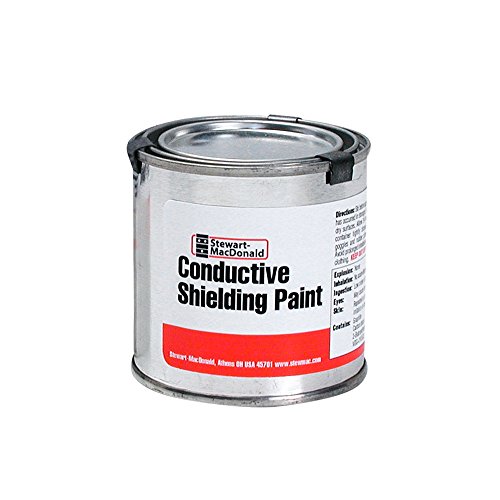
To put 30 to 60 dB in context, that is the same band our own testing guide uses for a well-applied, properly grounded EMF shielding paint. The material is legitimate. It belongs in the same conversation as carbon-loaded paint and nickel-coated fabric.
Why That Does Not Transfer to Pendants and Pyramids
Here is where the marketing and the physics part ways. Every number above was measured on a continuous plate placed in the path of the signal. Shielding works by interposing a conductive surface between a source and a receiver. Take away the coverage and the decibels go with it.
A shungite pyramid on a desk is not between anything and anything. Wi-Fi, cellular, and Bluetooth signals arrive from every direction and reflect off every surface in the room. An object occupying a few square centimetres of a spherical wavefront removes a rounding error’s worth of energy from the space you occupy, and that is true no matter how conductive the object is. The same applies to pendants, beads, and tiles: the material’s conductivity is real, the geometry is doing nothing.
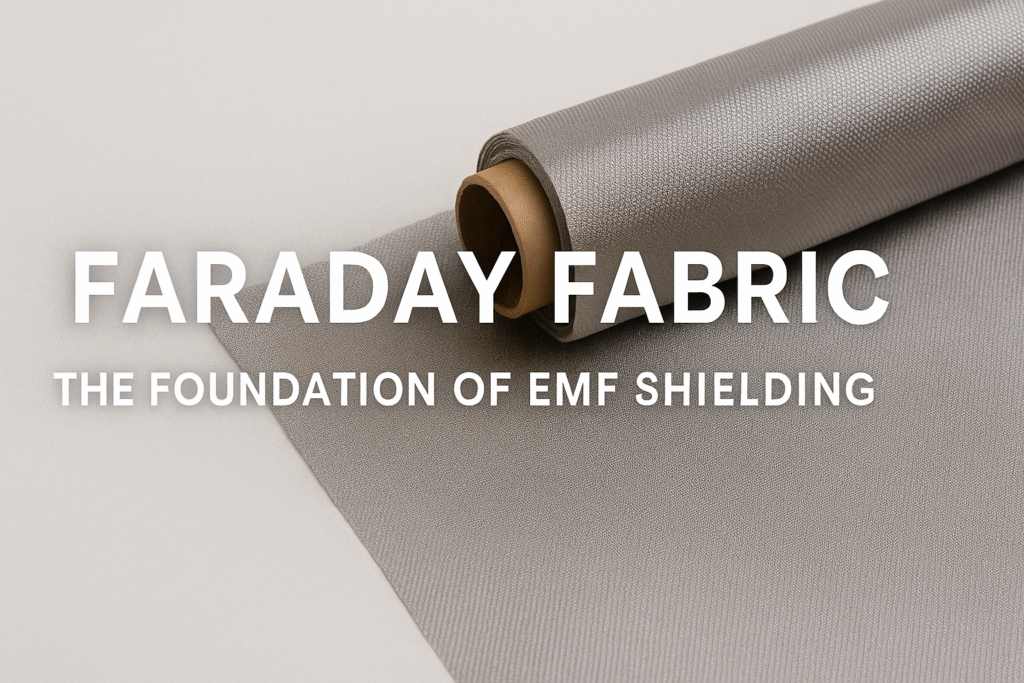
This is not a shungite-specific criticism. It is the reason a Faraday fabric canopy is sold as an enclosure rather than as a swatch, and the reason window film is sold by the roll. Enclosure and continuity are the product. A loose stone has neither.
The Sticker Problem, and Why It Is Worth Knowing About
Shungite phone stickers and adhesive discs sit in a category with a documented regulatory history. In 2002 the Federal Trade Commission charged sellers of cell phone radiation protection patches with making false and unsubstantiated claims, including representations that the products blocked up to 97 or 99% of the energy a phone emits [4]. A 2003 settlement in the same line of cases barred the marketers from claiming any phone shield reduces radiation exposure unless the claim is backed by competent and reliable scientific evidence [5].
One technical point from those cases is worth carrying forward, because it applies to any small shield attached to a transmitting device. Phones use adaptive transmit power control: when reception degrades, the handset raises its output to maintain the link. A partial barrier that weakens the signal without enclosing the antenna can therefore push the device to transmit harder, which is the opposite of the intended effect.
None of this makes shungite a fraud. It makes small partial shields on active transmitters an approach that does not do what buyers expect, regardless of what the shield is made of.
Where Shungite Legitimately Fits
Read as a material rather than as a talisman, shungite has a real and fairly narrow role:
- As a conductive filler in plasters, renders, concretes, and coatings, where it is mixed to a high loading and applied as a continuous layer over a surface. This is the form the shielding literature actually tested [3].
- As a research material, since a natural graphene-bearing conductor with tunable carbon content is a convenient model system for studying how radiation interacts with conducting solids [1].
- As a decorative object, which is a perfectly good reason to own one. It is a handsome, genuinely ancient rock. It is simply not shielding hardware.
Shungite-loaded building products are far more common in Russian construction than in the North American market, where the equivalent job is done by carbon and metal-loaded RF shielding paints. If you are shopping in the US or EU for whole-room attenuation, those paints are the practical route to the same physics.
How to Test Any Shielding Claim Yourself
The useful habit here is not learning which materials to trust. It is being able to check. An RF meter and ten minutes will settle any shielding question faster than any amount of reading:
- Take a baseline. Measure at a fixed spot, with the meter oriented the same way each time, and note the reading with nothing changed.
- Introduce the material. Place it directly between the meter and the source, covering the meter’s line of sight as completely as the material allows.
- Compare like for like. Ambient RF fluctuates constantly, so repeat the pair of readings several times rather than trusting one before-and-after.
- Watch for the enclosure effect. Wrapping a source or a meter completely will show a dramatic drop; holding a small object nearby will not. That contrast is the entire lesson of this article, reproduced on your kitchen table.
Our walkthrough on testing frequency-blocking materials at home covers the procedure in detail, and the companion guide on how shielding effectiveness is measured explains why lab numbers are quoted in decibels and what those figures do and do not promise in a real room.
Key Takeaways
- Shungite is a genuine carbon-mineral composite, and thin plates of it have measured 20 to 60 dB of shielding across the 8 to 12 GHz band depending on carbon content.
- Those results were obtained on continuous plates placed in the signal path, which is the condition that produces the numbers.
- Pendants, pyramids, and loose stones do not reproduce that condition and should not be expected to reduce your exposure.
- The fullerene story is contested and, for shielding purposes, beside the point. Bulk conductivity does the work.
- Small shields stuck to a phone can backfire, because handsets raise transmit power when the signal degrades.
- If you want measurable attenuation, buy coverage: shielding paint, fabric, or film, applied continuously and verified with a meter.


References
- Antonets, I.V., Golubev, Ye.A., Shcheglov, V.I., Sun, S. Electromagnetic shielding effectiveness of lightweight and flexible ultrathin shungite plates. Current Applied Physics 29, 97-106 (2021). doi:10.1016/j.cap.2021.06.008
- Concerning fullerenes in shungite. Carbon 34 (1996). doi:10.1016/0008-6223(96)85966-5
- Radar-Shielding and Microwave-Absorbing Properties of Composite Materials Based on Shungite. Russian Journal of Physical Chemistry A (2023). doi:10.1134/S0036024423020231
- Federal Trade Commission. FTC Charges Sellers of Cell Phone Radiation Protection Patches with Making False Claims (2002). ftc.gov
- Federal Trade Commission. Marketers of Cell Phone Radiation Protection Patches Settle FTC Charges (2003). ftc.gov
- A Study of the Antioxidant, Cytotoxic Activity and Adsorption Properties of Karelian Shungite by Physicochemical Methods. PMC8301057 (2021). ncbi.nlm.nih.gov
Related reading: Top 10 Frequency-Blocking Materials · Conductive Paint (technical guide) · Faraday Fabric
These statements have not been evaluated by the Food and Drug Administration. This information is not intended to diagnose, treat, cure, or prevent any disease. Content is for informational purposes only and is not medical advice; consult a qualified healthcare provider before starting any supplement. As an Amazon Associate we earn from qualifying purchases.